
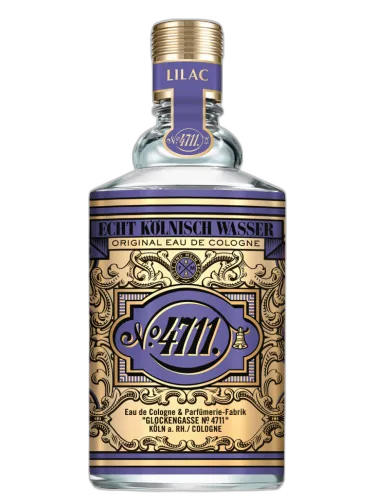
4711 Lilac Eau De Cologne 4711
At a glance
Is 4711 Lilac Eau De Cologne 4711 worth trying?
4711 Lilac Eau de Cologne by 4711 is a Floral Woody Musk fragrance for women and men.
- Best match
- Casual wear in Spring
- Performance feel
- Moderate longevity with Moderate sillage
- Signature profile
- floral, musky, powdery with Freesia, Peach, Bergamot
The first impression
4711 Lilac Eau de Cologne by 4711 is a Floral Woody Musk fragrance for women and men. 4711 Lilac Eau de Cologne was launched in 2019. The nose behind this fragrance is Alexandra Kalle. Top notes are Freesia, Peach and Bergamot; middle notes are Lilac, Jasmine and Rose; base notes are Musk and Sandalwood.
What shapes the scent
The perfumer behind it

Alexandra Kalle
Alexandra Kalle is a German perfumer known for her long-standing collaboration with the historic fragrance house 4711. Her style emphasizes bright, naturalistic accords that refresh classic eau de cologne structures, often pairing citrus with herbs or spices. She created numerous Acqua Colonia variations, including Blood Orange & Basil and Lemon & Ginger, as well as single-flower eaux de cologne like Jasmine and Lilac. Her work has helped modernize the 4711 brand while preserving its traditional freshness.
Notes pyramid
Top Notes
First impression · 15-30 min
 Freesia
 Peach
Peach
 Bergamot
Heart Notes
Core character · 2-4 hours
 Lilac
Lilac
 Jasmine
 Rose
Rose
Base Notes
Lasting impression · 4+ hours
 Musk
Musk
 Sandalwood
The mood it creates
The Lover Archetype: Portrait of 4711 Lilac Eau De Cologne 4711
Essence
4711 Lilac Eau de Cologne is a fragrance of simplicity and nostalgia-light, floral, and unpretentious. It does not overwhelm but lingers like a half-remembered dream. The person who chooses this scent is drawn to its purity, its fleeting nature, its connection to springtime and renewal. They are not one for heavy, intoxicating perfumes; they prefer something that whispers rather than shouts.
This person is most closely aligned with the Innocent archetype-a soul who seeks harmony, simplicity, and a return to what is natural and good. They believe in kindness, beauty, and the possibility of a world unspoiled by cynicism. Their optimism is not naive but deliberate, a choice to see the world through a lens of hope rather than despair.
Yet, like all archetypes, the Innocent has its shadow. Their idealism can blind them to harsh realities, their avoidance of conflict can lead to passivity, and their longing for purity may make them resistant to necessary complexity.
Style & Aesthetic
Their aesthetic is soft, organic, and timeless. They favor linen, cotton, and pastel hues-nothing too bold or aggressive. Their home is filled with dried flowers, well-loved furniture, and perhaps a collection of vintage teacups. They appreciate craftsmanship but are not materialistic; their possessions are chosen for their warmth, not their status.
In music, they are drawn to folk melodies, classical compositions, or anything that feels like it was made with sincerity rather than calculation. They might enjoy Chopin’s nocturnes or the simplicity of a well-played acoustic guitar.
Philosophy & Values
Their life is built on the belief that goodness is inherent, that people are fundamentally kind, and that happiness is found in small, sincere moments. They may have a garden, or at least a windowsill of herbs, because tending to living things brings them peace. They prefer handwritten letters to emails, tea to coffee, and old books with dog-eared pages to sleek digital screens.
Philosophically, they lean toward romanticism-not in the sentimental sense, but in the belief that nature, art, and human connection are the antidotes to modern alienation. They may admire thinkers like Rousseau or Thoreau, though they are not dogmatic. Their spirituality, if they have one, is gentle and personal-more about quiet reflection than rigid doctrine.
Relationships
They are the friend who remembers birthdays, who brings soup when you are sick, who listens without judgment. Their relationships are built on loyalty and tenderness. They avoid gossip and drama, sometimes to a fault-their discomfort with negativity can make them retreat rather than confront problems.
Romantically, they seek a partner who shares their appreciation for quiet intimacy. Grand gestures matter less than shared mornings, laughter over simple meals, and the comfort of knowing they are loved without pretense. Yet, their idealism in love can lead to disappointment-not everyone lives up to their vision of kindness, and they may struggle when faced with human flaws.
Shadow
For all their grace, the Innocent is not without weakness. Their aversion to conflict can make them passive, allowing others to take advantage of their kindness. They may suppress their own anger or needs, fearing that expressing them would disrupt harmony.
Their optimism, when unchecked, can slip into denial. They may ignore problems, hoping they will resolve themselves, or cling to relationships or beliefs long after they have turned toxic. The world is not always as gentle as they wish it to be, and when reality intrudes harshly, they may withdraw into nostalgia or fantasy rather than adapt.
Conclusion
Yet, their strength lies in their refusal to become jaded. They understand that cynicism is easy, but choosing hope is an act of courage. Their life is a quiet rebellion against the noise and haste of modernity, a testament to the idea that beauty still exists in small, unnoticed places.
They may never be the loudest voice in the room, but their presence is felt in the way they make others feel seen, in the way they cultivate joy in the mundane. Their flaw is their fragility, but their gift is their resilience-the ability to keep believing, keep loving, even when the world gives them reason not to.
In the end, they are like the lilac itself: delicate yet enduring, fleeting yet unforgettable.
If you like this, try these
Fragrances with a comparable profile - shared accords, notes, and character.

Lalique
Azalee Lalique
Shared top notes: bergamot, freesia, peach

Delle Grazie
Paris Rouge Delle Grazie
Shared top notes: bergamot, freesia

Salvador Dali
Crazy Kiss Salvador Dali
Shared top notes: bergamot, peach

Lancôme
La Vie Est Belle Flowers Of Happiness Lancôme
Shared top notes: bergamot

Lancôme
La Vie Est Belle Flowers Of Happiness Sparkling Limited Edition Lancôme
Shared top notes: bergamot