
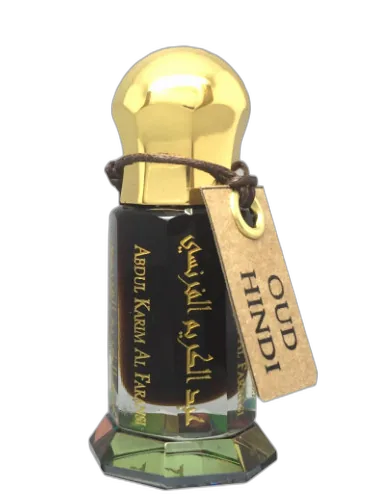

Oud Hindi Abdul Karim Al Faransi
Fragrance Story
Oud Hindi by Abdul Karim Al Faransi is a Woody fragrance for men. Oud Hindi was launched in 2014. The nose behind this fragrance is Anthony Abdul Karim Marmin. Top notes are Earthy Notes, Woody Notes and Honey; middle notes are Leather and Wood Resin; base note is Indian Oud.
Composition Profile
About the Perfumer

Anthony Abdul Karim Marmin
Anthony Abdul Karim Marmin is a perfumer closely associated with the house of Abdul Karim Al Faransi, where he has created a wide range of fragrances. His style spans bold, resinous compositions like Amber 4000 and Amber Afghani, as well as more complex, evocative scents such as Al Quds and Amazonia. Known for blending traditional Middle Eastern ingredients with modern accords, his work often features rich amber, oud, and spice notes.
Fragrance Notes
Top Notes
First impression · 15-30 min
 Earthy Notes
 Woody Notes
 Honey
Honey
Heart Notes
Core character · 2-4 hours
 Leather
 Wood Resin
Base Notes
Lasting impression · 4+ hours
 Indian Oud
Character Profile
The Lover Archetype: Portrait of Oud Hindi Abdul Karim Al Faransi
Essence
This person is most closely aligned with the Sage-a seeker of wisdom, drawn to the profound and the enigmatic. The scent of Oud Hindi Abdul Karim Al Faransi is not merely a fragrance to them; it is an olfactory manuscript, layered with history, mystique, and a quiet intensity. Like the Sage, they are introspective, valuing knowledge and authenticity above all else. Yet, wisdom is not merely acquired-it is wrestled from experience, and so their life is a tapestry of contemplation, occasional solitude, and a relentless pursuit of meaning.
Style & Aesthetic
Their tastes are deliberate, never accidental. They prefer the weight of aged leather-bound books, the texture of handwoven fabrics, and the slow burn of single-malt whisky over hurried pleasures. Their wardrobe leans toward timeless elegance-dark hues, tailored cuts, fabrics that whisper rather than shout. They are drawn to art that demands interpretation: Persian miniatures, Sufi poetry, the dissonant harmonies of Arvo Pärt.
Yet, this refinement can tip into fastidiousness, a shadow of the Sage. They may dismiss what they deem "common," not out of malice, but from an unshakable belief in their own discernment. Their disdain for the superficial can isolate them, leaving them stranded in their own intellectual fortress.
They move through the world with a measured pace, avoiding the frenzy of modernity. Their home is a sanctuary-dim lighting, shelves lined with well-thumbed books, the faint trace of oud lingering in the air. They might keep odd hours, finding the night more conducive to thought. Work is not merely a means to an end but an extension of their values; they gravitate toward professions that allow for autonomy and depth-writing, academia, perfumery, perhaps even spiritual guidance.
But their self-sufficiency can curdle into isolation. The Sage risks becoming the recluse, mistaking withdrawal for wisdom. The world, with all its chaos, is where wisdom is tested-and they must occasionally step out of their sanctuary to remember that.
Philosophy & Values
They believe the world is a palimpsest-layers of meaning waiting to be uncovered. Their philosophy is a blend of stoicism and mysticism; they accept suffering as a teacher but also seek transcendence beyond the material. They value depth in all things: conversation, relationships, even silence. Superficial chatter repels them, and they would rather sit in quiet communion with a kindred spirit than engage in hollow social rituals.
But here lies their shadow: the arrogance of the enlightened. Their certainty in their own insights can harden into dogma. They may dismiss those who do not share their depth as "unawakened," forgetting that wisdom is not a possession but a process.
Relationships
They do not collect acquaintances; they cultivate connections of substance. Their inner circle is small-perhaps a lifelong friend who understands their silences, a lover who shares their appetite for the esoteric, a mentor or student who mirrors their intellectual hunger. They are fiercely loyal but demand the same in return; betrayal cuts deeper for them than for most.
Yet their intensity can be overwhelming. Not everyone can bear the weight of their expectations, and their reluctance to engage in trivial bonding can make them seem aloof, even cold. They may mistake solitude for strength, forgetting that even the deepest minds need the friction of others to stay sharp.
Conclusion
They are a paradox-both enlightened and ensnared by their own intellect. Their strength is their depth, their ability to see beyond the surface. But their weakness is their pride in that very depth, the quiet arrogance of believing they have seen further than others. The oud they wear is a fitting emblem: rich, complex, slightly melancholic-a scent that lingers long after they have left the room.
To know them is to know that wisdom is not a destination but a journey, one that requires both solitude and the humility to return, again and again, to the messy, imperfect world.
Similar Fragrances
Fragrances with a comparable profile - shared accords, notes, and character.
Abdul Karim Al Faransi
Oud Hindi Abdul Karim Al Faransi
Shared accords: amber, animalic, balsamic

EBK
Nº 46 Ebk
Shared accords: amber, animalic, balsamic

Pineward Perfumes
Funerie Pineward Perfumes
Shared accords: amber, animalic, balsamic

Moresque
Sandal Granada Moresque
Shared accords: amber, animalic, balsamic

Ahmed Al Maghribi
Awfa Ahmed Al Maghribi
Shared accords: amber, animalic, balsamic