
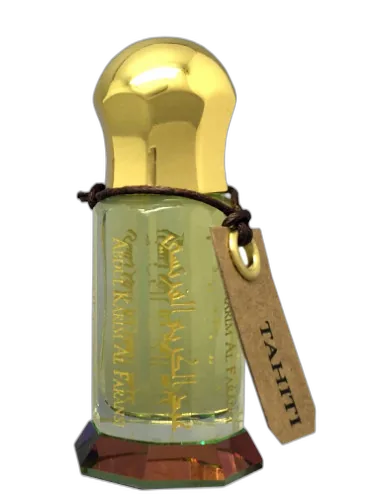

Tahiti Abdul Karim Al Faransi
At a glance
Is Tahiti Abdul Karim Al Faransi worth trying?
Tahiti by Abdul Karim Al Faransi is a Oriental fragrance for women and men.
- Best match
- Evening wear in Summer
- Performance feel
- Very Good longevity with Strong sillage
- Signature profile
- powdery, vanilla, coconut with Tahitian Vanilla, Cotton Flower, Coconut
The first impression
Tahiti by Abdul Karim Al Faransi is a Oriental fragrance for women and men. Tahiti was launched in 2014. The nose behind this fragrance is Anthony Abdul Karim Marmin. Top notes are Tahitian Vanilla and Cotton Flower; middle notes are Coconut and White Musk; base notes are Sandalwood and White Oud.
What shapes the scent
The perfumer behind it

Anthony Abdul Karim Marmin
Anthony Abdul Karim Marmin is a perfumer closely associated with the house of Abdul Karim Al Faransi, where he has created a wide range of fragrances. His style spans bold, resinous compositions like Amber 4000 and Amber Afghani, as well as more complex, evocative scents such as Al Quds and Amazonia. Known for blending traditional Middle Eastern ingredients with modern accords, his work often features rich amber, oud, and spice notes.
Notes pyramid
Top Notes
First impression · 15-30 min
 Tahitian Vanilla
 Cotton Flower
Heart Notes
Core character · 2-4 hours
 Coconut
White Musk
Coconut
White Musk
Base Notes
Lasting impression · 4+ hours
 Sandalwood
 White Oud
The mood it creates
The Lover Archetype: Portrait of Tahiti Abdul Karim Al Faransi
Essence
This is a person who refuses to be confined-by geography, convention, or expectation. Their soul is restless, always seeking the next horizon, the next sensation, the next revelation. The fragrance they choose-Tahiti Abdul Karim Al Faransi-is not merely a scent but a declaration: I am not of one place, but of many. The Explorer archetype defines them, for they are driven by curiosity, a hunger for the unknown, and an unshakable belief that life’s truest meaning is found in movement, not stasis.
Relationships
They love deeply but fleetingly, drawn to kindred spirits who share their hunger for the new. Their relationships are intense, passionate, but often short-lived-not out of cruelty, but because permanence feels like stagnation. They are the lover who leaves a handwritten letter on the pillow before dawn, the friend who sends postcards from unexpected places, the confidant who listens with rare depth but may vanish for months without explanation.
Those who understand them do not demand constancy; they accept that this person’s heart is a nomad. Yet, there is a quiet melancholy beneath their independence-a fear that they will never truly belong anywhere, or to anyone.
Shadow
The Explorer’s greatest strength-their refusal to be tied down-is also their deepest flaw. Their relentless pursuit of novelty can become an escape, a way to avoid confronting the parts of themselves that require stillness. They may mistake motion for growth, confusing the accumulation of experiences with true depth.
At times, their independence curdles into detachment. They may leave lovers, friendships, or commitments too easily, rationalizing it as necessity when it is, in truth, fear. The shadow of the Explorer is the Fugitive-one who runs not toward something, but away.
Conclusion
Their tastes are eclectic, shaped by encounters rather than tradition. They might wear a handwoven Moroccan jacket over Italian linen, or pair an antique Tibetan ring with a modern minimalist watch. Their home is a carefully curated museum of travels: a Balinese mask here, a Persian rug there, a stack of well-worn books in French, Arabic, and Japanese. They do not collect things for status, but for the stories they carry.
Philosophy is not an abstract exercise for them-it is lived. They reject dogma, preferring instead to assemble their own worldview from fragments of Sufi poetry, Zen koans, and Nietzschean aphorisms. They believe in the fluidity of identity, that a person is not a fixed point but a journey. Their values are rooted in freedom-not the reckless kind, but the deliberate choice to remain unbounded by others’ expectations.
If you like this, try these
Fragrances with a comparable profile - shared accords, notes, and character.

Aéropostale
Coconut Rush Aéropostale
Shared heart notes: coconut
Somens
Éclair Somens
Shared heart notes: coconut

Gas Bijoux
La Route Des Plages Gas Bijoux
Shared heart notes: coconut

Maison des Reves
Mousse Au Cafe Maison Des Reves
Shared heart notes: coconut
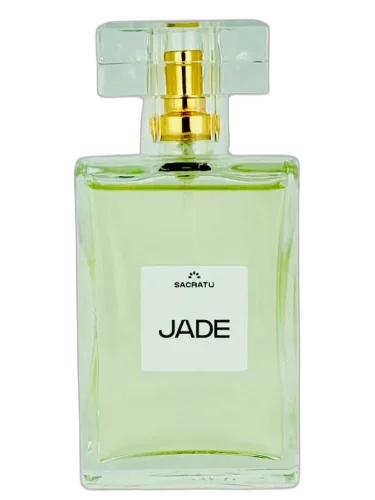
Sacratu
Jade Sacratu
Shared heart notes: coconut