
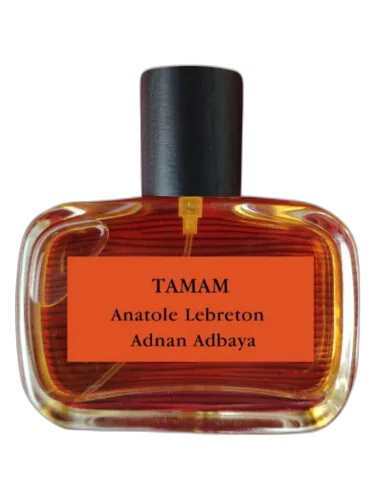

Tamam For Adnan Adbaya Anatole Lebreton
At a glance
Is Tamam For Adnan Adbaya Anatole Lebreton worth trying?
Tamam for Adnan Adbaya by Anatole Lebreton is a fragrance for women and men.
- Best match
- Evening wear in Fall
- Performance feel
- Very Good longevity with Moderate sillage
- Signature profile
- woody, amber, sweet with Dates, Grapefruit, Frankincense
The first impression
Tamam for Adnan Adbaya by Anatole Lebreton is a fragrance for women and men. Tamam for Adnan Adbaya was launched in 2023. The nose behind this fragrance is Anatole Lebreton. Top notes are Dates and Grapefruit; middle notes are Frankincense, Sandalwood, Cedar, Geranium and Cypriol Oil or Nagarmotha; base notes are Labdanum and Oakmoss.
What shapes the scent
The perfumer behind it

Anatole Lebreton
Anatole Lebreton is an independent French perfumer known for his artisanal approach and deep respect for raw materials. His olfactory style blends natural ingredients with bold, narrative-driven compositions that often evoke memory and place. Notable creations from our catalog include the luminous woody warmth of Bois Lumière, the gourmand comfort of Brioche, and the dark, resinous complexity of Grimoire.
Notes pyramid
Top Notes
First impression · 15-30 min
 Dates
Dates
 Grapefruit
Heart Notes
Core character · 2-4 hours
 Frankincense
 Sandalwood
 Cedar
Cedar
 Geranium
 Cypriol Oil or Nagarmotha
Base Notes
Lasting impression · 4+ hours
 Labdanum
 Oakmoss
The mood it creates
The Sage Archetype: Portrait of Tamam For Adnan Adbaya Anatole Lebreton
Essence
To wear Tamam by Anatole Lebreton is to embrace a fragrance that defies easy categorization-earthy yet ethereal, complex yet harmonious. It is a scent for those who dwell in the liminal spaces, where the sensual meets the intellectual, where the ancient whispers to the modern. The person who cherishes this fragrance is not merely a connoisseur of perfumes but a seeker of meaning, drawn to the enigmatic interplay of shadow and light within themselves and the world.
At their core, this individual is most closely aligned with the Sage-a Jungian archetype defined by wisdom, introspection, and an unquenchable thirst for understanding. The Sage does not merely accumulate knowledge; they distill it into insight, weaving together disparate threads of experience into a coherent philosophy. They are the quiet observer, the one who listens more than they speak, yet when they do speak, their words carry weight.
Yet, the Sage is not without their shadows. Their pursuit of wisdom can become a retreat from the messiness of life, a fortress of intellect built to keep emotion at bay. They may grow detached, mistaking contemplation for action, or worse-fall into the trap of believing their understanding exempts them from the vulnerabilities of being human.
Relationships
Their relationships are few but profound. They do not suffer fools gladly, yet they are patient with those who demonstrate genuine curiosity. Romantic partners are drawn to their quiet intensity, though some may grow frustrated by their reluctance to surrender fully to passion-love, for them, is as much an idea as it is an experience.
Friendship, for this person, is a sacred bond, not to be diluted by casual acquaintance. They listen deeply, offering counsel only when asked, yet their very presence has a grounding effect. However, their tendency to analyze rather than empathize can sometimes leave others feeling dissected rather than understood.
Shadow
The Sage’s greatest weakness is their own self-sufficiency. In their quest for wisdom, they may forget that some truths are only found in the crucible of shared experience. Their detachment, once a strength, can calcify into isolation. They may grow cynical, mistaking their own solitude for superiority, or fall prey to the illusion that they are above the petty dramas of ordinary life.
At their worst, they become the Hermit-not by necessity, but by choice, retreating into their own mind until the world outside feels distant and unreal. The very intellect that illuminates their path can also become a labyrinth from which they struggle to escape.
Conclusion
Yet when balanced, the Sage who wears Tamam is a beacon-not of answers, but of questions worth asking. They remind us that wisdom is not the absence of doubt but the courage to dwell in uncertainty. Their life is not one of grand gestures but of quiet revolutions, each small insight a ripple in the vast ocean of human understanding.
They know, as Nietzsche did, that "one must still have chaos in oneself to be able to give birth to a dancing star." And so they embrace the contradictions-the earthiness and the ethereal, the intellect and the senses-knowing that the truest wisdom lies not in resolution, but in the dance itself.
If you like this, try these
Fragrances with a comparable profile - shared accords, notes, and character.
Joop!
What About Adam Joop!
Shared top notes: grapefruit
Moresque
Oroluna Moresque
Shared top notes: grapefruit

Foras
11 Church Street Foras
Shared base notes: labdanum, oakmoss

Mavemade
Artig Mavemade
Shared top notes: grapefruit

Giorgio Armani
Emporio Armani Stronger With You Only Giorgio Armani
Shared top notes: grapefruit