
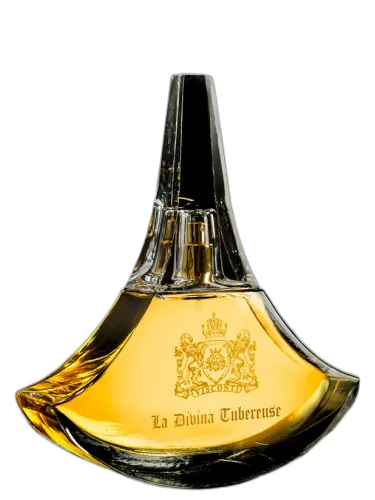

La Divina Tubereuse Antonio Visconti
At a glance
Is La Divina Tubereuse Antonio Visconti worth trying?
La Divina Tubereuse by Antonio Visconti is a Floral fragrance for women and men.
- Best match
- Evening, Special Occasion wear in Spring, Summer
- Performance feel
- Good longevity with Moderate sillage
- Signature profile
- white floral, tuberose, cacao with Tuberose, Neroli, Osmanthus
The first impression
La Divina Tubereuse by Antonio Visconti is a Floral fragrance for women and men. The nose behind this fragrance is Antonio Visconti. Top notes are Tuberose, Neroli, Osmanthus, Melon, Mandarin Orange and Bergamot; middle notes are Tuberose, Jasmine and Iris; base notes are Cacao Pod, Amber, Vanilla, Labdanum and Immortelle.
What shapes the scent
The perfumer behind it

Antonio Visconti
Antonio Visconti is an Italian perfumer who creates fragrances under his own name. His collection includes Alhambra, Bal Masqué, Coeur De Vanille, Foliage, Glam Flower, Juicy Flower, La Divina Tubereuse, and Le Sens Du Plaisir. His style ranges from gourmand vanillas to floral and green compositions, often with a luxurious, romantic feel.
Notes pyramid
Top Notes
First impression · 15-30 min
 Tuberose
 Neroli
 Osmanthus
 Melon
Melon
 Mandarin Orange
 Bergamot
Heart Notes
Core character · 2-4 hours
Tuberose
 Jasmine
 Iris
Iris
Base Notes
Lasting impression · 4+ hours
 Cacao Pod
 Amber
Amber
 Vanilla
 Labdanum
 Immortelle
The mood it creates
The Lover Archetype: Portrait of La Divina Tubereuse Antonio Visconti
Essence
To wear La Divina Tubereuse by Antonio Visconti is to embrace the intoxicating duality of beauty-both sacred and profane. This fragrance, with its lush tuberose, velvety vanilla, and darkly animalic undertones, speaks to a soul who thrives on intensity, seduction, and the sublime. The person who cherishes this scent is most closely aligned with the Lover archetype, though not in its superficial, romanticized form. Their love is a force-both creative and consuming-that shapes their world.
Relationships
In love, they are both generous and demanding. They do not seek mere companionship but a communion of souls. Their relationships are marked by depth, sometimes to the point of volatility. They are drawn to those who mirror their intensity-artists, poets, thinkers who understand that love is not a passive emotion but an act of creation. Yet, they are not possessive in the petty sense; they believe in freedom within devotion.
Friendships, too, are curated with care. They have little patience for small talk or superficial bonds. Their inner circle consists of those who challenge them, who share their hunger for beauty and meaning. They are the confidant who listens with rapt attention, the one who remembers the exact shade of your favorite flower, the friend who sends handwritten letters scented with sandalwood.
Shadow
But the Lover, in their unchecked form, risks becoming a slave to their own desires. Their greatest flaw is their capacity for obsession-not just with people, but with ideals, aesthetics, even their own self-image. They may mistake intensity for truth, believing that if something does not move them deeply, it is worthless. This can lead to a kind of emotional elitism, a dismissal of simpler joys.
Their sensuality, if unbalanced, can tip into hedonism. They might chase pleasure to the point of exhaustion, mistaking the next thrill for fulfillment. And in love, their need for profound connection can become suffocating-expecting a partner to be both muse and mirror, a demand few can sustain.
Conclusion
Yet, when this person learns to temper their fire with wisdom, they become a rare force-one who reminds others that life is not merely to be endured, but felt. They are the ones who teach us that a meal can be a sacrament, that a touch can be a poem, that even sorrow has its own dark beauty.
They will always walk the line between light and shadow, between rapture and ruin. But perhaps that is the price-and the privilege-of living so deeply.
If you like this, try these
Fragrances with a comparable profile - shared accords, notes, and character.

Perfumérica
Coco Tropic Perfumérica
Shared top notes: bergamot

Paris Elysees
Romantic Dream Paris Elysees
Shared heart notes: iris, jasmine, tuberose

Sospiro Perfumes
Verde Accento Sospiro Perfumes
Shared top notes: bergamot, mandarin orange

Robert Piguet
Petit Fracas Robert Piguet
Shared top notes: bergamot, mandarin orange
d'Annam
In The Garden D'annam
Shared top notes: neroli