
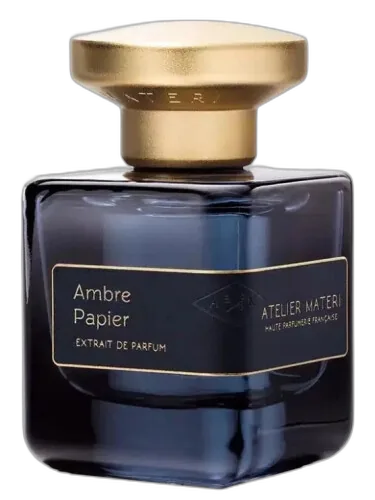

Ambre Papier Atelier Materi
At a glance
Is Ambre Papier Atelier Materi worth trying?
Ambre Papier by Atelier Materi is a Oriental Spicy fragrance for women and men.
- Best match
- Evening, Special Occasion wear in Fall, Winter
- Performance feel
- Very Good longevity with Strong sillage
- Signature profile
- warm spicy, amber, aromatic with Black Pepper, Pepper, Mandarin
The first impression
Ambre Papier by Atelier Materi is a Oriental Spicy fragrance for women and men. This is a new fragrance. Ambre Papier was launched in 2024. The nose behind this fragrance is Céline Perdriel. Top notes are Black Pepper, Pepper and Mandarin; middle notes are Myrrh, Saffron, Mate and Jasmine; base notes are Benzoin, Vetiver and Tonka.
What shapes the scent
The perfumer behind it

Celine Perdriel
Celine Perdriel is a French perfumer known for her work with Atelier Materi, where she has created scents like Ambre Papier and Cuir Nilam. Her portfolio also includes the fresh Cèdre Figalia and the floral Rose Ardoise. She has additionally crafted fragrances for Faberlic and Good Water Perfume, demonstrating a range from woody to aquatic notes.
Notes pyramid
Top Notes
First impression · 15-30 min
 Black Pepper
 Pepper
Mandarin
Pepper
Mandarin
Heart Notes
Core character · 2-4 hours
 Myrrh
Myrrh
 Saffron
 Mate
Mate
 Jasmine
Base Notes
Lasting impression · 4+ hours
 Benzoin
 Vetiver
Tonka
Vetiver
Tonka
The mood it creates
The Sage Archetype: Portrait of Ambre Papier Atelier Materi
Essence
Ambre Papier by Atelier Materi is not a fragrance for the casual admirer of scent. It is a paradox-warm yet austere, rich yet restrained, like an ancient manuscript bound in leather and dusted with incense. The person who chooses this fragrance is drawn to the alchemy of contradictions. They are not seduced by the obvious, nor do they seek the approval of fleeting trends. Instead, they gravitate toward depth, toward the quiet resonance of something that reveals itself slowly, like wisdom unfolding over time.
This individual is, at their core, a Sage-one of Jung’s fundamental archetypes. The Sage seeks truth, not as an absolute, but as an ever-evolving understanding. They are the observer, the interpreter, the one who distills life into meaning. Yet, like all archetypes, the Sage has a shadow-a tendency toward detachment, an over-reliance on intellect at the expense of instinct, and sometimes, a quiet arrogance in their certainty.
Shadow
Yet, the Sage’s intellect can become a fortress. They may mistake understanding for experience, believing that to know a thing is to have truly lived it. This can lead to a kind of emotional austerity-an unwillingness to surrender to chaos, to the messy, unexamined throes of passion. They may pride themselves on their objectivity, but objectivity, when overvalued, becomes its own form of blindness.
Their relationships may suffer from this remove. They can be frustratingly self-contained, withholding vulnerability under the guise of wisdom. There is a quiet hubris in believing one has transcended the need for raw, unfiltered connection.
Conclusion
Their tastes are deliberate, refined without being ostentatious. They prefer the weight of linen and wool over synthetic fabrics, the texture of handmade paper over glossy prints. Their home is a sanctuary of muted tones-ochre, slate, deep brown-where every object has been chosen with intention. Books line the shelves, not as decoration, but as companions in an ongoing dialogue with the world.
Philosophy is not an abstract exercise for them; it is the lens through which they navigate existence. They are drawn to thinkers like Nietzsche himself, who embraced contradiction, who saw wisdom as both a burden and a liberation. They believe in the sovereignty of the individual mind but are wary of dogma. Their values are rooted in authenticity-they despise pretense, yet they are not immune to the subtle vanity of believing themselves above it.
If you like this, try these
Fragrances with a comparable profile - shared accords, notes, and character.

Les Liquides Imaginaires
Saffron Mandarin Les Liquides Imaginaires
Shared top notes: black pepper

TOMBSTONE
No Need To Come By Tombstone
Shared top notes: pepper

Eau D'Italie
Baume Du Doge Eau D'italie
Shared top notes: pepper

Ex Nihilo
Chandigarh Express Ex Nihilo
Shared heart notes: jasmine
Santa Eulalia
Vesper Santa Eulalia
Shared top notes: pepper