
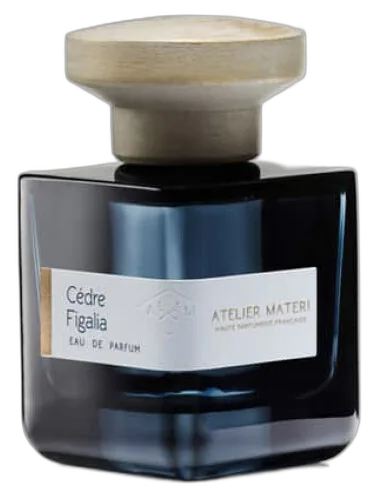

Cèdre Figalia Atelier Materi
Fragrance Story
Cèdre Figalia by Atelier Materi is a Woody Aromatic fragrance for women and men. This is a new fragrance. Cèdre Figalia was launched in 2024. The nose behind this fragrance is Celine Perdriel. Top notes are Basil, Bergamot and Allspice; middle notes are Fig Leaf, Mate and Spinach; base notes are Fig, Cedar and Dry Wood.
Composition Profile
About the Perfumer

Celine Perdriel
Celine Perdriel is a French perfumer known for her work with Atelier Materi, where she has created scents like Ambre Papier and Cuir Nilam. Her portfolio also includes the fresh Cèdre Figalia and the floral Rose Ardoise. She has additionally crafted fragrances for Faberlic and Good Water Perfume, demonstrating a range from woody to aquatic notes.
Fragrance Notes
Top Notes
First impression · 15-30 min
 Basil
Basil
 Bergamot
 Allspice
Heart Notes
Core character · 2-4 hours
 Fig Leaf
 Mate
Mate
 Spinach
Base Notes
Lasting impression · 4+ hours
 Fig
Fig
 Cedar
Cedar
 Dry Wood
Cèdre Figalia Atelier Materi by Atelier Materi offers a distinctive olfactory experience that stands out from other fragrances in its category.
Crafted with the finest ingredients and a blend of traditional and modern perfumery techniques, this fragrance represents the pinnacle of the perfumer's art.
Cèdre Figalia Atelier Materi embodies the distinctive style of Atelier Materi while adding a unique chapter to their fragrance portfolio.
Character Profile
The Sage Archetype: Portrait of Cèdre Figalia Atelier Materi
Essence
To wear Cèdre Figalia by Atelier Materi is to embrace a paradox-warmth and austerity, earthiness and intellect, sensuality and restraint. The fragrance itself is a dance of creamy fig, smoky cedar, and a whisper of spice, evoking a mind that thrives in both contemplation and creation. The person who chooses this scent is not one for fleeting pleasures; they seek depth, meaning, and a quiet mastery over their own existence.
They are, above all, a Sage-an archetype defined by wisdom, introspection, and a relentless pursuit of truth. Like the cedar, they stand firm in their convictions; like the fig, they harbor a hidden sweetness, a softness that only the worthy may glimpse. Their life is a carefully curated sanctuary, where every object, every relationship, every thought has been examined and deemed worthy of their time.
Shadow
Yet wisdom, when unchecked, can become a prison. The Sage’s greatest strength-their ability to observe, analyze, and remain above the fray-can also be their downfall. They risk becoming too removed, mistaking detachment for enlightenment. They may dismiss emotions as irrational, love as a distraction, and human frailty as weakness rather than an essential part of existence.
Their flaw is intellectual pride. They may grow impatient with those who do not share their depth, dismissing them as shallow or unworthy. This can lead to isolation, a self-imposed exile from the very world they seek to understand. Worse still, they may fall into the trap of believing their own wisdom is absolute, forgetting that knowledge, like cedar, must bend with the wind or risk breaking.
Conclusion
Their tastes are deliberate, almost ritualistic. They prefer the weight of linen and wool over synthetic fabrics, the texture of handmade paper over glossy prints, the slow burn of a single-malt whiskey over the immediacy of a cocktail. Their home is a temple of minimalism, where each piece-a well-worn leather chair, a stack of philosophy books, a single ceramic vase-serves a purpose beyond decoration.
Philosophy is not an abstract exercise for them; it is a way of life. They may be drawn to Stoicism for its discipline, to existentialism for its embrace of freedom, or to Zen for its clarity. What matters is not the school of thought, but the rigor with which they apply it. They believe in self-creation-that identity is not given, but forged through relentless self-examination.
In relationships, they are selective. They do not suffer fools, nor do they indulge in idle chatter. Their closest bonds are with those who can match their intellectual intensity, who understand that silence between them is not emptiness, but a shared language. They are not cold, but they are guarded; their love is expressed in acts of quiet devotion rather than grand gestures.
Similar Fragrances
Fragrances with a comparable profile - shared accords, notes, and character.
Atelier Materi
Cèdre Figalia Atelier Materi
Shared accords: aromatic, fresh, fresh spicy

Lonkoom Parfum
Listening Lonkoom Parfum
Shared accords: aromatic, fresh, fresh spicy

Andrea Maack
Flux Andrea Maack
Shared accords: aromatic, fresh, fresh spicy

Wild Drops Parfums
Vilage Wild Drops Parfums
Shared accords: aromatic, fresh, fresh spicy

House Of James
Rambla Del Mar House Of James
Shared accords: aromatic, fresh spicy, fruity