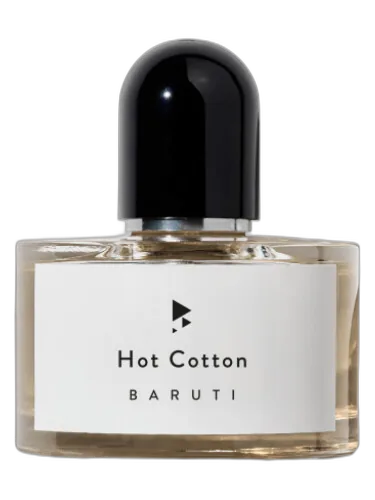

Hot Cotton Baruti
At a glance
Is Hot Cotton Baruti worth trying?
Hot Cotton by Baruti is a fragrance for women and men.
- Best match
- Casual wear in Summer
- Performance feel
- Good longevity with Moderate sillage
- Signature profile
- hot iron, musky, powdery with Hot iron, Musk
The first impression
Hot Cotton by Baruti is a fragrance for women and men. This is a new fragrance. Hot Cotton was launched in 2024. The nose behind this fragrance is Spyros Drosopoulos.
What shapes the scent
The perfumer behind it

Spyros Drosopoulos
Spyros Drosopoulos has created fragrances for Baruti and Annindriya, including Berlin Im Winter, Chai, and Indigo. His work often features unconventional and evocative themes. He is known for his artistic and narrative-driven approach to perfumery.
Notes pyramid
All Notes
Complete scent profile
 Hot iron
 Musk
Musk
The mood it creates
The Innocent Archetype: Portrait of Hot Cotton Baruti
Essence
To love Hot Cotton by Baruti is to embrace a fragrance that is deceptively simple-clean, warm, and unpretentious, yet with an undercurrent of quiet depth. The person who adores this scent is not one for ostentation; they seek purity, comfort, and an almost childlike appreciation for life’s small joys. Their soul resonates most closely with the Innocent archetype, an eternal optimist who believes in goodness, simplicity, and the possibility of an unspoiled world.
Shadow
Yet, the Innocent is not without their vulnerabilities. Their optimism can curdle into denial, their trust into gullibility. They may refuse to see the darker currents in people, clinging to a fantasy of universal goodness even when evidence suggests otherwise. This blindness can leave them wounded-betrayed by those they trusted too quickly, disillusioned when the world fails to match their pristine vision.
Their aversion to complexity can also manifest as passivity. They may avoid conflict to the point of self-erasure, smoothing over disagreements rather than confronting them. Their pursuit of purity can become a form of escapism-a refusal to engage with the messiness of life, love, and ambition. At worst, they risk becoming stagnant, mistaking simplicity for stagnation, comfort for growth.
Conclusion
This person moves through life with a lightness that others find either refreshing or naive. They are drawn to the tactile pleasures of freshly laundered linen, sunlit rooms, and the scent of warm skin after a bath. Their aesthetic is minimalist but never sterile-white cotton shirts, well-worn denim, unadorned ceramics, and open spaces where sunlight filters in without obstruction. They believe in the inherent goodness of people, in kindness as a default mode of existence, and in the possibility of renewal.
Philosophically, they are drawn to thinkers who champion simplicity-Thoreau’s Walden, the Zen concept of wabi-sabi, or the Stoic ideal of finding contentment in the present. They do not chase grandeur; they find divinity in the mundane. Their relationships are built on trust and sincerity-they are the friend who remembers small kindnesses, who listens without judgment, who offers a cup of tea and a quiet presence rather than dramatic advice.
Their lifestyle reflects this inner clarity. They prefer mornings to nights, open windows to closed doors, and handwritten letters to digital messages. They may work in a creative field-textile design, gardening, or perhaps teaching-where their appreciation for simplicity can flourish. Their home is a sanctuary, free of clutter but rich in texture: linen curtains, wooden bowls, a single vase of wildflowers on the table.
If you like this, try these
Fragrances with a comparable profile - shared accords, notes, and character.