
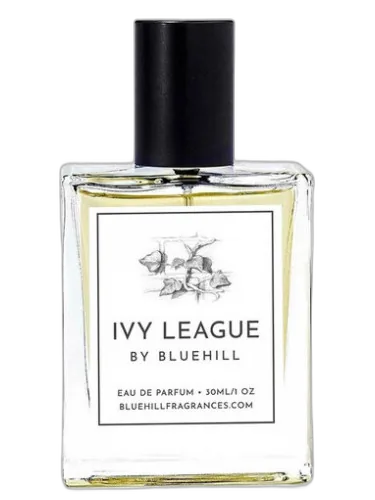

Ivy League Bluehill
At a glance
Is Ivy League Bluehill worth trying?
Ivy League by Bluehill is a Floral Green fragrance for women and men.
- Best match
- Office wear in Fall
- Performance feel
- Good longevity with Moderate sillage
- Signature profile
- green, fresh spicy, aromatic with Ivy, Green Mandarin, Black Pepper
The first impression
Ivy League by Bluehill is a Floral Green fragrance for women and men. Ivy League was launched in 2021. The nose behind this fragrance is Sandy Carr. Top notes are Ivy, Green Mandarin and Black Pepper; middle notes are Pea, Basil, Mint, Grass, Narcissus and Rosemary; base notes are Black Currant and Balsamic Notes.
What shapes the scent
The perfumer behind it

Sandy Carr
Sandy Carr is the perfumer behind two fragrances for the Bluehill brand, Back Bay and Ivy League. Back Bay evokes a coastal and refined atmosphere, while Ivy League captures a classic, academic sensibility. Both scents demonstrate her ability to create sophisticated and place-inspired compositions. Her work for Bluehill reflects a focus on clean, elegant olfactory profiles.
Notes pyramid
Top Notes
First impression · 15-30 min
 Ivy
Ivy
 Green Mandarin
Black Pepper
Green Mandarin
Black Pepper
Heart Notes
Core character · 2-4 hours
 Pea
Pea
 Basil
Basil
 Mint
Mint
 Grass
Grass
 Narcissus
 Rosemary
Base Notes
Lasting impression · 4+ hours
 Black Currant
 Balsamic Notes
The mood it creates
The Sage Archetype: Portrait of Ivy League Bluehill
Essence
Ivy League Bluehill is a fragrance of crisp refinement-cool, intellectual, and effortlessly composed. It carries the sharpness of bergamot, the depth of vetiver, and a whisper of leather, evoking the quiet confidence of old libraries, polished wood, and the first chill of autumn. The person who chooses this scent does not seek to overwhelm but to intrigue, to signal belonging to an unspoken aristocracy of the mind.
Style & Aesthetic
Their wardrobe is a study in understated elegance-tailored blazers, oxford shirts, perhaps a well-worn leather satchel. They favor muted tones: navy, charcoal, forest green. Every piece is chosen not for trend but for timelessness, as if they are dressing for a future where their image will be preserved in black-and-white photographs.
Their tastes in art, literature, and music reflect the same discerning eye. They prefer Bach over Beethoven (too emotional), Hemingway over Faulkner (too chaotic), and the clean lines of mid-century modernism over Baroque excess. They collect first editions not for rarity alone but for the weight of history they carry.
Their home is a sanctuary of control. Books are alphabetized, whiskey is properly aged, and the record player is always dusted. They rise early, exercise with methodical discipline, and keep a journal not for confession but for self-audit.
Work is not just a career but a calling-whether in law, academia, finance, or another field where precision is rewarded. They are respected but not always loved. Colleagues admire their competence but may resent their unwillingness to suffer fools.
Philosophy & Values
They believe in self-mastery above all else. Emotions are to be examined, not indulged; passions are to be directed, not surrendered to. Stoicism appeals to them-not as a rejection of feeling but as a way to refine it into something useful.
Their moral code is built on rationality, fairness, and a quiet disdain for irrationality. They despise dogma but respect tradition when it serves a purpose. They are not religious, but if they were, it would be a faith of contemplation, not ecstasy.
Yet their devotion to reason can become a prison. They may dismiss intuition as superstition, love as sentimentality, and spontaneity as recklessness. Their greatest fear is not failure but irrelevance-being left behind in the march of progress, exposed as unworthy of their own ideals.
Relationships
Friendships are carefully chosen, not stumbled into. They prefer small circles of like-minded individuals-those who can spar intellectually without resorting to pettiness. Romantic partners must meet an exacting standard: intelligence is non-negotiable, emotional neediness is a red flag.
They are not cold, but they are guarded. Vulnerability is a risk, not a virtue. Their love is expressed in acts of service, in shared silence, in the gift of a perfectly chosen book. But if their partner ever accuses them of emotional distance, they will retreat further, seeing the demand as weakness rather than a plea for intimacy.
Shadow
The Sage’s greatest weakness is their inability to surrender. Life, in its messiness, does not always conform to logic. When faced with chaos-failure, heartbreak, irrational opposition-they may respond not with adaptation but with brittle defiance.
Their intellect, once a tool for understanding, can become a weapon. They dismiss what they do not comprehend, ridicule what they cannot categorize. The very clarity they prize becomes a blindness.
Conclusion
Ivy League Bluehill is not just a scent but a statement-a declaration of allegiance to the life of the mind. The person who wears it is neither hero nor villain but a figure of contradictions: brilliant yet aloof, disciplined yet rigid, wise yet sometimes blind to their own limitations.
They are the Sage, walking the fine line between enlightenment and isolation. And like all who seek wisdom, they must eventually ask: What good is knowledge if it does not teach you how to live?
If you like this, try these
Fragrances with a comparable profile - shared accords, notes, and character.

Tom Ford
Beau De Jour Tom Ford
Shared heart notes: basil, mint, rosemary

Phytoderm
Bravus Phytoderm
Shared top notes: black pepper, green mandarin

Hilde Soliani
Menta Glaciale Hilde Soliani
Shared accords: aromatic, fresh, fresh spicy

DSH Perfumes
Amish Dsh Perfumes
Shared accords: aromatic, fresh, fresh spicy

Neil Morris
Cathedral Neil Morris
Shared top notes: black pepper