
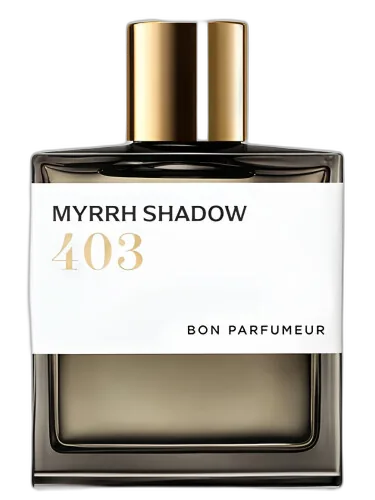

403 Myrrh Shadow Bon Parfumeur
At a glance
Is 403 Myrrh Shadow Bon Parfumeur worth trying?
403 Myrrh Shadow by Bon Parfumeur is a Woody Spicy fragrance for women and men.
- Best match
- Evening wear in Fall
- Performance feel
- Very Good longevity with Moderate sillage
- Signature profile
- amber, warm spicy, fresh spicy with Bitter Orange, Black currant leaf, Grapefruit
The first impression
403 Myrrh Shadow by Bon Parfumeur is a Woody Spicy fragrance for women and men. This is a new fragrance. 403 Myrrh Shadow was launched in 2025. 403 Myrrh Shadow was created by Quentin Bisch and Amélie Jacquin. Top notes are Bitter Orange, Black currant leaf and Grapefruit; middle notes are Basil, Timur, Cinnamon and Cypress; base notes are Myrrh, Vanilla, Akigalawood, Cosmone, Benzoin, Patchouli, Musk and Atlas Cedar.
What shapes the scent
The perfumer behind it

Amelie Jacquin
Amelie Jacquin is a French perfumer known for her work with brands like Bon Parfumeur, Dries Van Noten, and Goldfield & Banks Australia. Her style often explores rich, textured accords, with a particular affinity for myrrh and resinous notes, as seen in creations such as Rock The Myrrh and Myrrh Shadow. She balances bold, opulent ingredients with a refined clarity, evident in compositions like Island Lush and Honeyed Tobacco & Oud.
Notes pyramid
Top Notes
First impression · 15-30 min
 Bitter Orange
 Black currant leaf
 Grapefruit
Heart Notes
Core character · 2-4 hours
 Basil
Basil
 Timur
Timur
 Cinnamon
 Cypress
Base Notes
Lasting impression · 4+ hours
 Myrrh
Myrrh
 Vanilla
 Akigalawood
 Cosmone
 Benzoin
 Patchouli
 Musk
Musk
 Atlas Cedar
The mood it creates
The Alchemist Archetype: Portrait of 403 Myrrh Shadow Bon Parfumeur
Essence
To wear 403 Myrrh Shadow by Bon Parfumeur is to embrace the scent of transformation-dark, resinous, and enigmatic. The fragrance itself is an olfactory paradox: warm yet distant, sacred yet sensual, ancient yet timeless. The person who chooses this scent is drawn not to the obvious, but to the veiled, the layered, the things that require patience to unravel. They are, above all, an Alchemist-one who seeks meaning in the hidden, who turns the raw material of existence into something richer, deeper.
Shadow
Yet every strength has its inverse. The Alchemist’s depth can become solipsism. Their love of mystery can turn into a refusal to engage with the tangible world. They may withdraw too far into their own mind, mistaking introspection for enlightenment, forgetting that wisdom must sometimes be lived, not just pondered.
Their skepticism can harden into cynicism. They may dismiss what is simple or joyful as "naive," forgetting that not all truth must be unearthed from the depths-some of it floats on the surface, waiting to be seen.
In relationships, their reticence can be mistaken for coldness. They may hoard their emotions, believing that to share them would be to dilute their power. This can leave loved ones feeling shut out, forced to interpret silences instead of hearing words.
And then there is the danger of obsession. The Alchemist is drawn to the hidden, but sometimes what is hidden should remain so. They may fixate on deciphering every symbol, every dream, every unspoken tension, until life becomes a labyrinth with no exit.
Conclusion
This is someone who moves through the world with quiet intensity. Their presence is not loud, but it lingers. They are drawn to the mystical-not in a frivolous or superstitious way, but in the way of a seeker who understands that reality is more porous than it seems. They may have a fascination with ancient religions, esoteric philosophies, or the occult, not for the sake of novelty, but because these traditions speak to something in their bones.
Their tastes are refined but never ostentatious. They prefer dark, textured fabrics-velvet, raw silk, aged leather-things that carry weight and history. Their home is likely filled with curiosities: antique books, dried botanicals, perhaps an old brass compass or a collection of handwritten notes. They do not decorate for others; every object is chosen because it resonates with some private significance.
Philosophically, they believe in depth over surface, in essence over appearance. They distrust dogma but respect wisdom. They are drawn to paradoxes-the idea that light cannot exist without shadow, that meaning is often found in what is unspoken. They may quote Heraclitus or Jung in conversation, not to impress, but because these thinkers articulate something they have always felt.
If you like this, try these
Fragrances with a comparable profile - shared accords, notes, and character.
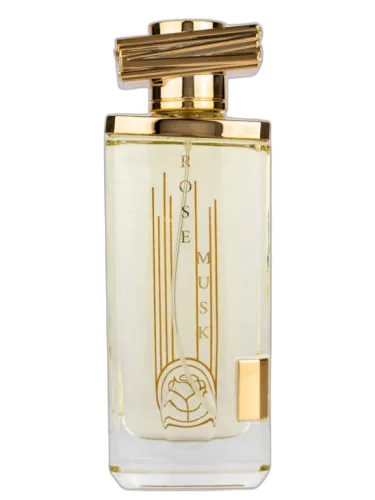
MAISON ASRAR
Rose Musk Maison Asrar
Shared top notes: black currant leaf, grapefruit

Avon
U By Ungaro For Him Avon
Shared top notes: bitter orange, grapefruit
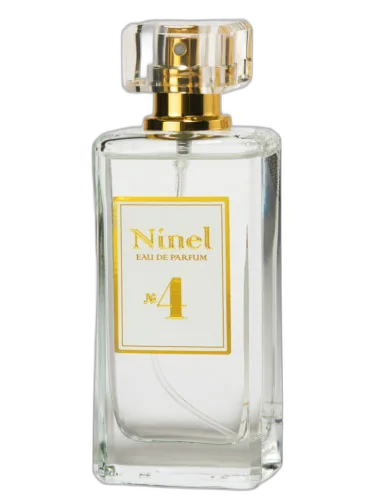
Ninel Perfume
Ninel No. 4 Ninel Perfume
Shared top notes: black currant leaf

Hermès
Terre D'hermes Flacon H 2020 Eau De Toilette Hermès
Shared top notes: grapefruit

Odorata
Authentique Homme Odorata
Shared top notes: grapefruit