
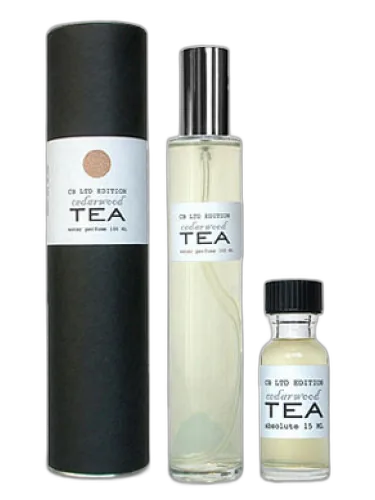

Cedarwood Tea Cb I Hate Perfume
At a glance
Is Cedarwood Tea Cb I Hate Perfume worth trying?
Cedarwood Tea by CB I Hate Perfume is a Woody Aromatic fragrance for women and men.
- Best match
- Casual wear in Fall, Winter
- Performance feel
- Moderate longevity with Moderate sillage
- Signature profile
- woody, green, amber with Virginia Cedar, Tea, Incense
The first impression
Cedarwood Tea by CB I Hate Perfume is a Woody Aromatic fragrance for women and men. Cedarwood Tea was launched in 2006. The nose behind this fragrance is Christopher Brosius.
What shapes the scent
The perfumer behind it

Christopher Brosius
Christopher Brosius is an American perfumer and founder of CB I Hate Perfume, known for his unconventional, narrative-driven scents. His portfolio includes fragrances like 2nd Cumming, At the Beach 1966, and Beautiful Launderette, which evoke specific memories and atmospheres. He also created Cumming for actor Alan Cumming, blending personal storytelling with olfactory art.
Notes pyramid
All Notes
Complete scent profile
 Virginia Cedar
 Tea
Tea
 Incense
The mood it creates
The Sage Archetype: Portrait of Cedarwood Tea Cb I Hate Perfume
Essence
The Sage archetype is the seeker of truth and wisdom. They are introspective, thoughtful, and driven by a desire to understand the deeper nature of reality. The Sage finds solace in solitude and clarity in simplicity, valuing knowledge and insight above all else.
Cedarwood Tea is a fragrance that embodies this quiet contemplation. The scent is a minimalist meditation: the dry, woody embrace of Virginia cedar, the subtle steam of black tea, and a whisper of incense smoke. It is not a loud declaration, but a gentle invitation inward, a scent for moments of reflection and the pursuit of inner peace.
Style & Aesthetic
The Sage's style is understated and functional, favoring quality over quantity. They are drawn to natural fibers like linen, wool, and cotton in neutral tones-greys, browns, and deep greens. Their aesthetic is one of quiet elegance, where comfort and practicality are paramount.
They might be found in a well-worn cardigan, a simple scarf, or sturdy boots. Their home is a sanctuary of order and calm, filled with books, plants, and perhaps a dedicated space for meditation or study. The Sage's appearance is not about fashion, but about authenticity and a life lived with intention.
Philosophy & Values
The Sage values truth, clarity, and the relentless pursuit of wisdom. They believe that understanding is the highest good and that knowledge should be shared for the betterment of all. They are lifelong learners, constantly reading, questioning, and exploring new ideas.
They hold skepticism and critical thinking in high regard, but also value the wisdom found in silence and stillness. The Sage believes in the power of perspective and that by understanding the world, we can better understand ourselves. Their philosophy is one of continuous growth, where every experience is a lesson to be learned.
Relationships
In relationships, the Sage is a thoughtful and loyal companion, but they require ample space for their own pursuits. They are excellent listeners and offer wise counsel, but they may struggle with superficial small talk or highly emotional displays. They connect most deeply with those who share their intellectual curiosity.
They value deep, meaningful conversations over large social gatherings. A Sage's ideal relationship is one of mutual respect and intellectual partnership, where both individuals can grow and learn together. They are not cold, but their love is expressed through shared ideas, quiet presence, and the gift of their undivided attention.
Lifestyle
The Sage's lifestyle is one of routine and ritual, designed to foster focus and clarity. Their mornings might begin with a cup of tea and a few pages of a book, or a quiet meditation. They carve out time for solitary walks in nature, journaling, or engaging in a craft that requires patience and precision.
They are likely to have a home library or a study, a place of retreat from the noise of the world. Their days are structured around periods of deep work and reflection. They are not anti-social, but they are selective about how they spend their energy, preferring quality over quantity in all things, including their time.
Shadow
The Sage's shadow is the risk of becoming detached or overly critical. Their love of analysis can lead to overthinking, paralysis, or a sense of superiority. They may retreat so far into their own mind that they lose touch with their emotions and the simple joys of life.
They can become cynical or dismissive of things they deem unworthy of their intellectual rigor. The shadow of the Sage is isolation-a fortress of knowledge that keeps the world at a safe but lonely distance. The challenge is to balance wisdom with warmth, and to remember that some truths are felt, not thought.
Conclusion
Cedarwood Tea is the fragrance of the Sage who finds wisdom in the quiet spaces. It is a scent for the thinker, the writer, the meditator-anyone who seeks clarity in a chaotic world. This fragrance is a companion for moments of solitude, a reminder that the deepest truths are often found in the simplest of elements: wood, leaf, and smoke. It is the scent of a mind at peace, and a soul in search of understanding.
If you like this, try these
Fragrances with a comparable profile - shared accords, notes, and character.

CB I Hate Perfume
Just Breathe Cb I Hate Perfume
Shared top notes: incense, tea, virginia cedar

Phaedon
Cendres De The Phaedon
Shared top notes: tea, virginia cedar

Montale
Full Incense Montale
Shared top notes: incense, virginia cedar

DS&Durga
Amber Kiso Ds&durga
Shared top notes: incense

Incarna parfums
Silentium Incarna Parfums
Shared top notes: incense