
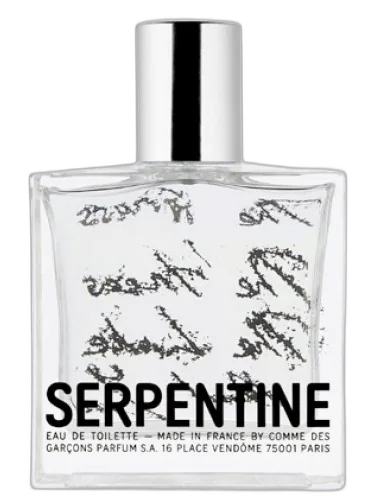

Serpentine Comme Des Garcons
At a glance
Is Serpentine Comme Des Garcons worth trying?
Serpentine by Comme des Garcons is a Aromatic Green fragrance for women and men.
- Best match
- Evening wear in Fall
- Performance feel
- Good longevity with Moderate sillage
- Signature profile
- green, fresh, asphault with Asphalt, Grass, Aldehydes
The first impression
Serpentine by Comme des Garcons is a Aromatic Green fragrance for women and men. Serpentine was launched in 2014. The nose behind this fragrance is Emilie Bevierre-Coppermann.
What shapes the scent
The perfumer behind it

Emilie Bevierre-Coppermann
Emilie Bevierre-Coppermann is a versatile perfumer who has created fragrances for a wide range of brands, including A Lab on Fire, Adidas, Avon, Benetton, Blumarine, and Boitown. Her portfolio spans from the aquatic notes of Adidas Full Recharge to the floral elegance of Avon Iris Fetiche and the green freshness of Benetton Green Amazonia. She demonstrates skill in crafting both commercial and niche scents.
Notes pyramid
All Notes
Complete scent profile
 Asphalt
 Grass
Grass
 Aldehydes
 Green Leaves
 Galbanum
Iris leaf
Galbanum
Iris leaf
 Musk
Musk
 Juniper
 Cedar
Cedar
 Labdanum
 Benzoin
 Nutmeg
 Guaiac Wood
The mood it creates
The Alchemist Archetype: Portrait of Serpentine Comme Des Garcons
Essence
To wear Serpentine by Comme des Garçons is to embrace contradiction-an olfactory paradox of cool mineral freshness entwined with dark, vegetal mystery. This fragrance is not for those who seek comfort in familiarity; it is for the individual who thrives in the liminal, the ambiguous, the spaces where meaning is fluid. The person who chooses this scent is an Alchemist-Jung’s archetype of transformation, experimentation, and the pursuit of hidden truths.
Shadow
Yet, no archetype is without its darkness. The Alchemist’s relentless pursuit of transformation can become self-consuming. Their fascination with the obscure may lead them into solipsism, mistaking obscurity for profundity. They risk becoming the serpent that eats its own tail-forever chasing revelation but never satisfied.
Their detachment, while a strength, can also manifest as emotional austerity. They may rationalize cruelty as honesty, dismiss sentimentality as weakness, and mistake coldness for wisdom. Relationships may suffer under their exacting standards, as few can endure the heat of their inner forge for long.
Conclusion
This is someone who views life as a crucible, a vessel in which raw experience is transmuted into something greater. They are drawn to the esoteric, the unconventional, the things that resist easy categorization. Their tastes reflect this: they prefer avant-garde art over classical symmetry, dissonant music over predictable harmonies, and literature that challenges rather than comforts. Their style is deliberate-structured yet subversive, often favoring monochrome palettes with a single unsettling detail: a jagged cut, an asymmetrical drape, a texture that shouldn’t belong but somehow does.
Philosophically, they reject dogma. Truth, to them, is not fixed but mutable-something to be uncovered layer by layer, like peeling back the skin of an onion only to find another beneath. They are drawn to thinkers like Nietzsche, Bataille, or even the surrealists, who dismantle conventional reality to glimpse what lies beneath. Their values center on autonomy, curiosity, and the courage to confront the unknown.
If you like this, try these
Fragrances with a comparable profile - shared accords, notes, and character.
UERMI
Xx ± Latex Uermi
Shared top notes: aldehydes

Strangers Parfumerie
Spring Ambience Strangers Parfumerie
Shared top notes: aldehydes, cedar, galbanum

Olympic Orchids Artisan Perfumes
Carosello Olympic Orchids Artisan Perfumes
Shared top notes: benzoin, cedar, nutmeg

Precious Liquid
Bergamote Precious Liquid
Shared top notes: galbanum, musk

Oliver & Co.
Ambergreen Oliver & Co.
Shared top notes: galbanum, grass, guaiac wood