
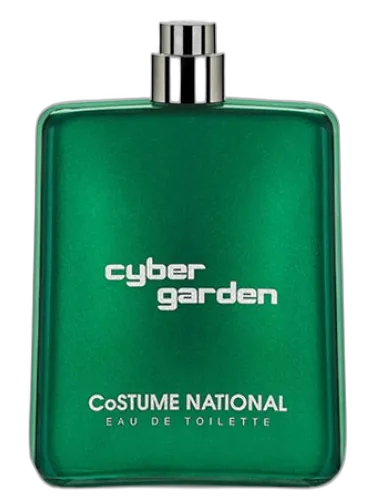

Cyber Garden Costume National
At a glance
Is Cyber Garden Costume National worth trying?
Cyber Garden by CoSTUME NATIONAL is a Oriental Fougere fragrance for men.
- Best match
- Evening wear in Fall
- Performance feel
- Good longevity with Moderate sillage
- Signature profile
- green, aromatic, citrus with Green Notes, Grapefruit, Bergamot
The first impression
Cyber Garden by CoSTUME NATIONAL is a Oriental Fougere fragrance for men. Cyber Garden was launched in 2013. The nose behind this fragrance is Antoine Lie. Top notes are Green Notes, Grapefruit, Bergamot and Pink Pepper; middle notes are Vinyl, Violet Leaf, Geranium and Saffron; base notes are Vetiver, Moss, Patchouli, Labdanum and Opoponax.
What shapes the scent
The perfumer behind it

Antoine Lie
Antoine Lie is a French perfumer trained at Givaudan and known for his work with brands like Burberry and Avon. His style often blends bold contrasts, pairing fresh or woody accords with unexpected gourmand or metallic touches. He created the earthy, resinous Sequoia for Abbott New York City and the spicy, incense-laced Sword for CZAR, showcasing his skill with complex, atmospheric compositions.
Notes pyramid
Top Notes
First impression · 15-30 min
 Green Notes
 Grapefruit
 Bergamot
 Pink Pepper
Heart Notes
Core character · 2-4 hours
 Vinyl
Vinyl
 Violet Leaf
 Geranium
 Saffron
Base Notes
Lasting impression · 4+ hours
 Vetiver
 Moss
Moss
 Patchouli
 Labdanum
 Opoponax
The mood it creates
The Alchemist Archetype: Portrait of Cyber Garden Costume National
Essence
To wear Cyber Garden by Costume National is to embrace a paradox-a scent that fuses the synthetic with the organic, the futuristic with the primordial. It is a fragrance for those who dwell at the crossroads of contradiction, who find harmony in dissonance. The person who chooses this scent is not merely a wearer of perfume but a seeker of transformation, an Alchemist in the Jungian sense-driven by the pursuit of turning base elements into gold, whether in ideas, aesthetics, or the self.
Style & Aesthetic
Their appearance is a deliberate composition of contrasts. Sleek, minimalist garments in monochrome or metallic tones are paired with an unexpected organic detail-a rough-textured scarf, a piece of hand-forged jewelry, or a single vibrant accessory that disrupts the uniformity. They favor designs that suggest futurism but refuse cold sterility; there is always warmth beneath the precision.
Their living space mirrors this duality. Clean lines and uncluttered surfaces coexist with lush greenery or a carefully curated collection of oddities-perhaps a vintage scientific instrument, a holographic artwork, or a shelf of esoteric books. They are drawn to objects that tell a story of evolution, of something old reimagined into something new.
Their daily existence is a series of controlled experiments. They may follow a meticulously optimized routine-intermittent fasting, polyphasic sleep, nootropics-not out of vanity, but as a challenge to biological limits. Their career, if conventional at all, is a vessel for deeper exploration: a tech entrepreneur researching neural interfaces, a perfumer blending synthetic molecules with raw botanicals, a writer crafting mythologies for the post-human age.
They thrive in cities that pulse with possibility-Tokyo, Berlin, Seoul-where the past and future are in constant negotiation. Yet they are not mere urbanites; they seek pockets of wilderness, not for escape, but to remind themselves that even nature is an alchemical process.
Philosophy & Values
They believe in the mutability of reality. To them, the world is not fixed but a medium to be shaped, a system to be hacked. They are skeptical of dogma, whether in science, art, or spirituality, yet they are not nihilists-they simply demand that truth prove itself through reinvention. Their guiding principle is transformation: the idea that nothing is final, that even the self is a work in progress.
This philosophy makes them both visionary and restless. They are drawn to disciplines that bridge disciplines-biohacking, digital art, speculative fiction, or experimental psychology. They may dabble in meditation, not for tranquility, but as a tool for cognitive rewiring. They respect tradition only insofar as it can be dismantled and reassembled into something more potent.
Relationships
They do not seek conventional companionship. Their relationships are laboratories of mutual evolution-partnerships where ideas, emotions, and identities are in perpetual flux. They attract those who are equally unafraid of deconstruction, who understand that love, like alchemy, requires both fire and patience.
Yet their shadow emerges here. Their obsession with transformation can make them impatient with stagnation, leading them to discard relationships that no longer "evolve." They may mistake stability for inertia, fleeing from depth in pursuit of novelty. Their partners may feel like experiments rather than equals, leaving them isolated in their tower of self-imposed reinvention.
Shadow
The Alchemist’s greatest strength is also their flaw: the refusal to accept anything as finished. In their quest to transmute every experience, they risk never arriving, never resting. Their relentless innovation can become a form of avoidance-a fear of confronting the mundane, the imperfect, the unchangeable.
At their worst, they grow detached, treating people and passions as temporary substrates for their experiments. They may oscillate between grandiosity and existential fatigue, wondering if their endless pursuit of transformation is itself a kind of stasis.
Conclusion
Cyber Garden is not a scent for those who wish to be defined. It is for those who see identity as a hypothesis, perpetually tested and revised. The Alchemist who wears it is neither purely futurist nor nostalgist-they are the bridge between, the one who understands that the future is only the past reshaped.
They are brilliant, restless, and occasionally tragic. But in their hands, even tragedy is merely material-something to be dissolved and distilled into something new.
If you like this, try these
Fragrances with a comparable profile - shared accords, notes, and character.
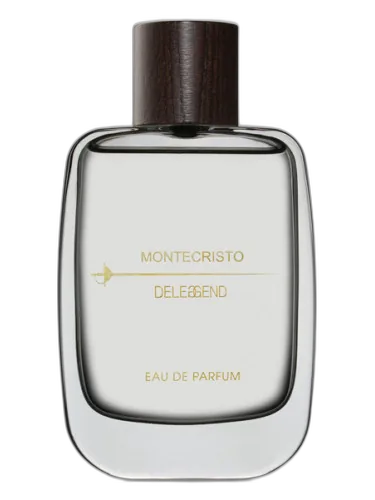
Mille Centum Parfums
Montecristo Deleggend Signature Mille Centum Parfums
Shared top notes: bergamot, grapefruit, pink pepper
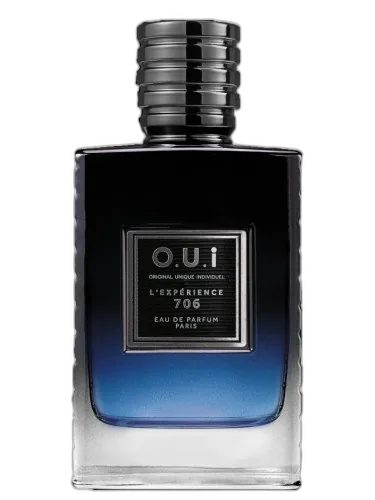
O.U.i Original Unique Individual
L’expérience 706 O.u.i Original Unique Individual
Shared top notes: bergamot, grapefruit
Caron
Vétiver Infini (2021) Caron
Shared top notes: bergamot, grapefruit, pink pepper
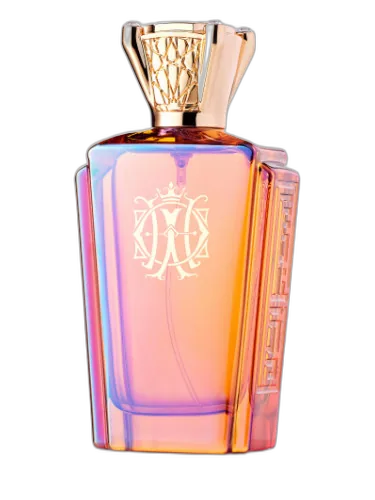
Attar Al Has
Spice Rose Attar Al Has
Shared top notes: bergamot, grapefruit, pink pepper
Maison Martin Margiela
When The Rain Stops Maison Martin Margiela
Shared top notes: bergamot, green notes, pink pepper