


Dialogs (диалог) Dzintars
Fragrance Story
Dialogs (Диалог) by Dzintars is a Chypre fragrance for women. Dialogs (Диалог) was launched in 1980. The nose behind this fragrance is Antonina Vitkovskaya. Top notes are Aldehydes, Violet, Lily-of-the-Valley, Lemon and Bergamot; middle notes are Coriander, Rose, Iris, Patchouli, Ylang-Ylang, Carnation and Vetiver; base notes are Sweet Notes, Fruity Notes and Musk.
Composition Profile
About the Perfumer
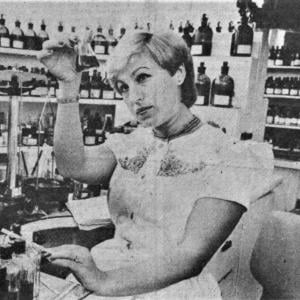
Antonina Vitkovskaya
Antonina Vitkovskaya was a prominent Soviet and Latvian perfumer, best known for her long tenure at the Dzintars perfume factory in Riga. Her olfactory style balanced bold, floral compositions with subtle woody and amber undertones, creating accessible yet sophisticated fragrances. She created numerous iconic Dzintars scents, including Allegro (1981) and Briga (1982), which became beloved staples in Eastern Europe.
Fragrance Notes
Top Notes
First impression · 15-30 min
 Aldehydes
 Violet
 Lily-of-the-Valley
 Lemon
Lemon
 Bergamot
Heart Notes
Core character · 2-4 hours
 Coriander
 Rose
Rose
 Iris
Iris
 Patchouli
 Ylang-Ylang
 Carnation
 Vetiver
Base Notes
Lasting impression · 4+ hours
 Sweet Notes
 Fruity Notes
 Musk
Musk
Dialogs (диалог) Dzintars by Dzintars offers a distinctive olfactory experience that stands out from other fragrances in its category.
Crafted with the finest ingredients and a blend of traditional and modern perfumery techniques, this fragrance represents the pinnacle of the perfumer's art.
Dialogs (диалог) Dzintars embodies the distinctive style of Dzintars while adding a unique chapter to their fragrance portfolio.
Character Profile
The Lover Archetype: Portrait of Dialogs (диалог) Dzintars
Essence
To wear Dialogs Dzintars is to embrace a fragrance that is both delicate and assertive-floral yet grounded, soft but with an undercurrent of quiet intensity. The person who chooses this scent is drawn to the interplay of contrasts, much like the archetype that defines them: The Lover.
The Lover is not merely a romantic in the conventional sense, but a seeker of deep connection-to people, to beauty, to the sensual and emotional layers of existence. They do not merely experience life; they savor it. Their philosophy is one of immersion-whether in art, conversation, or the ephemeral pleasures of touch, scent, and sound.
Style & Aesthetic
Their taste is refined but never ostentatious. They prefer subtle elegance over loud statements, favoring textures that invite touch-soft wool, silk, well-worn leather. Their wardrobe is curated with an intuitive sense of harmony, blending vintage and contemporary pieces in a way that feels personal rather than trend-driven.
Colors are muted but warm: deep burgundies, forest greens, the soft haze of twilight blues. They appreciate craftsmanship-handmade ceramics, the weight of a well-bound book, the faint imperfections of something made by human hands. Their home is a sanctuary, filled with objects that carry meaning: a dried flower pressed between pages, a candle burned down to its last inch, a record collection that tells the story of their emotional evolution.
They are drawn to careers that allow them to engage with beauty and human connection-art curation, psychology, writing, perfumery itself. Their work is not just a job but an extension of their identity.
Their daily rituals are sacred: morning tea sipped slowly, the deliberate choice of a scent to match their mood, evening walks where they absorb the world like a sponge. They are not hurried people; they understand that depth requires time.
Philosophy & Values
For them, life is not a problem to be solved but a mystery to be explored. They reject rigid dogma, instead embracing ambiguity and the richness of paradox. Their morality is rooted in empathy-they believe in the sacredness of feeling, in the idea that understanding another’s pain is the highest form of intelligence.
Yet this sensitivity is both their gift and their burden. They are acutely aware of the fragility of human connection, and this awareness can make them hesitant-afraid of disrupting harmony, of causing pain, of being misunderstood. They value loyalty deeply but may struggle with boundaries, sometimes absorbing others’ emotions to the point of exhaustion.
Relationships
To be loved by them is to be seen in full color-they have an uncanny ability to notice the details others miss: the slight tremor in a voice, the way someone’s hands move when they’re nervous, the unspoken longing behind a casual remark. They are the confidant, the keeper of secrets, the one who listens not just to respond but to understand.
Romantically, they are passionate but not possessive. They crave depth, not control. Their love is a slow burn rather than a wildfire-they prefer the quiet intensity of a shared glance over grand gestures. Yet their shadow emerges in their fear of abandonment; they may cling to fading relationships, mistaking endurance for devotion.
Shadow
The Lover’s greatest weakness is their reluctance to let go. Their idealism can blind them to toxicity; they may romanticize suffering, believing that if they love deeply enough, they can heal what is broken-in others, in themselves, in the world. This can lead to self-neglect, as they pour their energy into others while their own needs go unmet.
At their worst, they may become melancholic, mourning lost connections like a poet mourning a vanished era. They must learn that love is not only about holding on-it is also about release.
Conclusion
The lover of Dialogs Dzintars is a soul who walks the line between dream and reality, between passion and restraint. They are not naive-they know the world is flawed-but they choose to focus on what is luminous. Their life is a quiet rebellion against cynicism, a testament to the belief that beauty, in all its forms, is worth pursuing.
Yet they must remember: to love the world deeply, they must first love themselves without condition. Only then can their devotion become not a chain, but a liberation.
Similar Fragrances
Fragrances with a comparable profile - shared accords, notes, and character.

BDK Parfums
French Bouquet Bdk Parfums
Shared accords: aldehydic, aromatic, fresh

Lancôme
La Vie Est Belle En Rose Lancôme
Shared accords: floral, fresh, fruity

Les Parfums de Rosine
Roseberry Les Parfums De Rosine
Shared accords: aldehydic, aromatic, floral

Natori
Natori Natori
Shared accords: aldehydic, floral, fresh

O Boticário
Elysée Nuit O Boticário
Shared accords: aromatic, floral, fresh