
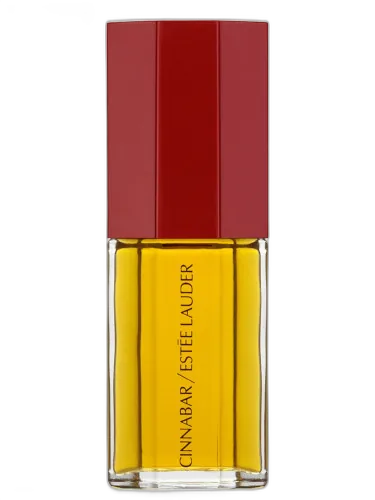
Cinnabar Estée Lauder
Fragrance Story
Cinnabar by Estée Lauder is a Oriental Spicy fragrance for women. Cinnabar was launched in 1978. Cinnabar was created by Bernard Chant and Josephine Catapano. Top notes are Spices, Cloves, Tangerine, Peach, Orange Blossom and Bergamot; middle notes are Cinnamon, Carnation, Ylang-Ylang, Jasmine, Lily, Rose and Lily-of-the-Valley; base notes are Incense, Tolu Balsam, Amber, Benzoin, Sandalwood, Patchouli, Vanilla and Vetiver.
Composition Profile
About the Perfumer

Bernard Chant
Bernard Chant is a renowned perfumer known for iconic creations such as Aramis, Devin, Gold, and Jhl for Aramis, as well as Aromatics Elixir for Clinique, Imprevu for Coty, and Aliage for Estée Lauder. His work also includes Antonia's Flowers for Antonia's Flowers. Chant's style is marked by bold, complex compositions that have become classics in modern perfumery.
Fragrance Notes
Top Notes
First impression · 15-30 min
 Spices
 Cloves
 Tangerine
 Peach
Peach
 Orange Blossom
 Bergamot
Heart Notes
Core character · 2-4 hours
 Cinnamon
 Carnation
 Ylang-Ylang
 Jasmine
 Lily
Lily
 Rose
Rose
 Lily-of-the-Valley
Base Notes
Lasting impression · 4+ hours
 Incense
 Tolu Balsam
 Amber
Amber
 Benzoin
 Sandalwood
 Patchouli
 Vanilla
 Vetiver
Cinnabar Estée Lauder by Estée Lauder offers a distinctive olfactory experience that stands out from other fragrances in its category.
Crafted with the finest ingredients and a blend of traditional and modern perfumery techniques, this fragrance represents the pinnacle of the perfumer's art.
Cinnabar Estée Lauder embodies the distinctive style of Estée Lauder while adding a unique chapter to their fragrance portfolio.
Character Profile
The Alchemist Archetype: Portrait of Cinnabar Estée Lauder
Essence
Cinnabar by Estée Lauder is not a fragrance for the timid. It is rich, warm, and unapologetically bold-a blend of spices, amber, and incense that lingers like an ancient incantation. The person who chooses this scent is drawn to its depth, its mystery, its suggestion of transformation. They are not content with the ephemeral or the superficial; they seek the alchemy of experience, the slow burn of meaning.
This is a person ruled by the Alchemist archetype-the seeker who transmutes the base materials of life into something greater. Like the medieval mystics who pursued the philosopher’s stone, they are driven by a need to refine, to perfect, to uncover hidden truths. Their world is one of symbols, layers, and slow revelations. They do not merely live; they distill.
Style & Aesthetic
Their presence is deliberate. They favor textures that tell a story-heavy silks, aged leather, the patina of well-worn brass. Their home is a sanctuary of dark woods, deep reds, and flickering candlelight, a space that feels both sacred and secret. They collect rare books, antique talismans, and objects that carry the weight of history.
In art, they are drawn to the baroque, the ornate, the decadent-Caravaggio’s chiaroscuro, the poetry of Rilke, the operas of Wagner. They do not shy away from intensity; they court it. Their taste in music leans toward the symphonic, the hypnotic-something that demands surrender rather than casual listening.
Philosophy & Values
They believe in the unseen architecture of existence-that beneath the surface of things, there are patterns, correspondences, hidden meanings. They are not religious in a conventional sense, but they are deeply spiritual, treating life as a ritual. Time, for them, is not linear but cyclical; they see echoes of the past in the present, and they search for omens in the mundane.
Their morality is not rigid but fluid, shaped by experience rather than dogma. They value wisdom over virtue, depth over purity. They are drawn to paradoxes-the idea that one must lose oneself to be found, that destruction can be a form of creation.
Relationships
They do not love lightly. Their relationships are intense, forged in the fires of shared secrets and mutual transformation. They seek partners who are equally unafraid of darkness, who understand that love is not always gentle-sometimes it is a crucible.
Yet, their depth can be isolating. They struggle with those who prefer the shallows, who shy away from the shadows they so willingly explore. Their friendships are few but profound, built on unspoken understandings rather than casual camaraderie. They are the confidant, the keeper of secrets-but they, too, need someone who can hold their own darkness without flinching.
Shadow
The Alchemist’s brilliance has its cost. Their pursuit of meaning can tip into obsession-an endless refining that never satisfies. They may become lost in their own labyrinth, mistaking solitude for wisdom, isolation for enlightenment.
At their worst, they grow disdainful of those who do not share their depth, dismissing simpler joys as trivial. Their introspection can curdle into self-absorption, their love of mystery into a refusal to engage with the tangible world. They must remember that alchemy is not just about turning lead into gold-it is also about learning to touch the earth.
They are neither saint nor cynic, but a seeker suspended between the two. Their strength lies in their ability to see beyond surfaces, to find beauty in decay, meaning in chaos. Their flaw is the temptation to withdraw too far, to mistake the map for the territory.
Yet, when balanced, they are a force of quiet transformation-a reminder that life is not just to be lived, but to be deciphered. They are the ones who leave traces of incense in the air long after they have left the room, whose presence lingers like a half-remembered dream.
In the end, they are not just wearing Cinnabar-they are living it.
Similar Fragrances
Fragrances with a comparable profile - shared accords, notes, and character.

The Dua Brand
Forbidden 1 The Dua Brand
Shared accords: amber, balsamic, cinnamon

biehl parfumkunstwerke
Al02 Biehl Parfumkunstwerke
Shared accords: amber, balsamic, cinnamon

Yves Saint Laurent
24 Rue De L'université Yves Saint Laurent
Shared accords: amber, balsamic, powdery

Fueguia 1833
El Mono De La Tinta Fueguia 1833
Shared accords: amber, balsamic, cinnamon

La Closerie des Parfums
Oud Cannelle La Closerie Des Parfums
Shared accords: amber, balsamic, cinnamon