
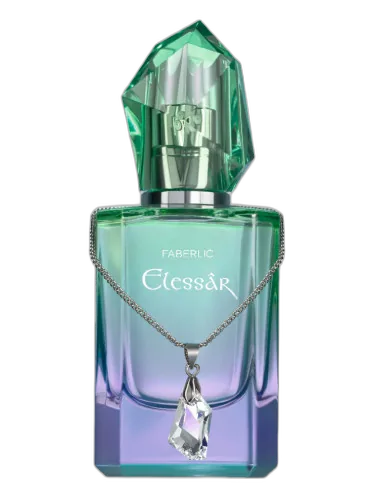

Elessâr Faberlic
Fragrance Story
Elessâr by Faberlic is a Floral Green fragrance for women. Elessâr was launched in 2020. The nose behind this fragrance is Thomas Fontaine. Top notes are Water Notes, Grapefruit and Bergamot; middle notes are Water Lily, Clover, Peony and Gentiana; base notes are White Musk, White Cedar Extract and Sandalwood.
Composition Profile
About the Perfumer

Thomas Fontaine
Thomas Fontaine is a perfumer who has created Jasmine Yang for Anima Vinci, Cafe-cafe for Cafe Parfums, and several scents for Comptoir Sud Pacifique including Coeur D'ylang, Lime Tropical, Rhum & Tabac, and Yucatán Secret. He also composed Debut for Etienne Aigner and No 7 for Eutopie. Fontaine's work often features exotic and tropical notes, as well as gourmand and floral accords.
Fragrance Notes
Top Notes
First impression · 15-30 min
 Water Notes
 Grapefruit
 Bergamot
Heart Notes
Core character · 2-4 hours
 Water Lily
 Clover
 Peony
Gentiana
Peony
Gentiana
Base Notes
Lasting impression · 4+ hours
White Musk
White Cedar Extract
 Sandalwood
Elessâr Faberlic by Faberlic offers a distinctive olfactory experience that stands out from other fragrances in its category.
Crafted with the finest ingredients and a blend of traditional and modern perfumery techniques, this fragrance represents the pinnacle of the perfumer's art.
Elessâr Faberlic embodies the distinctive style of Faberlic while adding a unique chapter to their fragrance portfolio.
Character Profile
The Seeker Archetype: Portrait of Elessâr Faberlic
Essence
Elessâr by Faberlic is a fragrance that balances freshness with depth-citrus and green notes mingle with woody undertones, suggesting both vitality and introspection. It is neither heavy nor frivolous, neither entirely conventional nor rebellious. The person who chooses this scent is drawn to its duality: it is bright enough to signal openness, yet grounded enough to hint at mystery. They are not one for extremes; they seek equilibrium, but their search is restless.
Style & Aesthetic
Their aesthetic mirrors their psyche: layered, evolving, resistant to easy categorization. They favor clothing that is understated but intentional-natural fabrics, earthy tones, perhaps a single striking detail (a vintage watch, an heirloom ring) that suggests depth beneath simplicity. They appreciate craftsmanship but disdain ostentation.
In art and music, they gravitate toward works that reward patience-films with ambiguous endings, novels that demand rereading, albums that reveal new textures with each listen. They are drawn to the impressionistic, the suggestive, the things that cannot be fully grasped. Yet this same preference can make them impatient with the straightforward, the unadorned, the uncomplicated joys that others take for granted.
Their life is a mosaic of exploration and ritual. They may keep a journal, practice yoga or meditation, or have a rotating list of hobbies-each abandoned once mastered, not out of fickleness but because the thrill lies in the learning, not the repetition. They thrive in environments that allow for both solitude and stimulation: a quiet café, a forest trail, a city street at dawn.
Work must engage their intellect, but it need not define them. They resist being pigeonholed by career, seeing themselves as more than their profession. Yet this resistance can manifest as restlessness-a reluctance to commit to mastery, a habit of moving on before reaching their full potential.
Philosophy & Values
They believe in growth, not as a vague ideal but as a necessity. Their philosophy is one of becoming-they see themselves as unfinished, always refining, always questioning. Tradition holds little sway unless it proves its worth; they respect wisdom but distrust dogma. Their values are fluid, shaped by experience rather than inherited doctrine. They prize authenticity, though they sometimes mistake novelty for depth.
Freedom is sacred to them, but not in the anarchic sense. They seek the kind of freedom that comes from self-mastery-the ability to choose one’s path without being enslaved by impulse or convention. Yet this very ideal can become a burden, as their relentless pursuit of "more" sometimes obscures the value of what they already have.
Relationships
They are engaging conversationalists, skilled at drawing out others’ thoughts while revealing just enough of their own to maintain intrigue. Friends value them for their insight and their willingness to entertain unconventional ideas. Yet their relationships often exist in a state of gentle tension-they crave connection but fear confinement.
Romantically, they are drawn to partners who mirror their own complexity. They disdain superficiality but may mistake emotional turbulence for depth. Their shadow emerges here: they can be inconsistent, retreating just as intimacy deepens, fearing that commitment will dull their sense of possibility. They must learn that true freedom is not the absence of bonds but the ability to choose them consciously.
Shadow
The Seeker’s greatest strength-their refusal to settle-is also their greatest peril. When unbalanced, their quest becomes a form of evasion. They mistake motion for progress, novelty for growth. They may grow cynical, dismissing what they cannot immediately understand, or become paralyzed by the weight of endless choice.
Their shadow whispers that they are never quite where they should be, that fulfillment lies just beyond the next horizon. But the true challenge is not to keep searching-it is to recognize when they have found something worth staying for.
Conclusion
The person who wears Elessâr Faberlic is neither entirely at peace nor in turmoil. They are in motion, always refining, always questioning. Their life is an experiment, their identity a work in progress. They are the Seeker-not lost, but not yet found. And perhaps that is exactly where they need to be.
Similar Fragrances
Fragrances with a comparable profile - shared accords, notes, and character.

Faberlic
Elessâr Faberlic
Shared accords: aquatic, citrus, floral

By Far
Daydream Of A Splash By Far
Shared accords: aquatic, citrus, floral

Ormonde Jayne
Sampaquita Ormonde Jayne
Shared accords: aquatic, citrus, floral

Donna Karan
Dkny Women Summer 2014 Donna Karan
Shared accords: aquatic, citrus, floral

Teo Cabanel
Très French Teo Cabanel
Shared accords: aquatic, floral, fresh