
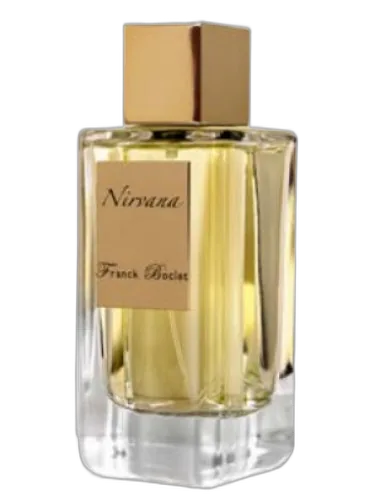

Nirvana Franck Boclet
At a glance
Is Nirvana Franck Boclet worth trying?
Nirvana by Franck Boclet is a Oriental fragrance for women.
- Best match
- Casual wear in Summer
- Performance feel
- Good longevity with Moderate sillage
- Signature profile
- woody, fruity, citrus with Basil, Bergamot, Lemon
The first impression
Nirvana by Franck Boclet is a Oriental fragrance for women. Nirvana was launched in 2021. The nose behind this fragrance is Bruno Herve. Top notes are Basil, Bergamot, Lemon and Orange; middle notes are Mango, Grapefruit, Dried Plum, Plum and Jasmine; base notes are Cedar, Sandalwood, Benzoin, Amber, Patchouli, Musk and Civet.
What shapes the scent
The perfumer behind it

Bruno Herve
Bruno Herve has created fragrances for Franck Boclet, including Addiction, Be My Wife, Blue Moon, Cafe, Crime, Enjoy, Flowers, and Icon. His style often incorporates gourmand and oriental notes with a modern twist. Herve's scents are designed to be both evocative and wearable, appealing to a broad audience.
Notes pyramid
Top Notes
First impression · 15-30 min
 Basil
Basil
 Bergamot
 Lemon
Lemon
 Orange
Heart Notes
Core character · 2-4 hours
 Mango
Mango
 Grapefruit
 Dried Plum
 Plum
Plum
 Jasmine
Base Notes
Lasting impression · 4+ hours
 Cedar
Cedar
 Sandalwood
 Benzoin
 Amber
Amber
 Patchouli
 Musk
Musk
 Civet
Civet
The mood it creates
The Lover Archetype: Portrait of Nirvana Franck Boclet
Essence
The one who chooses Nirvana Franck Boclet is governed by the Aesthete, a refined variation of the Lover archetype. This is a soul who seeks beauty not as mere ornament but as the very essence of existence. The Aesthete does not merely enjoy pleasure-they demand that life itself be a carefully composed symphony of sensation, meaning, and form. Their fragrance, with its deep woody warmth, subtle spice, and velvety vanilla, is not an accessory but an extension of their being-a whispered manifesto of their philosophy.
Philosophy & Values
To the Aesthete, beauty is not frivolity but a discipline. They believe that how one engages with the sensory world is a measure of one’s depth. A poorly set table is not just an oversight-it is a failure of reverence. They are drawn to philosophies that elevate the sensual as sacred, from the Japanese concept of wabi-sabi to the decadent musings of Baudelaire.
Yet theirs is not a passive appreciation. They are creators of atmosphere, architects of mood. They understand that the right scent, the right texture, the right silence can alter the course of an evening, a relationship, a life. They do not merely exist-they compose.
Relationships
In love, they are neither reckless nor cold but intentional. They do not give their affection freely, for to do so would be to cheapen it. Instead, they offer it as one might present a rare wine-only to those who will truly savor it. Their relationships are marked by intensity, not in the sense of melodrama, but in the depth of presence they demand.
They are not possessive lovers, but they are particular. A partner who fails to appreciate the nuance of their world will soon find themselves outside of it. Yet when they find a kindred spirit-one who understands the weight of a glance, the significance of a shared silence-their devotion is unwavering.
Shadow
But the Aesthete is not without their demons. Their pursuit of beauty can become a prison. When the world fails to meet their standards-when the wine is corked, the conversation dull, the lover clumsy-they risk retreating into disdain. Their discernment can curdle into snobbery, their refinement into rigidity.
Worse still, they may grow so enamored with the idea of beauty that they forget to live within it. They become the curator of a museum they no longer visit, preserving moments rather than experiencing them. The very sensitivity that makes them extraordinary can render them brittle, unable to endure the messiness of real life.
Conclusion
Their world is one of deliberate curation. They do not merely wear clothes; they inhabit them, favoring fabrics that drape with quiet elegance-cashmere that whispers against the skin, linen that breathes with the seasons. Their home is an altar to tactile and visual harmony: a mid-century chair placed just so, a single art book left open on a table like an invitation. They are drawn to the interplay of shadow and light, the way a candle flickers against aged brass, the slow unfurling of a vinyl record’s crackle before the music begins.
They do not chase trends but rather the timeless-those rare objects and experiences that transcend the ephemeral. A well-worn leather-bound book, a perfectly balanced Negroni, the scent of rain on cobblestones-these are their sacraments. Their taste is not ostentatious but considered, each choice a reflection of an inner dialogue between desire and discernment.
If you like this, try these
Fragrances with a comparable profile - shared accords, notes, and character.

Avon
Soneto De Fidelidade Avon
Shared top notes: bergamot, lemon

O Boticário
Capricho Vintage O Boticário
Shared top notes: bergamot, lemon

Alain Delon
Lyra Alain Delon
Shared top notes: bergamot, lemon

Momiji
Angel's Tea Momiji
Shared top notes: bergamot, lemon, orange

Guru Scent
Alkimia Donna Guru Scent
Shared top notes: bergamot, lemon, orange