
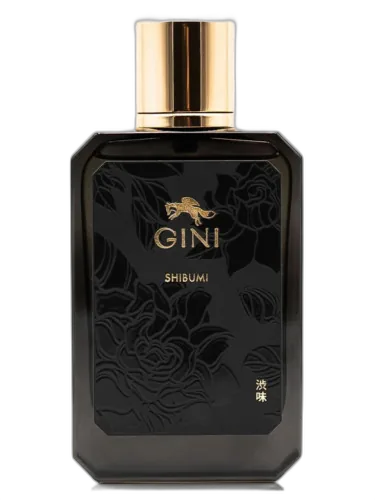

Shibumi Gini Parfum
At a glance
Is Shibumi Gini Parfum worth trying?
Shibumi by Gini Parfum is a fragrance for women and men.
- Best match
- Casual wear in Spring
- Performance feel
- Good longevity with Moderate sillage
- Signature profile
- floral, white floral, fruity with Nashi Pear, Mirabelle Plum, Yellow Mandarin
The first impression
Shibumi by Gini Parfum is a fragrance for women and men. Shibumi was launched in 2021. Top notes are Nashi Pear, Mirabelle Plum, Yellow Mandarin and Pink Grapefruit; middle notes are Gardenia, Magnolia, Freesia and Peony; base notes are Bamboo, Matcha Tea, Sandalwood and Precious Woods.
What shapes the scent
The perfumer behind it

Gini Parfum
Gini Parfum creates evocative fragrances that capture emotions and moments through scent. Their Ivre De Vie and Shibumi highlight a balance between vibrant energy and serene sophistication. The brand emphasizes storytelling through carefully curated accords that feel both personal and universal. Gini Parfum's offerings appeal to those who appreciate nuanced, mood-driven compositions.
Notes pyramid
Top Notes
First impression · 15-30 min
 Nashi Pear
 Mirabelle Plum
Yellow Mandarin
Pink Grapefruit
Mirabelle Plum
Yellow Mandarin
Pink Grapefruit
Heart Notes
Core character · 2-4 hours
 Gardenia
 Magnolia
 Freesia
 Peony
Peony
Base Notes
Lasting impression · 4+ hours
 Bamboo
 Matcha Tea
 Sandalwood
Precious Woods
Sandalwood
Precious Woods
The mood it creates
The Sage Archetype: Portrait of Shibumi Gini Parfum
Essence
The person who gravitates toward Shibumi Gini Parfum is, above all, a seeker of refinement-not in the ostentatious sense, but in the quiet mastery of subtlety. This fragrance, with its blend of citrus, woods, and delicate florals, speaks to an individual who values depth over dazzle, wisdom over noise. They embody the Sage archetype, one of Jung’s fundamental patterns of the psyche-the thinker, the observer, the one who distills life into its most essential truths.
This is not the scholar lost in dusty tomes, nor the aloof intellectual who disdains the world. Rather, they are the modern philosopher, the aesthete who understands that true sophistication lies in restraint. Their life is an exercise in discernment, a continuous refinement of perception.
Style & Aesthetic
Their tastes are deliberate, never accidental. In art, they prefer the understated elegance of Japanese wabi-sabi or the muted tones of Scandinavian minimalism. They might admire the precise brushstrokes of a Zen ink painting more than the chaotic splendor of a Baroque masterpiece. Music is likely to be ambient, jazz, or classical compositions that reward attentive listening-nothing garish, nothing disposable.
Their personal style mirrors this ethos: well-tailored but never flashy, favoring natural fabrics, muted colors, and timeless cuts. They do not follow trends; they curate a wardrobe that reflects permanence. Even their home is a sanctuary of order-sparse but meaningful, each object chosen with intention.
Their days are structured but not rigid. Mornings might begin with meditation or a slow cup of meticulously brewed tea. Work is something they approach with discipline-whether they are an architect, a writer, a scientist, or a designer, they excel in fields that reward precision and depth.
Leisure is equally intentional. They might hike in solitude, absorbing the silence of nature, or lose themselves in a book that challenges their assumptions. They are not prone to excess; even their indulgences-a fine whiskey, a rare vinyl record-are savored, not consumed.
Philosophy & Values
For them, wisdom is not merely knowledge but the ability to see through illusions. They value clarity, precision, and intellectual honesty. Their philosophy leans toward stoicism or Zen, embracing the idea that true freedom comes from detachment-not from cold indifference, but from understanding impermanence.
They are skeptical of dogma, whether religious, political, or cultural. Their morality is self-defined, rooted in reason rather than tradition. Yet they are not nihilists; they believe in meaning, but only that which is earned through introspection.
Relationships
They do not suffer fools gladly, but neither are they cruel in their dismissals. Their friendships are few but profound, built on mutual respect and intellectual exchange. Small talk bores them; they prefer conversations that dissect ideas, that explore the hidden layers beneath the surface.
Romantically, they are drawn to partners who are equally self-possessed, who do not demand constant validation. Their love is quiet but deep, expressed more through actions than grand gestures. They may struggle with emotional vulnerability, not out of fear, but because they see excessive sentiment as a form of dishonesty.
Shadow
Yet, for all their wisdom, the Sage is not without flaws. Their relentless pursuit of objectivity can make them emotionally distant, even to those who love them. They may mistake cynicism for insight, dismissing passion as naivety. At their worst, they become the recluse, the critic who observes life but does not fully participate in it.
Their greatest challenge is to balance intellect with warmth, to recognize that wisdom without humanity is sterile. If they fail, they risk becoming the cold observer, the one who understands everything but feels nothing.
Conclusion
Shibumi Gini Parfum suits them because it is a fragrance that does not shout but lingers-a scent for those who know that true power lies in subtlety. They are the quiet philosophers of the modern age, the ones who remind us that depth is not found in volume but in the spaces between words, in the silence after the storm.
They are not perfect, nor do they seek to be. But in their pursuit of refinement-of mind, of spirit, of being-they offer a rare kind of beauty: one that is earned, not inherited. And that, perhaps, is the most profound elegance of all.
If you like this, try these
Fragrances with a comparable profile - shared accords, notes, and character.

Adolfo Dominguez
Agua Fresca De Gardenia Musk Adolfo Dominguez
Shared heart notes: freesia, gardenia, magnolia

Grès
Madame Gres Grès
Shared heart notes: freesia, magnolia, peony

Bath & Body Works
Forever Sunshine Bath & Body Works
Shared heart notes: freesia, gardenia, peony

Elizabeth Arden
5th Avenue Nyc Love Elizabeth Arden
Shared heart notes: freesia, gardenia, peony

Tufi Duek
Forum Classic Jeans Tufi Duek
Shared heart notes: freesia, gardenia, peony