
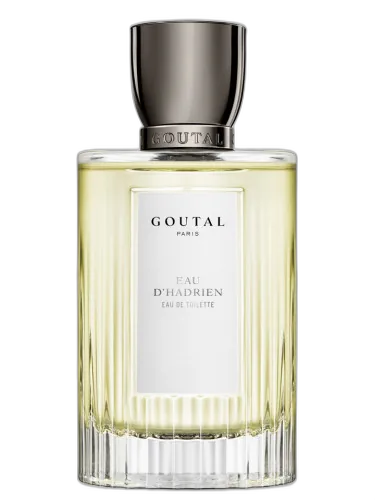

Bois D'hadrien Goutal
Fragrance Story
Bois d'Hadrien by Goutal is a Woody Aromatic fragrance for women and men. Bois d'Hadrien was launched in 2017. The nose behind this fragrance is Camille Goutal.
Composition Profile
About the Perfumer

Camille Goutal
Camille Goutal is a perfumer associated with the Goutal brand, continuing its legacy of artistic fragrances. She has created notable scents such as Ambre Fétiche, Bois D'hadrien, and La Violette. Her work often emphasizes natural floral and amber notes with a refined sensibility.
Fragrance Notes
All Notes
Complete scent profile
 Pine
Pine
 Lime
Lime
 Cypress
 Woody Notes
 Fir
Fir
 Spicy Notes
 Ivy
Ivy
Bois D'hadrien Goutal by Goutal offers a distinctive olfactory experience that stands out from other fragrances in its category.
Crafted with the finest ingredients and a blend of traditional and modern perfumery techniques, this fragrance represents the pinnacle of the perfumer's art.
Bois D'hadrien Goutal embodies the distinctive style of Goutal while adding a unique chapter to their fragrance portfolio.
Character Profile
The Lover Archetype: Portrait of Bois D'hadrien Goutal
Essence
The one who chooses Bois D’Hadrien by Goutal is drawn to the scent of sun-warmed cypress, the crispness of citrus, and the quiet, mineral stillness of stone. This fragrance evokes an atmosphere of clarity, of sunlight filtering through ancient groves-a scent for those who seek wisdom in simplicity. The dominant archetype here is The Sage, the seeker of truth, the observer who finds meaning in the interplay of nature and intellect.
The Sage is not merely a scholar but a wanderer of thought, one who values insight over dogma, who prefers the whisper of the wind to the clamor of crowds. They are not content with superficial answers; they crave depth, nuance, the quiet revelations that come from contemplation. Yet, like all archetypes, The Sage has a shadow-a tendency toward detachment, an over-reliance on reason that can leave the heart unmoored.
Relationships
They are not the type to surround themselves with many, but those they keep close are bound by shared depth rather than mere familiarity. Their friendships are built on mutual respect for silence, for the unspoken understanding that some truths are too vast for words. In love, they are cautious, not out of fear but out of reverence-they know that true connection requires patience, that the soul must be met slowly, like dawn breaking over a landscape.
Yet here lies the shadow: their love of solitude can become isolation. Their pursuit of wisdom may harden into a kind of emotional austerity, a reluctance to surrender to the messiness of human need. They may rationalize their detachment, telling themselves that they are above the turbulence of passion-but in doing so, they risk becoming spectators of their own lives.
Shadow
The Sage’s greatest strength-their ability to see clearly-can also be their undoing. When wisdom turns to cynicism, when observation becomes a shield against vulnerability, they drift into the realm of the Hermit, cut off from the warmth of human imperfection. They may dismiss sentiment as weakness, mistake detachment for enlightenment.
But the scent of Bois D’Hadrien carries a reminder: wisdom is not found in cold detachment, but in the balance between thought and feeling. The cypress does not resist the wind; it bends, it endures. The stone does not refuse the sun; it absorbs its warmth. The true Sage knows that to live deeply is to embrace both light and shadow-not just to observe the world, but to be part of it.
Conclusion
Their tastes are deliberate, never ostentatious. They prefer the understated elegance of linen and raw silk, the muted tones of sand and slate. Their home is a sanctuary of clean lines, uncluttered spaces, perhaps a single piece of driftwood or a well-worn book left open on a table. They are drawn to art that suggests rather than declares-Japanese ink paintings, the poetry of Rilke, the sparse compositions of Arvo Pärt.
Philosophy is not an abstraction for them but a lived experience. They might find solace in Stoicism, in the idea that wisdom lies in accepting what cannot be changed. Or perhaps they are drawn to Zen, to the notion that enlightenment is found in the ordinary-the scent of rain on dry earth, the weight of a teacup in the hand. They do not preach; they observe.
Similar Fragrances
Fragrances with a comparable profile - shared accords, notes, and character.

Burberry
Burberry Summer 2013 Burberry
Shared accords: aromatic, citrus, fresh spicy

Nissaba
Chaco Nissaba
Shared accords: aromatic, citrus, fresh spicy

A Wing & A Prayer Perfumes
Gemini A Wing & A Prayer Perfumes
Shared accords: aromatic, citrus, conifer

DS&Durga
Freetrapper Ds&durga
Shared accords: aromatic, citrus, conifer

Tempus Vitae
Élixir De Vie Tempus Vitae
Shared accords: aromatic, citrus, conifer