
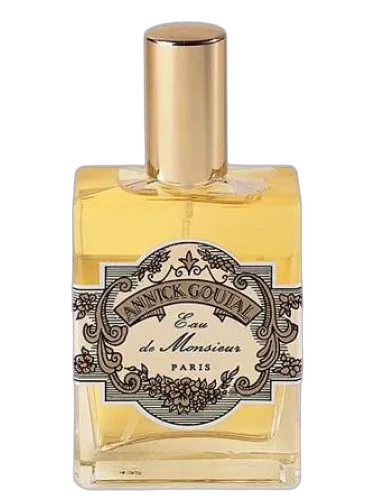

Eau De Monsieur Goutal
At a glance
Is Eau De Monsieur Goutal worth trying?
Eau de Monsieur by Goutal is a Woody Chypre fragrance for women and men.
- Best match
- Evening wear in Fall
- Performance feel
- Good longevity with Moderate sillage
- Signature profile
- mossy, citrus, woody with Oakmoss, Lemon, Amber
The first impression
Eau de Monsieur by Goutal is a Woody Chypre fragrance for women and men. Eau de Monsieur was launched in 1981. The nose behind this fragrance is Annick Goutal.
What shapes the scent
The perfumer behind it

Annick Goutal
Annick Goutal began her career as a pianist and model before founding her eponymous perfume house in 1981, where she worked closely with her daughter Camille Goutal. Known for a natural, luminous style, her compositions often highlight a single note, as seen in the citrusy Eau d'Hadrien and the fresh, floral Eau de Camille. Her creations, including the romantic Ce Soir Ou Jamais and the gentle Eau de Charlotte, are celebrated for their elegant simplicity and emotional resonance, establishing a legacy of intimate, artisanal perfumery.
Notes pyramid
Top Notes
First impression · 15-30 min
 Oakmoss
 Lemon
Lemon
 Amber
Amber
 Sandalwood
 Immortelle
Heart Notes
Core character · 2-4 hours
 Geranium
Base Notes
Lasting impression · 4+ hours
Sandalwood
 Patchouli
The mood it creates
The Lover Archetype: Portrait of Eau De Monsieur Goutal
Essence
The one who favors Eau De Monsieur Goutal is ruled by the Aesthete-an archetype that embodies refinement, sensuality, and an almost religious devotion to beauty. This is not mere vanity, but a philosophy: life must be lived as art. The Aesthete seeks harmony in all things-scent, form, texture, thought. They are drawn to the subtle, the layered, the understated yet profound. Eau De Monsieur Goutal, with its blend of citrus, spice, and woody depth, is their olfactory manifesto: elegant, complex, never loud but impossible to ignore.
Style & Aesthetic
Their world is curated with precision. They wear tailored but never ostentatious clothing-linen that drapes just so, cashmere that whispers against the skin. Their home is an altar to muted luxury: aged leather, dark wood, a single perfect orchid in a ceramic vase. They read poetry, not for sentimentality, but for the way words can be sculpted. Music is Debussy or Erik Satie-structured yet fluid, like water over stone.
Food is an experience, never mere sustenance. They savor the bitterness of an espresso, the slow burn of a well-aged whiskey. They do not chase trends; they cultivate timelessness.
Their days are structured, not by obligation, but by ritual. Mornings begin with slow deliberation-a shave with a silver razor, the deliberate choice of a tie. Evenings are for contemplation: a book by lamplight, a record spinning in the background. They travel not to check landmarks off a list, but to absorb the essence of a place-the scent of a Parisian bakery at dawn, the hush of a Kyoto temple.
Yet this very discipline can become decadence. When taken to extremes, their life becomes a performance-even for themselves. They may forget to live, too preoccupied with how things ought to be.
Philosophy & Values
For them, beauty is not superficial-it is the highest form of truth. They believe that how one lives, what one surrounds oneself with, is a reflection of the soul. They disdain vulgarity, not out of snobbery, but because excess is a kind of violence against harmony. Their morality is aesthetic: cruelty is ugly, kindness is elegant.
Yet this devotion to beauty can become a cage. They may dismiss what is raw, unpolished, or chaotic-even if it is genuine. The imperfect, the unrefined, can unsettle them, revealing a hidden rigidity beneath their grace.
Relationships
They do not love carelessly. Relationships are like fine wine-chosen with discernment, allowed to breathe, appreciated in layers. They are drawn to those who possess depth, mystery, a quiet intensity. Their love is not possessive; it is reverent. They adore with their senses-the curve of a lover’s neck, the timbre of a voice, the way light falls across a face at dusk.
But here, the shadow emerges. Their pursuit of the ideal can make them impatient with human frailty. A partner’s flaws, once charming, may later feel like blemishes on a perfect canvas. They may withdraw rather than endure messiness, leaving others feeling like discarded sketches.
Shadow
The Aesthete’s greatest danger is their own exacting standards. What begins as appreciation can curdle into intolerance-for others, for themselves. They may grow brittle, fearing any disruption to their carefully composed world. The scent they love, Eau De Monsieur Goutal, is balanced-citrus brightening the dark woods. But if they lose that balance, they risk becoming cold, detached, more connoisseur than human.
Yet in their best moments, they remind us that life need not be coarse to be real. Beauty, in their hands, is not escape-it is a way of being fully present. They teach that elegance is not the absence of depth, but its highest expression.
In the end, they are like their favorite fragrance: complex, lingering, impossible to reduce to simple notes. They are a question posed in scent-How should one live?-and their life is the answer, unfolding one deliberate breath at a time.
If you like this, try these
Fragrances with a comparable profile - shared accords, notes, and character.

LaBron
Oakmoss & Sandalwood Intense Labron
Shared top notes: lemon
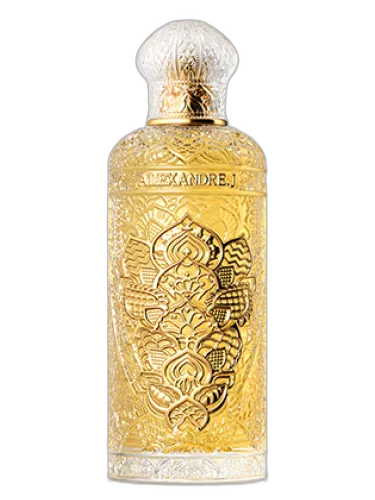
Alexandre.J
Ode To Rose Alexandre.j
Shared heart notes: geranium

Água de Cheiro
Ávidus Água De Cheiro
Shared heart notes: geranium
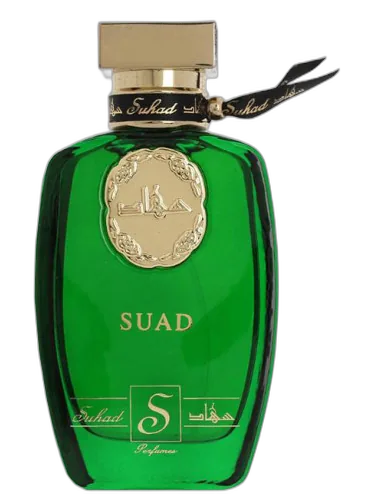
Suhad Perfumes
Suad Suhad Perfumes
Shared heart notes: geranium
Vanessa Somerset Design
Lemon Vanessa Somerset Design
Shared top notes: lemon