
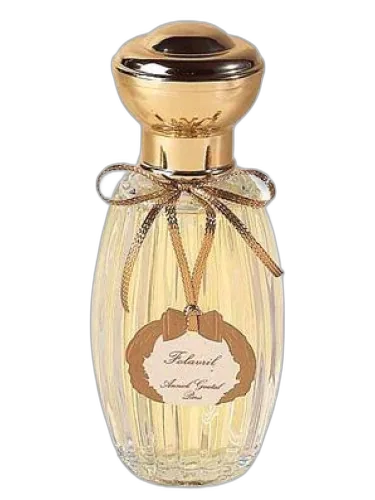

Folavril Goutal
At a glance
Is Folavril Goutal worth trying?
Folavril by Goutal is a Floral Aldehyde fragrance for women.
- Best match
- Casual wear in Spring
- Performance feel
- Moderate longevity with Moderate sillage
- Signature profile
- floral, aromatic, tropical with Tomato Leaf, Mango, Exotic floral notes
The first impression
Folavril by Goutal is a Floral Aldehyde fragrance for women. Folavril was launched in 1981. The nose behind this fragrance is Annick Goutal.
What shapes the scent
The perfumer behind it

Annick Goutal
Annick Goutal began her career as a pianist and model before founding her eponymous perfume house in 1981, where she worked closely with her daughter Camille Goutal. Known for a natural, luminous style, her compositions often highlight a single note, as seen in the citrusy Eau d'Hadrien and the fresh, floral Eau de Camille. Her creations, including the romantic Ce Soir Ou Jamais and the gentle Eau de Charlotte, are celebrated for their elegant simplicity and emotional resonance, establishing a legacy of intimate, artisanal perfumery.
Notes pyramid
All Notes
Complete scent profile
 Tomato Leaf
 Mango
Mango
 Exotic floral notes
 Boronia
 Jasmine
The mood it creates
The Lover Archetype: Portrait of Folavril Goutal
Essence
The person who cherishes Folavril by Annick Goutal is, above all, an Aesthete-one who finds profound meaning in sensory refinement. This archetype is not merely drawn to beauty but seeks to embody it, to live within its delicate tension between ephemerality and permanence. The Aesthete is attuned to the whispers of elegance, the quiet grace of things that do not shout but instead linger in the mind like a half-remembered dream.
Folavril, with its green, dewy freshness-hints of ivy, hyacinth, and a whisper of citrus-reflects a soul who values purity, subtlety, and the poetry of restraint. Unlike those who gravitate toward bold, opulent fragrances, this individual finds power in understatement. Their love for this scent is not an accident but a declaration: I do not need to overwhelm to be remembered.
Relationships
They do not surround themselves with many, but the few they keep close are bound by shared depth. Superficial charm repels them; they seek conversations that unfold like the layers of their favorite fragrance-slowly, revealing complexity with time. Their romantic relationships are intense but never possessive; they love with an almost artistic detachment, valuing freedom as much as intimacy.
Yet, this very refinement can become a barrier. Their standards, both for themselves and others, are exacting. They may dismiss people too quickly for lacking taste-a flaw disguised as discernment.
Shadow
The Aesthete’s greatest weakness is their potential to slip into elitism, mistaking personal preference for universal truth. They may grow impatient with those who do not share their sensibilities, dismissing them as crude or unworthy. This is the shadow that lurks beneath their polished exterior-a quiet arrogance, a belief that beauty belongs only to those who understand it.
At their worst, they become prisoners of their own refinement, so afraid of vulgarity that they avoid raw, unfiltered life. They may hesitate to take risks, fearing that failure would be ugly.
Yet, when self-aware, the Aesthete is a rare force-one who reminds others that life is not merely to be lived but to be felt. They teach that restraint can be as powerful as excess, that silence can speak louder than noise. Their flaw-their occasional disdain for the unrefined-is also their strength: an unwillingness to settle for mediocrity.
They are not for everyone. But for those who recognize their depth, they are a reminder that beauty, in its truest form, is not decoration but a way of being.
Conclusion
Their tastes are curated with precision-not in the sterile manner of a collector, but with the instinct of one who understands that beauty is felt before it is understood. Their home is likely filled with natural light, uncluttered but not austere, where every object has been chosen for its quiet resonance. They prefer linen over silk, matte over gloss, the muted over the garish.
In philosophy, they are drawn to thinkers who balance intellect with sensuality-Nietzsche’s "Become who you are" resonates, but so does Keats’ "Beauty is truth, truth beauty." They do not see these as contradictions. For them, wisdom and aesthetics are intertwined; one refines the other.
If you like this, try these
Fragrances with a comparable profile - shared accords, notes, and character.

Soki London
Aphrodite Soki London
Shared top notes: mango

Héritage Berbère
Hb Femme 03 Héritage Berbère
Shared top notes: jasmine

DIEM
Love Tangle Diem
Shared top notes: jasmine

Nicolai Parfumeur Createur
L’eau Corail Nicolai Parfumeur Createur
Shared top notes: mango

Heretic Parfum
Dirty Jasmine Heretic Parfum
Shared top notes: jasmine