
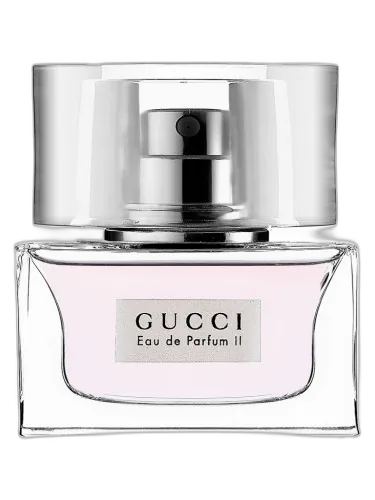

Gucci Eau De Parfum Ii Gucci
At a glance
Is Gucci Eau De Parfum Ii Gucci worth trying?
Gucci Eau de Parfum II by Gucci is a Floral Fruity fragrance for women.
- Best match
- Casual, Office wear in Spring, Summer
- Performance feel
- Moderate longevity with Moderate sillage
- Signature profile
- fruity, woody, floral with Black Currant, Red Berries, Cassia
The first impression
Gucci Eau de Parfum II by Gucci is a Floral Fruity fragrance for women. Gucci Eau de Parfum II was launched in 2004. Gucci Eau de Parfum II was created by Antoine Maisondieu and Daniela Andrier. Top notes are Black Currant, Red Berries, Cassia, Bitter Orange and Mandarin Orange; middle notes are Blackberry, Peony, Violet, Freesia, Jasmine and Lily-of-the-Valley; base notes are Cedar, Musk and Heliotrope.
What shapes the scent
The perfumer behind it

Antoine Maisondieu
Antoine Maisondieu is a French perfumer and a senior vice president at Givaudan, where he has worked for decades. He is known for creating refined, modern compositions that balance natural elegance with subtle complexity. His work includes the woody, leathery Bottega Veneta Pour Homme and the fresh, floral Acqua di Parma Magnolia Nobile.
Notes pyramid
Top Notes
First impression · 15-30 min
 Black Currant
 Red Berries
 Cassia
 Bitter Orange
 Mandarin Orange
Heart Notes
Core character · 2-4 hours
 Blackberry
 Peony
Peony
 Violet
 Freesia
 Jasmine
 Lily-of-the-Valley
Base Notes
Lasting impression · 4+ hours
 Cedar
Cedar
 Musk
Musk
 Heliotrope
The mood it creates
The Lover Archetype: Portrait of Gucci Eau De Parfum Ii Gucci
Essence
At the core of this person’s being lies the Lover archetype, a force that governs their pursuit of beauty, sensuality, and deep emotional connection. The Lover is not merely about romance-it is about the intoxication of existence itself, the way textures, scents, and experiences can be woven into a tapestry of meaning. Gucci Eau de Parfum II, with its delicate blend of violet, peach, and sandalwood, is the olfactory manifestation of this archetype: soft yet enduring, elegant yet passionate.
This person does not merely wear fragrance-they embody it. The scent is an extension of their aura, a whispered invitation to step into their world, where aesthetics and emotion are inseparable.
Relationships
They do not love lightly. Their relationships are intense, immersive, sometimes overwhelming. They seek partners who understand that love is not just an emotion but an art form-one that requires patience, attention, and a willingness to dissolve into the moment. Their presence is magnetic; people are drawn to them like moths to a flame, sensing an unspoken promise of depth.
Yet, this very intensity can become their undoing. They are prone to idealization, constructing fantasies around people who may not deserve such devotion. When reality fails to match their vision, disillusionment cuts deep. Their shadow emerges-a tendency toward melancholy, a fear of abandonment that can make them cling too tightly or withdraw entirely.
Shadow
For all their grace, they are not immune to vanity. The Lover’s shadow is the Prisoner of Beauty, one who mistakes aesthetic perfection for inner worth. They may fall into the trap of measuring their value by external admiration, fearing the day their allure fades. In darker moments, they might manipulate their charm to control others, trading sincerity for seduction.
There is also a quiet loneliness beneath the surface. Their pursuit of the exquisite can isolate them-few can sustain the level of emotional and sensory engagement they crave. They may drift through relationships like a ghost, always searching, never quite satisfied.
Conclusion
Their tastes are curated with an almost instinctual precision. They are drawn to textures that beg to be touched-cashmere that drapes like liquid, silk that whispers against the skin. Their wardrobe is an exercise in restraint and allure, favoring muted tones that shimmer under the right light, garments that move with the body rather than constrain it. They appreciate art that evokes rather than declares, music that lingers in the air like smoke-Chopin nocturnes, the haunting melodies of Cocteau Twins.
Philosophically, they reject the notion that life must be harsh to be meaningful. Instead, they believe in the sacredness of pleasure-not as indulgence, but as a form of intelligence. A well-set table, the perfect glass of wine, the quiet thrill of a shared glance-these are not frivolities but the essence of a life well-lived.
If you like this, try these
Fragrances with a comparable profile - shared accords, notes, and character.

Love2Love
Freesia + Violet Petals Love2love
Shared heart notes: freesia, violet
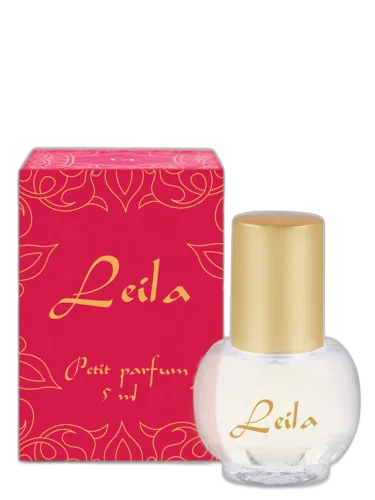
CIEL Parfum
Leila Ciel Parfum
Shared top notes: bitter orange, mandarin orange

Oriflame
Blue Sapphire Oriflame
Shared heart notes: violet
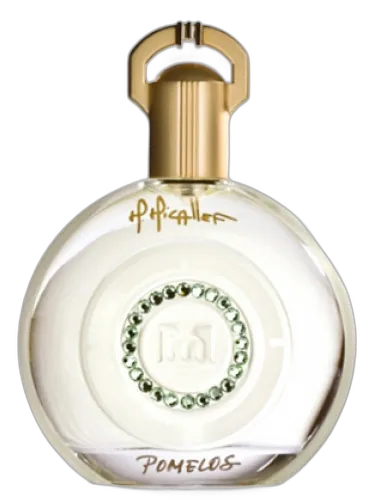
M. Micallef
Pomelos No 21 M. Micallef
Shared top notes: mandarin orange

Natura
Amis <3 Natura
Shared top notes: mandarin orange