
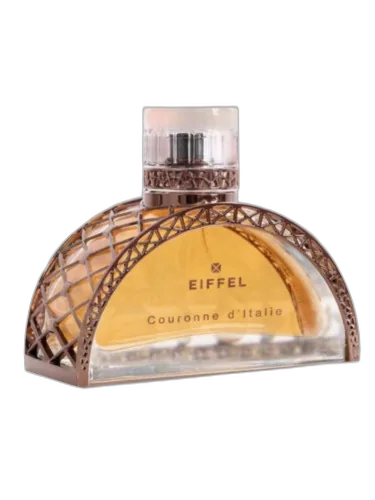

Couronne D'italie Gustave Eiffel
Fragrance Story
Couronne d'Italie by Gustave Eiffel is a fragrance for women and men. Couronne d'Italie was launched in 2019. The nose behind this fragrance is Bruno Herve. Top notes are Grapefruit, Lemon and Orange; middle notes are Green Apple, Tomato Leaf, Rhubarb, Gardenia and Jasmine Orchid; base notes are Vanilla, Cedar and White Musk.
Composition Profile
About the Perfumer

Bruno Herve
Bruno Herve has created fragrances for Franck Boclet, including Addiction, Be My Wife, Blue Moon, Cafe, Crime, Enjoy, Flowers, and Icon. His style often incorporates gourmand and oriental notes with a modern twist. Herve's scents are designed to be both evocative and wearable, appealing to a broad audience.
Fragrance Notes
Top Notes
First impression · 15-30 min
 Grapefruit
 Lemon
Lemon
 Orange
Heart Notes
Core character · 2-4 hours
 Green Apple
 Tomato Leaf
 Rhubarb
 Gardenia
 Jasmine Orchid
Base Notes
Lasting impression · 4+ hours
 Vanilla
 Cedar
White Musk
Cedar
White Musk
Couronne D'italie Gustave Eiffel by Gustave Eiffel offers a distinctive olfactory experience that stands out from other fragrances in its category.
Crafted with the finest ingredients and a blend of traditional and modern perfumery techniques, this fragrance represents the pinnacle of the perfumer's art.
Couronne D'italie Gustave Eiffel embodies the distinctive style of Gustave Eiffel while adding a unique chapter to their fragrance portfolio.
Character Profile
The Couronne D Archetype: Portrait of Couronne D'italie Gustave Eiffel
Essence
This person is most closely aligned with the Creator archetype-a visionary who shapes reality according to their will. Like Gustave Eiffel, whose iron latticework defied gravity, they are drawn to structure, innovation, and beauty that transcends the mundane. The fragrance itself-bold, intricate, and layered-mirrors their essence: a blend of classical elegance and modern audacity.
They do not merely consume the world; they seek to remake it. Their mind is a workshop of ideas, their life a carefully composed symphony of aesthetics and intellect. Yet, like all Creators, they walk the fine line between genius and obsession, between crafting a masterpiece and becoming lost in their own design.
Style & Aesthetic
Their tastes are neither opulent nor austere, but deliberate. They favor clean lines, muted luxury, and objects that whisper rather than shout. Their wardrobe is a curated archive of timeless pieces-tailored blazers, structured dresses, perhaps a vintage watch with visible mechanics. They appreciate craftsmanship, the kind that reveals itself subtly, like the slow unfurling of Couronne D’Italie’s notes: bergamot giving way to leather, spice melting into amber.
In art, they are drawn to the intersection of precision and passion-Baroque architecture, Bauhaus minimalism, the controlled chaos of a Cy Twombly canvas. Music is either meticulously composed (Bach, Debussy) or rebelliously structured (post-punk, avant-garde jazz). They do not indulge in the frivolous; every choice is a statement, a brick in the edifice of their identity.
Their home is a sanctuary of balance-spare but warm, modern but imbued with history. A steel-framed bookshelf holds leather-bound classics; a single orchid rests on a reclaimed wood desk. They thrive in cities where past and future collide-Paris, Tokyo, Berlin-places where tradition is not preserved but reinvented.
Professionally, they are drawn to fields where form meets function: architecture, design, engineering, or even strategic roles in business. They excel when given the freedom to build, but they chafe under bureaucracy that stifles innovation.
Philosophy & Values
For them, life is not about finding meaning but imposing it. They reject fatalism; they believe in the power of human ingenuity to carve order from chaos. Their guiding principle is intentionality-nothing should exist without purpose, nothing should be left to chance.
Yet this conviction has its shadow. They may disdain spontaneity, viewing it as a surrender to disorder. They might grow impatient with those who "drift" through life, seeing lack of direction as a moral failing. Their love of structure can harden into rigidity, their pursuit of perfection into intolerance for flaws-in others and themselves.
Relationships
They do not collect people; they select them. Their inner circle is small, composed of those who stimulate their intellect or reflect their ideals. Romantic partners must be more than lovers-they must be collaborators, co-architects of a shared vision.
But intimacy, for them, is a double-edged sword. They crave depth yet fear vulnerability, preferring the safety of controlled connections. They may intellectualize emotions, analyzing love as though it were a blueprint rather than a living thing. Their shadow emerges when their need for order stifles the raw, messy beauty of human connection.
Shadow
The Creator’s greatest strength is also their weakness: the compulsion to control. When unbalanced, they become the tyrant of their own existence, suffocating under the weight of their expectations. They may grow frustrated with imperfection, dismissing anything that falls short of their vision.
Their relationships may suffer from emotional detachment, their creativity may stagnate under self-imposed rules. The shadow whispers that if they cannot shape something flawlessly, it is worthless-a lie that can isolate them from life’s unpredictable richness.
Conclusion
To evolve, they must learn that not everything must be built-some things must simply be. The scent they wear, after all, is not engineered by them; it is a gift, an art they receive rather than construct. True mastery lies not just in creation but in appreciation, not just in control but in the wisdom to sometimes let go.
They are at their best when they balance the architect and the poet-when their love of form is tempered by an openness to the formless. Then, like Couronne D’Italie itself, they become something rare: a harmony of strength and subtlety, a testament to the beauty of both structure and soul.
Similar Fragrances
Fragrances with a comparable profile - shared accords, notes, and character.
Gustave Eiffel
Couronne D'italie Gustave Eiffel
Shared accords: aromatic, citrus, fresh

Donna Karan
Dkny Be Delicious Charmingly Delicious Donna Karan
Shared accords: aromatic, citrus, fresh

Wolf Brothers
Wisent Wolf Brothers
Shared accords: citrus, fresh, fresh spicy

Trussardi
Trussardi A Way For Him Trussardi
Shared accords: aromatic, citrus, fresh

Avon
Be... Joyful Avon
Shared accords: aromatic, citrus, fresh