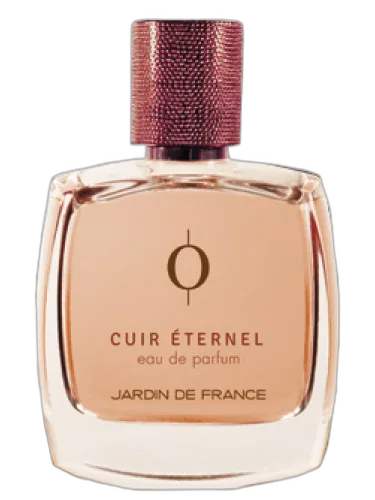

Cuir Eternel Jardin De France
At a glance
Is Cuir Eternel Jardin De France worth trying?
Cuir Eternel by Jardin de France is a Leather fragrance for women and men.
- Best match
- Evening wear in Fall
- Performance feel
- Very Good longevity with Strong sillage
- Signature profile
- woody, leather, oud with Jasmine Sambac, Neroli, Russian Leather
The first impression
Cuir Eternel by Jardin de France is a Leather fragrance for women and men. Cuir Eternel was launched in 2016. The nose behind this fragrance is Justine Brivet. Top notes are Jasmine Sambac and Neroli; middle notes are Russian Leather, Cypriol Oil or Nagarmotha and Saffron; base notes are Laotian Oud, Guaiac Wood and Madagascar Vanilla.
What shapes the scent
The perfumer behind it

Justine Brivet
Justine Brivet is a French perfumer known for her work with Jardin de France. Her creations for the brand include Air Elemental, Bois Premier, Cuir Eternel, Damona Eau Divine, Feu Primitif, Gaia Eau Mythique, Metal Absolu, and Osiris Eau Eternelle. Her style often explores elemental and mythological themes through balanced compositions.
Notes pyramid
Top Notes
First impression · 15-30 min
 Jasmine Sambac
 Neroli
Heart Notes
Core character · 2-4 hours
Russian Leather
 Cypriol Oil or Nagarmotha
 Saffron
Base Notes
Lasting impression · 4+ hours
 Laotian Oud
 Guaiac Wood
Madagascar Vanilla
Guaiac Wood
Madagascar Vanilla
The mood it creates
The Wanderer Archetype: Portrait of Cuir Eternel Jardin De France
Essence
The one who wears Cuir Eternel is not bound by convention, nor do they seek the comfort of the familiar. Their soul is restless, driven by an insatiable curiosity-a modern-day Ulysses, though their odyssey unfolds in the quiet corners of existence rather than on stormy seas. The Explorer archetype defines them, for they are forever in search of the unseen, the untasted, the undiscovered. Leather, smoke, and spice are not mere notes in a fragrance; they are echoes of their spirit-raw, untamed, and resistant to decay.
They do not merely walk through life; they traverse it with intention, each step a silent rebellion against stagnation. Yet, like all archetypes, the Explorer has its shadow-the rootless wanderer who fears commitment, the seeker who never finds, the adventurer who mistakes motion for meaning.
Style & Aesthetic
Their tastes are an intricate dance between refinement and primal instinct. They may favor well-worn leather jackets, vintage books, and the dim glow of candlelight in an otherwise minimalist room. Their wardrobe is a study in contrasts-tailored yet undone, elegant yet slightly disheveled, as if they have just returned from someplace far more interesting.
In art, they are drawn to the works of symbolists and surrealists-Gustav Klimt’s golden decadence, the haunting dreamscapes of Leonora Carrington. Music is not mere background noise but a sacred ritual-perhaps the melancholic strings of Arvo Pärt or the raw growl of Nick Cave. They do not consume; they commune.
Yet beneath this cultivated exterior lies an impatience with the mundane. They may dismiss anything too polished, too predictable, as beneath them-a flaw that can render them dismissive of simpler joys.
Their home is a curated sanctuary, a place where order and disorder exist in deliberate tension. A single candle burns beside a stack of unfinished books; a perfectly made bed is offset by a closet in disarray. They thrive in cities with history-Paris, Prague, Istanbul-but may also retreat to remote cabins, seeking solitude to recalibrate.
Professionally, they are often drawn to fields that allow for reinvention-journalism, photography, academia, or the arts. Routine is their enemy; they would rather struggle as a freelancer than suffocate in a cubicle.
Philosophy & Values
They do not believe in destiny, only in the unfolding of experience. Truth, for them, is not found in dogma but in the unvarnished moments of life-the scent of rain on cobblestones, the weight of silence in an empty cathedral, the fleeting intensity of a stranger’s gaze. They reject hollow optimism, preferring instead the stark beauty of reality, even when it wounds.
Their values are rooted in autonomy. They despise coercion, whether from institutions or interpersonal expectations. Freedom is their creed, but this can make them elusive-lovers, friends, and even family may find them slipping away when the air grows too thick with obligation.
Relationships
They love deeply but fleetingly. Their relationships are intense, marked by a rare vulnerability that makes others feel chosen-until the moment they feel the walls closing in. They are drawn to those who mirror their own complexity: the poet with a sharp tongue, the musician with a haunted past, the philosopher who speaks in riddles.
Yet their fear of confinement can make them cruel in subtle ways-ghosting without explanation, withholding affection when they sense dependency. They mistake independence for invulnerability, forgetting that even the wildest rivers must sometimes flow into the sea.
Shadow
For all their brilliance, the Explorer’s greatest weakness is their inability to stay. They mistake movement for growth, believing that if they stand still too long, they will fossilize. This can lead to a life of perpetual dissatisfaction, where no achievement is enough, no love deep enough to anchor them.
Their shadow is the Wanderer Who Forgot the Way Home-a soul so afraid of being caged that they forget the value of roots. The leather of Cuir Eternel may age beautifully, but they themselves may resist the patina of time, forever chasing the next horizon.
Conclusion
To wear Cuir Eternel is to embrace the paradox of permanence and transience. The Explorer lives in the tension between the desire to be rooted and the terror of being trapped. Their life is not a straight path but a spiral-always circling deeper, never quite arriving.
Perhaps, in the end, their greatest lesson is this: that the search itself is the destination, and the only eternity worth pursuing is the one they create in the spaces between their wanderings.
If you like this, try these
Fragrances with a comparable profile - shared accords, notes, and character.