
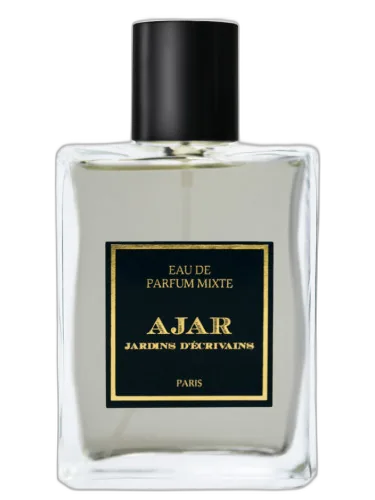

Ajar Jardins D’ecrivains
Fragrance Story
Ajar by Jardins d’Ecrivains is a Oriental Floral fragrance for women and men. Ajar was launched in 2017. The nose behind this fragrance is Anais Biguine. Top notes are Pear and Bergamot; middle notes are Orchid and Jasmine; base notes are Sandalwood, Oakmoss and Incense.
Composition Profile
About the Perfumer

Anais Biguine
Anais Biguine is a French perfumer known for her work with independent niche houses such as Chapel Factory, Gri Gri Parfums, and Jardins d’Ecrivains. Her style often blends raw, smoky, or incense-like accords with unexpected gourmand or floral touches, as seen in creations like Chapel Factory’s Baptisma and Gri Gri Parfums’ Moko Maori. She is recognized for crafting evocative, narrative-driven scents that balance darkness with subtle sweetness.
Fragrance Notes
Top Notes
First impression · 15-30 min
 Pear
Pear
 Bergamot
Heart Notes
Core character · 2-4 hours
 Orchid
 Jasmine
Base Notes
Lasting impression · 4+ hours
 Sandalwood
 Oakmoss
 Incense
Character Profile
The Lover Archetype: Portrait of Ajar Jardins D’ecrivains
Essence
This person is a modern embodiment of the Sage, the seeker of truth and meaning, whose mind is a labyrinth of ideas and whose soul is nourished by beauty in its most refined forms. The Sage does not merely consume knowledge-they distill it, turning observation into wisdom, and wisdom into art. Ajar Jardins D’écrivains, a fragrance that evokes ink, paper, and the quiet intensity of a writer’s solitude, is their olfactory manifesto. It is a scent for those who dwell in the liminal space between thought and expression, between the world as it is and the world as they imagine it could be.
Philosophy & Values
They believe in the sanctity of ideas, in the power of language to shape reality. Truth is not something to be possessed but pursued-an endless dialogue between the self and the world. They are skeptical of dogma, of easy answers, of the tyranny of the majority. Their morality is not rigid but fluid, shaped by empathy and curiosity rather than tradition.
Yet this devotion to the life of the mind is not without its costs. They can become lost in abstraction, mistaking contemplation for action. They may disdain the mundane, the practical, the everyday concerns that sustain human life. Their idealism can harden into a kind of elitism-a quiet contempt for those who do not share their intellectual passions.
Relationships
They are not gregarious, but neither are they entirely solitary. Their relationships are few but deep, built on shared intellectual and emotional resonance. They do not suffer fools gladly, and their standards for companionship are exacting. Romantic partners must be both muse and equal-someone who can match their wit, challenge their assumptions, and endure their occasional retreats into silence.
Yet their shadow lurks here as well. Their love of solitude can become isolation. Their fear of banality may make them emotionally withholding, as if vulnerability is a weakness rather than a necessity. They may idealize love in the abstract while struggling with its messy, imperfect reality.
Shadow
The Sage’s greatest strength-their intellect-can also be their undoing. When wisdom becomes a fortress rather than a bridge, they risk becoming the Hermit, cut off from the warmth of human connection. Their pursuit of truth can turn into paralysis, an endless questioning that prevents decisive action. They may grow cynical, seeing the world as too crude for their refined sensibilities.
But when balanced, they are a rare and luminous presence-a thinker who does not merely accumulate knowledge but transforms it into something alive. Their fragrance, Ajar Jardins D’écrivains, is not just a scent but a declaration: that beauty and meaning are worth pursuing, even if the pursuit is never truly finished.
They are not for everyone. But for those who recognize them, they are unforgettable.
Conclusion
Their tastes are cerebral yet sensual-they do not merely read books; they converse with them. Their shelves are lined with dog-eared volumes of philosophy, poetry, and obscure novels that most people have never heard of. They are drawn to writers like Borges, Woolf, and Pessoa, whose words shimmer with layers of meaning. Music is not background noise but an intellectual companion-perhaps the melancholic strains of Satie or the structured chaos of free jazz.
Their style is deliberate, neither ostentatious nor careless. They favor muted tones-soft grays, deep blues, the occasional black-but with subtle textures: a well-worn leather satchel, a linen scarf, a single silver ring. Their aesthetic is one of quiet distinction, as if they are always slightly removed from the present moment, observing rather than participating.
Similar Fragrances
Fragrances with a comparable profile - shared accords, notes, and character.

Rochas
Mademoiselle Rochas In Paris Rochas
Shared accords: citrus, floral, fruity

Ésika
Impredecible Mysterious Ésika
Shared accords: aquatic, citrus, floral

Celine
Celine Celine
Shared accords: aquatic, citrus, floral

L’Occitane Au Brésil
Dama Da Noite (2019) L’occitane Au Brésil
Shared accords: citrus, fruity, powdery

Cacharel
Promesse Cacharel
Shared accords: citrus, floral, fruity