
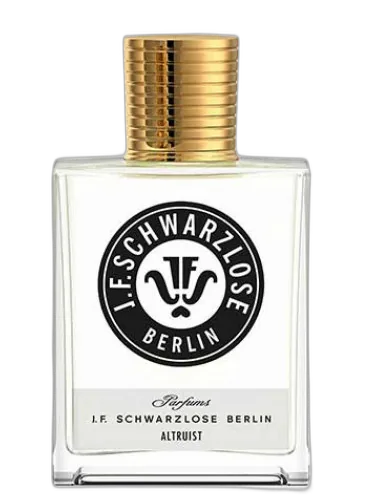

Altruist Eau De Parfum J.f. Schwarzlose Berlin
Fragrance Story
Altruist Eau de Parfum by J.F. Schwarzlose Berlin is a Chypre Floral fragrance for women and men. Altruist Eau de Parfum was launched in 2017. The nose behind this fragrance is Véronique Nyberg. Top notes are Watery Notes, Lemon, Ginger and Bergamot; middle notes are Orange Blossom, Rose, Black Pepper and Nutmeg; base notes are Ambrarome, Cedar, Vetiver and Patchouli.
Composition Profile
About the Perfumer

Véronique Nyberg
Véronique Nyberg is a French perfumer with a diverse portfolio spanning multiple brands. She has created fragrances for Armand Basi, BORNTOSTANDOUT®, Benetton, and Blumarine, among others. Her work includes Night Blue, Be My Cookie, and Mon Bouquet Blanc, showcasing versatility from gourmand to floral. Nyberg also contributed to Burdin's Les Beaux Jours and Paris Minuit.
Fragrance Notes
Top Notes
First impression · 15-30 min
 Watery Notes
 Lemon
Lemon
 Ginger
 Bergamot
Heart Notes
Core character · 2-4 hours
 Orange Blossom
 Rose
Black Pepper
Rose
Black Pepper
 Nutmeg
Base Notes
Lasting impression · 4+ hours
 Ambrarome
 Cedar
Cedar
 Vetiver
 Patchouli
Character Profile
The Caregiver Archetype: Portrait of Altruist Eau De Parfum J.f. Schwarzlose Berlin
Essence
To wear Altruist Eau de Parfum by J.F. Schwarzlose Berlin is to embody a quiet, unassuming generosity-a fragrance that does not announce itself with bravado but lingers with warmth, like the memory of a kindness. The person who chooses this scent is not one who seeks the spotlight but rather the space between people, where connection and care unfold. They are the Caregiver, an archetype rooted in compassion, service, and the deep human impulse to nurture.
Yet, like all archetypes, the Caregiver has a shadow-one that can smother as easily as it sustains, that can lose itself in the act of giving until nothing remains of the self.
Their philosophy is simple but profound: To be human is to be for others. They do not preach this; they live it. Their presence is a balm, their words measured and thoughtful, their actions deliberate. They move through life with a quiet assurance that the world can be made softer, gentler, through small, persistent acts of care.
Their tastes reflect this ethos-nothing garish, nothing excessive. They prefer understated elegance: well-worn books, linen clothing, the warmth of handcrafted ceramics over mass-produced gloss. Their home is a sanctuary, not for display but for comfort-a place where friends linger, where tea is always brewing, where the light falls just so in the late afternoon.
In relationships, they are the steady hand, the listener, the one who remembers birthdays and brings soup when you are ill. They do not demand reciprocity, but they thrive in the quiet exchange of mutual regard. Their love is not possessive; it is expansive, patient, enduring.
Shadow
Yet, the Caregiver’s greatest virtue can become their greatest weakness. Their selflessness, when unchecked, turns into self-neglect. They may pour so much into others that they forget to nourish themselves, leading to exhaustion or resentment-emotions they suppress, for they have convinced themselves that to need is to be weak.
Their empathy, so often a gift, can become a trap. They absorb the pain of others until it weighs them down, mistaking suffering for virtue. They may stay too long in relationships that drain them, believing that if they just give more, the other person will change.
And then there is the quiet tyranny of their generosity-unspoken expectations that others should appreciate them, should reciprocate. When this goes unacknowledged, bitterness can fester beneath their serene exterior.
Conclusion
Their strength lies in their ability to see need before it is spoken. They are the ones who notice the coworker who hasn’t eaten lunch, the friend who hesitates before answering "How are you?" They act without expectation, their kindness a reflex rather than a transaction.
They are deeply attuned to the emotional undercurrents of any room, a skill that makes them exceptional mediators and confidants. Their advice is never self-serving; it is practical, grounded, and often exactly what the other person needed to hear.
Their lifestyle is one of intentional simplicity. They do not chase wealth or status but derive fulfillment from meaningful work-perhaps in healing professions, education, or community-building. They are the neighbor who organizes the block party, the colleague who mentors without being asked.
Similar Fragrances
Fragrances with a comparable profile - shared accords, notes, and character.
J.F. Schwarzlose Berlin
Altruist Eau De Parfum J.f. Schwarzlose Berlin
Shared accords: amber, aquatic, aromatic

Botanique
Bleu Botanique
Shared accords: amber, aquatic, aromatic

Thera Cosméticos
Amorgos Blue Thera Cosméticos
Shared accords: amber, aromatic, balsamic

My Alchemy
Lucky Charm My Alchemy
Shared accords: amber, aromatic, balsamic

Rockford
Rockford Night Blue Rockford
Shared accords: amber, aromatic, balsamic