
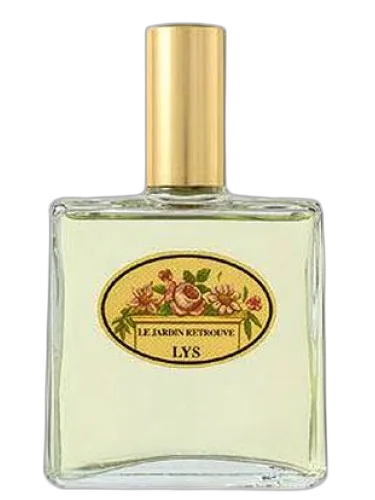

The Lys Le Jardin Retrouve
At a glance
Is The Lys Le Jardin Retrouve worth trying?
The Lys by Le Jardin Retrouve is a Floral fragrance for women and men.
- Best match
- Casual wear in Spring
- Performance feel
- Good longevity with Moderate sillage
- Signature profile
- citrus, white floral, yellow floral with Bergamot, Lily, St John's Wort
The first impression
The Lys by Le Jardin Retrouve is a Floral fragrance for women and men. The nose behind this fragrance is Yuri Gutsatz. Top note is Bergamot; middle notes are Lily and St John's Wort; base notes are Vanille and Oakmoss.
What shapes the scent
The perfumer behind it

Yuri Gutsatz
Yuri Gutsatz was a pioneering perfumer and founder of Le Jardin Retrouve, a niche house dedicated to natural and classic compositions. He trained at some of the finest perfume houses in France before establishing his own brand in 1975. His creations, such as Bois Tabac Virginia and Cuir De Russie, reflect a deep respect for traditional craftsmanship and botanical ingredients. He also contributed to Carven's Chasse Gardée, showcasing his versatility.
Notes pyramid
Top Notes
First impression · 15-30 min
 Bergamot
Heart Notes
Core character · 2-4 hours
 Lily
Lily
 St John's Wort
Base Notes
Lasting impression · 4+ hours
 Vanille
 Oakmoss
The mood it creates
The Lover Archetype: Portrait of The Lys Le Jardin Retrouve
Essence
To wear The Lys Le Jardin Retrouvé is to embrace a scent that is luminous, delicate, and unapologetically pure-a whisper of white lilies, green stems, and morning dew. This fragrance does not shout; it glows. The person who chooses it is drawn to beauty in its most unspoiled form, seeking a world where simplicity and grace still hold meaning. They are, at their core, an embodiment of the Innocent archetype-one who believes in goodness, harmony, and the possibility of an untainted existence.
Yet, as with all archetypes, the Innocent is not without its shadow. Their purity can become naivety; their idealism, a refusal to see the darker currents of life. They walk a fine line between enlightenment and escapism, between genuine serenity and a quiet denial of complexity.
Relationships
They love deeply but cautiously, for betrayal wounds them more than most. Their friendships are few but lifelong, built on mutual understanding rather than obligation. In romance, they seek a partner who shares their appreciation for quiet intimacy-someone who understands that love is not grand gestures, but the act of remembering how they take their coffee, or the way they pause to watch a butterfly.
Yet their idealism in love can be their undoing. They may cling to the belief that love should be effortless, that conflict is a sign of failure rather than growth. When reality fails to match their vision, they retreat-into solitude, into art, into the safety of their own carefully curated world.
Shadow
Their greatest strength-their unwavering belief in goodness-is also their greatest vulnerability. They struggle with cynicism, not because they embrace it, but because they fear its erosion of their inner peace. When faced with cruelty or injustice, they may turn away rather than confront it, telling themselves that negativity is "beneath them." This avoidance can harden into passivity, a refusal to engage with the messier truths of existence.
At their worst, they become fragile-not in the sense of weakness, but in the way a lily wilts at the first touch of frost. They may grow resentful of those who seem to navigate the world with more pragmatism, secretly envying the strength they lack.
For the Innocent to truly flourish, they must learn that purity is not the absence of darkness, but the courage to acknowledge it without being consumed. They must temper their idealism with wisdom, understanding that true serenity comes not from avoiding life’s storms, but from learning to stand within them without losing oneself.
When they do, they become more than just a lover of lilies-they become the gardener who tends them, knowing that even the most delicate blooms must weather the rain to grow.
Conclusion
Their tastes are refined but never ostentatious. They prefer linen over silk, unadorned ceramics over gilded decor, a sunlit room over artificial glamour. Their home is a sanctuary-minimal, airy, filled with books of poetry and pressed flowers between pages. They might collect vintage botanical prints or handcrafted pottery, not for status, but for the quiet joy of craftsmanship.
In philosophy, they lean toward the transcendental-Rilke’s letters, Thoreau’s Walden, the quiet wisdom of Zen. They believe in the sacredness of small moments: the first sip of tea, the sound of rain on leaves, the way light shifts through a window. They are not religious in a dogmatic sense, but they hold a deep, almost mystical reverence for nature.
If you like this, try these
Fragrances with a comparable profile - shared accords, notes, and character.

Adidas
Adidas Floral Dream Adidas
Shared top notes: bergamot

Creed
Jasmin Imperatrice Eugenie Creed
Shared top notes: bergamot
DSH Perfumes
Wedding Bouquet Dsh Perfumes
Shared top notes: bergamot

Possets Perfume
Landscape In Suffolk (gainsborough) Perfume Oil Possets Perfume
Shared top notes: bergamot

Nina Ricci
Capricci Nina Ricci
Shared top notes: bergamot