
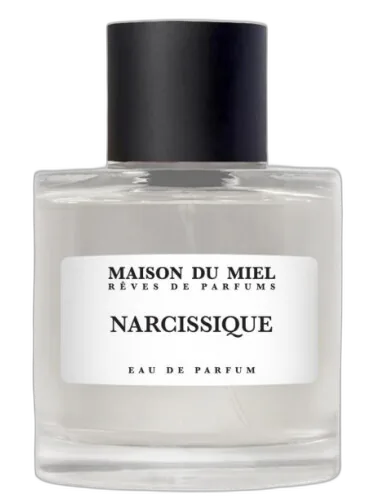

Narcissique Maison Du Miel
At a glance
Is Narcissique Maison Du Miel worth trying?
Narcissique by Maison Du Miel is a fragrance for women and men.
- Best match
- Evening wear in Fall
- Performance feel
- Good longevity with Moderate sillage
- Signature profile
- white floral, soft spicy with Cognac, Iris Pallida, Lily
The first impression
Narcissique by Maison Du Miel is a fragrance for women and men. This is a new fragrance. Narcissique was launched in 2024. Top note is Cognac; middle notes are Iris Pallida and Lily; base notes are Animal notes and White Musk.
What shapes the scent
The perfumer behind it

Notes pyramid
Top Notes
First impression · 15-30 min
 Cognac
Heart Notes
Core character · 2-4 hours
 Iris Pallida
 Lily
Lily
Base Notes
Lasting impression · 4+ hours
 Animal notes
 White Musk
The mood it creates
The Lover Archetype: Portrait of Narcissique Maison Du Miel
Essence
The one who adores Narcissique Maison Du Miel is not merely drawn to its honeyed warmth, its narcotic sweetness, or its golden decadence-they are seduced by the way it mirrors their own essence. This fragrance, rich yet delicate, opulent yet innocent, belongs to those who embody the Divine Child archetype.
The Divine Child is an eternal seeker of beauty, wonder, and pleasure, untouched by the cynicism of the world. They are not naive, but rather, they choose to see the world through a lens of enchantment. Like the honey at the heart of their beloved scent, they are both nourishing and intoxicating-a presence that draws others in with the promise of something rare and exquisite.
Yet, as with all archetypes, the Divine Child has a shadow. Their refusal to fully engage with life’s harsher truths can render them fragile, even self-indulgent. They may retreat into aestheticism when reality becomes too abrasive, or demand admiration without offering depth in return.
Philosophy & Values
Their philosophy is simple yet profound: life must be beautiful, or it is not worth living. They reject the utilitarian, the purely functional, the gray pragmatism of modern existence. For them, pleasure is not indulgence-it is a moral imperative, a way of honoring the divine spark within.
They value authenticity, but only if it is aesthetically pleasing. They have little patience for ugliness, even if it is truthful. This is both their strength and their weakness-they elevate the world with their vision, but they may turn away from anything that threatens to tarnish it.
Shadow
Beneath the golden exterior lies a vulnerability. The Divine Child fears being ordinary, fears the day when their enchantment fades and they are left with only themselves, unadorned. This fear can manifest as vanity, as a need for constant affirmation, or as a retreat into fantasy when reality disappoints.
They may also struggle with commitment, both to people and to purpose. Like Narcissus gazing into the pool, they risk becoming trapped in their own reflection, mistaking admiration for love, aesthetics for meaning.
Conclusion
Their world is one of sensual refinement. They surround themselves with objects that delight the senses-velvet drapes, antique mirrors, Persian rugs worn soft by time. Their home is a sanctuary of curated beauty, where even the smallest detail-a single bloom in a Murano glass vase, a well-worn leather-bound book-speaks of deliberate elegance.
They are drawn to art that evokes nostalgia, whether it be Renaissance paintings suffused with divine light or the melancholic melodies of Chopin. Their taste in literature leans toward the poetic-Rilke, Neruda, or the decadent prose of Oscar Wilde. They do not merely consume beauty; they absorb it, letting it shape their very being.
In relationships, they are magnetic but elusive. People are drawn to their radiance, their effortless charm, their ability to make even the mundane feel sacred. Yet they are not quick to reveal their depths. They prefer connections that are intense but fleeting-conversations that sparkle like champagne, then dissolve before they grow heavy. They love love, but they fear its weight.
If you like this, try these
Fragrances with a comparable profile - shared accords, notes, and character.

Banana Republic
Black Walnut Banana Republic
Shared top notes: cognac

Hermès
Hermessence Muguet Porcelain Hermès
Shared base notes: animal notes, white musk

Amber Oud
Snow Musk Amber Oud
Shared heart notes: lily

Arabesque Perfumes
Dion Arabesque Perfumes
Shared top notes: cognac
Nest
Amazon Lily Nest
Shared heart notes: lily