
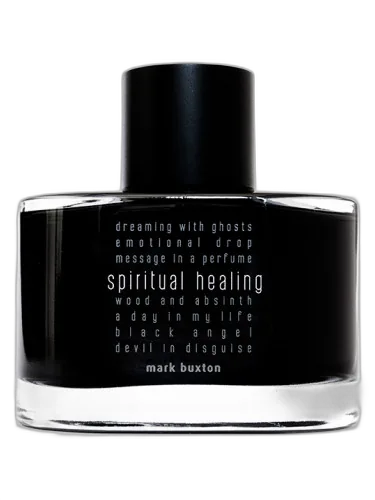

Spiritual Healing Mark Buxton
At a glance
Is Spiritual Healing Mark Buxton worth trying?
Spiritual Healing by Mark Buxton is a Oriental Floral fragrance for women and men.
- Best match
- Evening wear in Fall
- Performance feel
- Very Good longevity with Moderate sillage
- Signature profile
- floral, fruity, aromatic with Black Currant Blossom, Davana, Elderberry
The first impression
Spiritual Healing by Mark Buxton is a Oriental Floral fragrance for women and men. Spiritual Healing was launched in 2021. The nose behind this fragrance is Mark Buxton. Top notes are Black Currant Blossom and Davana; middle notes are Elderberry and Osmanthus; base notes are Castoreum and Labdanum.
What shapes the scent
The perfumer behind it

Mark Buxton
Mark Buxton is a renowned perfumer whose creations include Dead Air for .Oddity, Elixir De Bombe for 27 87, and Orchid Vanilla for 4711. His diverse portfolio spans avant-garde, woody, and floral scents for both niche and classic brands. He is celebrated for his innovative and unconventional style.
Notes pyramid
Top Notes
First impression · 15-30 min
 Black Currant Blossom
 Davana
Heart Notes
Core character · 2-4 hours
 Elderberry
 Osmanthus
Base Notes
Lasting impression · 4+ hours
 Castoreum
 Labdanum
The mood it creates
The Wanderer Archetype: Portrait of Spiritual Healing Mark Buxton
Essence
To wear Spiritual Healing by Mark Buxton is to embrace an olfactory paradox-a fragrance that is at once ethereal and grounding, meditative yet provocative. The person who chooses this scent is not merely drawn to its aromatic composition but to the philosophy it embodies: a quest for meaning beyond the material, a longing to transcend the mundane while remaining rooted in the senses.
Above all, this individual is defined by the Sage archetype, the seeker of wisdom, the one who looks beyond appearances to uncover deeper truths. The Sage does not accept dogma blindly but questions, reflects, and distills knowledge into understanding. Their life is an ongoing dialogue between the seen and the unseen, the known and the mysterious.
Yet, like all archetypes, the Sage has its shadow-the Dogmatist, the one who becomes so enamored with their own insights that they grow rigid, mistaking intellectual certainty for absolute truth. The lover of Spiritual Healing must guard against this tendency, lest their pursuit of wisdom become a prison rather than a liberation.
Style & Aesthetic
Their appearance is an extension of their philosophy-minimal yet intentional. They favor natural fabrics, muted tones, and garments that suggest depth rather than display it. There is an effortless elegance to their presence, as though they have distilled their essence into a visual language.
They may wear a single piece of jewelry with personal significance-a talisman, a stone, something that carries meaning beyond ornamentation. Their scent, Spiritual Healing, is not merely a fragrance but a statement: a declaration that beauty and transcendence are intertwined.
Their daily life reflects their inner rhythm-structured yet fluid. They may practice meditation, journaling, or some form of contemplative ritual, but they resist rigid dogma. Their home is a sanctuary, filled with books, art, and objects that inspire reflection. They are drawn to nature, finding solace in forests, mountains, or the sea-places where the boundary between self and universe feels thin.
They consume art, literature, and music that provokes thought rather than mere entertainment. They appreciate ambiguity, symbolism, and works that demand interpretation. A film like Stalker (Tarkovsky) or a novel like The Glass Bead Game (Hesse) speaks to them more than straightforward narratives.
Philosophy & Values
Their worldview is one of curiosity tempered by skepticism. They are drawn to esoteric traditions-Eastern philosophy, Jungian psychology, alchemical symbolism-but they engage with them critically, not as a disciple but as an investigator. They believe in the power of the unseen-energy, intuition, synchronicity-yet they demand evidence, not in the empirical sense, but in the resonance of experience.
They value authenticity above all, despising pretense and hollow social conventions. Their morality is not dictated by external rules but by an inner compass, one that often leads them away from the herd. They are not necessarily rebellious, but they refuse to conform for conformity’s sake.
Relationships
They are selective in their connections, preferring depth over breadth. Small talk exhausts them; they crave conversations that pierce the surface, that explore ideas, dreams, and fears. Their friendships are few but enduring, built on mutual respect and intellectual kinship.
Romantically, they seek a partner who is both a mirror and a challenge-someone who understands their need for solitude but also draws them out of their introspection. They are not possessive lovers, but they demand honesty and emotional courage. Superficial relationships wither quickly in their presence.
Shadow
For all their wisdom, they risk withdrawing too far into their own mind. Their skepticism can harden into cynicism; their love of solitude can become isolation. They may dismiss others as shallow, not realizing that depth is found in many forms.
At their worst, they become the Dogmatist of their own insights, unwilling to accept perspectives that challenge their worldview. They may grow impatient with those who do not share their intellectual fervor, forgetting that wisdom must sometimes wear a humble cloak.
Conclusion
The lover of Spiritual Healing is, at their core, an alchemist of the self-someone who seeks to transmute experience into understanding, sensation into meaning. They walk a fine line between the mystical and the rational, the solitary and the communal.
Their greatest strength is their ability to see beyond the obvious, to find the sacred in the subtle. Their greatest challenge is to remain open, to remember that wisdom is not a possession but a journey-one that must sometimes be shared to be fully realized.
In the end, they are not just wearing a fragrance; they are embodying a quest. And like all true seekers, they know that the destination is less important than the path itself.
If you like this, try these
Fragrances with a comparable profile - shared accords, notes, and character.
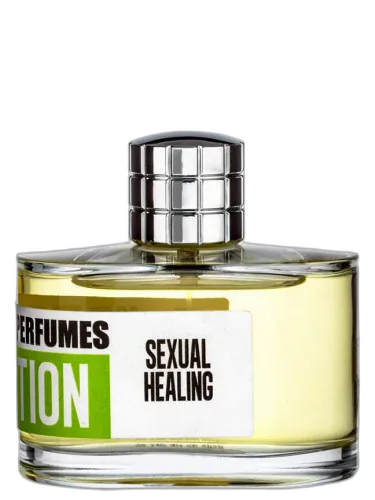
Mark Buxton
Sexual Healing Mark Buxton
Shared heart notes: osmanthus

Hugo Boss
The Collection Daring Saffiano Hugo Boss
Shared top notes: davana

DeGrhaal
Liqueur D'osmanthus Degrhaal
Shared top notes: davana

Illuminum
Wild Tobacco Illuminum
Shared base notes: castoreum, labdanum
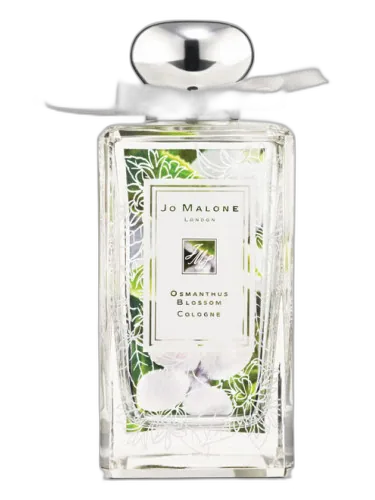
Jo Malone London
Osmanthus Blossom Jo Malone London
Shared heart notes: osmanthus