
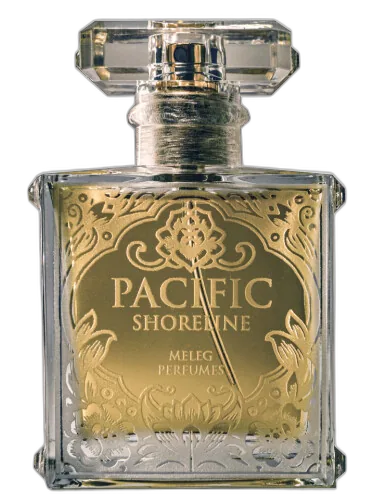

Pacific Shoreline Meleg Perfumes
At a glance
Is Pacific Shoreline Meleg Perfumes worth trying?
Pacific Shoreline by Meleg Perfumes is a Aromatic Aquatic fragrance for women and men.
- Best match
- Casual wear in Summer
- Performance feel
- Good longevity with Moderate sillage
- Signature profile
- marine, aromatic, mineral with Wintergreen, Pine Tree, Earthy Notes
The first impression
Pacific Shoreline by Meleg Perfumes is a Aromatic Aquatic fragrance for women and men. Pacific Shoreline was launched in 2021. The nose behind this fragrance is Matthew Meleg. Top notes are Wintergreen and Pine Tree; middle notes are Earthy Notes, Seaweed, Fennel and Patchouli; base notes are Salt, Mineral notes, Floralozone and Ambergris.
What shapes the scent
The perfumer behind it

Matthew Meleg
Matthew Meleg is the independent perfumer behind Meleg Perfumes, known for his bold and animalic compositions. His catalog includes Birch Tar And Russian Leather, Civet Cat Chypre, and Honey And Deer Musk, which highlight his use of rare and potent ingredients. Meleg's work often explores contrasts between darkness and sweetness, as seen in Golden Gai and Mushin Japanese Incense.
Notes pyramid
Top Notes
First impression · 15-30 min
 Wintergreen
 Pine Tree
Heart Notes
Core character · 2-4 hours
 Earthy Notes
 Seaweed
 Fennel
 Patchouli
Base Notes
Lasting impression · 4+ hours
 Salt
Salt
 Mineral notes
 Floralozone
 Ambergris
The mood it creates
The Wanderer Archetype: Portrait of Pacific Shoreline Meleg Perfumes
Essence
The one who wears Pacific Shoreline by Meleg Perfumes is, at their core, an Explorer-a restless seeker drawn to the liminal spaces where land meets water, where stability dissolves into motion. This fragrance, with its aquatic freshness, mineral depth, and whispers of driftwood and salt, mirrors their essence: a soul in flux, neither fully anchored nor entirely adrift. They are the kind of person who feels most alive when standing at the edge of something vast, where the horizon stretches beyond comprehension.
Style & Aesthetic
Their aesthetic is organic minimalism-clean lines, natural textures, a palette of sand, sea foam, and weathered wood. They favor clothes that move with them, fabrics that breathe, jewelry shaped by nature rather than artifice. Their home, if they stay in one place long enough to have one, is sparse but deliberate: a few well-chosen books, a collection of stones gathered from distant shores, a single piece of driftwood on the mantel.
They listen to music that evokes open spaces-ambient soundscapes, folk melodies with a melancholy edge, the rhythmic pulse of waves. Their taste in literature leans toward the introspective and the ephemeral: travelogues, haiku, essays on transience.
They thrive in transitional spaces-coastal towns, mountain cabins, cities with rivers running through them. They are drawn to professions that allow movement: travel writing, marine biology, photography, freelance work that keeps them untethered. Routine suffocates them; they need the irregular rhythm of tides, the unpredictability of weather.
They are early risers, drawn to the quiet hours when the world is still half-asleep. They walk barefoot whenever possible, savor the taste of salt on their lips, and find solace in the sound of rain on a tin roof.
Philosophy & Values
To them, life is not a fixed path but an unfolding journey. They reject rigid dogma, preferring instead the fluid wisdom of experience. Their philosophy is one of dynamic equilibrium-balance found in movement, not stasis. They value freedom above security, curiosity above certainty. The sea, ever-changing yet eternal, is their metaphor for existence: vast, untamed, indifferent to human concerns yet endlessly inspiring.
They are drawn to thinkers who embrace paradox-Nietzsche’s amor fati, Camus’s rebel, the Zen acceptance of impermanence. They do not seek answers so much as they seek the right questions-the kind that unsettle, that provoke, that keep the mind restless.
Relationships
They are warm but elusive, capable of deep connection yet resistant to permanence. Their friendships are intense but often transient, like ships passing in the night. They love fiercely but fear confinement-the moment a relationship begins to feel like an anchor, they grow restless.
Romantically, they are drawn to fellow wanderers, those who understand that love need not be possessive to be profound. They struggle with partners who demand predictability, who mistake their need for space as detachment. In truth, they feel deeply-perhaps too deeply-which is why they sometimes retreat.
Shadow
Their Strengths:
- Adaptability-They flow with life’s currents rather than resist them.
- Openness-They embrace the unknown with curiosity rather than fear.
- Depth-Their love of solitude grants them a rich inner world.
Their Flaws:
- Rootlessness-Their fear of stagnation can become a refusal to commit, even when it would serve them.
- Detachment-They sometimes mistake emotional distance for wisdom, leaving others feeling unmoored.
- Restlessness-Their constant seeking can become evasion, a way to avoid facing deeper wounds.
Conclusion
Beneath their wanderer’s ease lies a quiet tension: Do they travel to find something, or to escape themselves? The sea does not answer-it only whispers back in waves.
If you like this, try these
Fragrances with a comparable profile - shared accords, notes, and character.

UNTAMED
Salish Sea Untamed
Shared heart notes: seaweed
Kate Spade
Trulydazzling Kate Spade
Shared base notes: mineral notes, salt

Ranger Station
Leather + Pine Ranger Station
Shared heart notes: earthy notes

Wild Drops Parfums
Gray Forest (серый Лес) Wild Drops Parfums
Shared base notes: ambergris

Giorgio Armani
Acqua Di Giò Absolu Instinct Giorgio Armani
Shared heart notes: patchouli, seaweed