
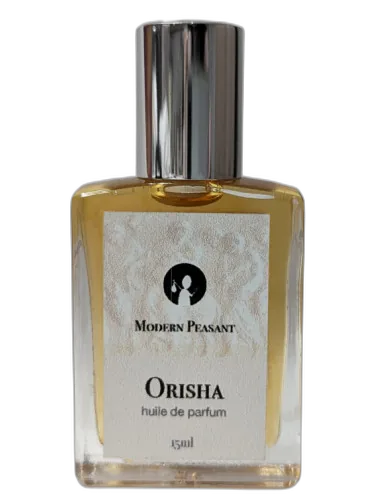

Orisha Modern Peasant
At a glance
Is Orisha Modern Peasant worth trying?
Orisha by Modern Peasant is a Oriental Vanilla fragrance for women and men.
- Best match
- Evening wear in Fall
- Performance feel
- Good longevity with Moderate sillage
- Signature profile
- amber, woody, warm spicy with Bourbon Whiskey, Labdanum, Agarwood (Oud)
The first impression
Orisha by Modern Peasant is a Oriental Vanilla fragrance for women and men. The nose behind this fragrance is Lakenda Wallace.
What shapes the scent
The perfumer behind it

Lakenda Wallace
Lakenda Wallace is a perfumer behind the Modern Peasant brand, creating fragrances such as Bossing Up, Divine Lover, and Orisha. Her scents often blend modern sophistication with earthy, natural elements, appealing to a contemporary audience. Wallace’s work is characterized by a balance of boldness and elegance, making each fragrance distinct and wearable.
Notes pyramid
All Notes
Complete scent profile
 Bourbon Whiskey
 Labdanum
 Agarwood (Oud)
 Orange
 Vanilla
 Amber
Amber
 Benzoin
 Patchouli
 Coumarin
The mood it creates
The Sage Archetype: Portrait of Orisha Modern Peasant
Essence
The one who favors Orisha Modern Peasant is most closely aligned with the Sage-a seeker of wisdom, drawn to the raw and unfiltered truths of existence. Yet this is no cloistered scholar; their wisdom is earthy, rooted in the tangible, the organic, the unpretentious. They are drawn to scents that evoke soil after rain, sun-warmed herbs, and the quiet dignity of simplicity. The Sage does not merely accumulate knowledge but distills it into lived experience, valuing authenticity over dogma.
Yet, like all archetypes, the Sage has a shadow-a tendency toward detachment, an over-reliance on intellect at the expense of emotion, and sometimes, a quiet arrogance in believing they see what others do not.
Style & Aesthetic
Their appearance is unstudied but deliberate. They favor natural fabrics-linen, wool, undyed cotton-worn with the ease of someone who does not seek admiration but refuses to be careless. Their home is a sanctuary of muted tones, handcrafted objects, and well-loved books. They surround themselves with things that have history, texture, weight.
They are drawn to art that feels alive-pottery with the marks of the maker’s hands, paintings that suggest rather than declare, music that breathes rather than blares. Their taste is not minimalist but curated, each object chosen for its resonance, not its trendiness.
They rise early, not out of discipline but because dawn feels sacred. They move through the world with quiet intention, avoiding excess but indulging in what truly nourishes-good food, strong coffee, long walks. They may keep a garden, not for show but for the ritual of tending to living things.
Work is not merely a means to an end but an extension of their values. They gravitate toward vocations that allow autonomy-writing, teaching, crafting, healing. They resist the tyranny of productivity, measuring success by depth, not speed.
Philosophy & Values
They reject the hollow glamour of modernity, yet they are no ascetic. Their philosophy is one of conscious simplicity-not deprivation, but refinement. They believe in the intelligence of nature, the wisdom of slow living, and the necessity of solitude. They are skeptical of grand ideologies, preferring the quiet authority of personal experience.
Their morality is not rigid but fluid, shaped by intuition and observation. They distrust institutions but respect tradition when it serves truth rather than dogma. They value patience, discernment, and depth-qualities rare in an age of haste.
Relationships
They are not gregarious but form deep, enduring bonds. Their friendships are few but fierce, built on mutual respect rather than convenience. They do not suffer fools, yet they are not unkind-merely unwilling to dilute their time with superficiality.
In love, they seek a partner who understands silence as well as speech, who values independence as much as intimacy. They are slow to trust but fiercely loyal once trust is earned. Their relationships are not without friction-their need for solitude can be mistaken for coldness, their honesty for harshness.
Shadow
For all their wisdom, they risk becoming too removed, too self-contained. Their love of solitude can harden into isolation; their discernment can sour into cynicism. They may mistake their own perspective for absolute truth, dismissing those who think differently as shallow or misguided.
At their worst, they grow brittle-unwilling to bend, to be vulnerable, to admit they too are still learning. The Sage must remember that wisdom without warmth is merely cleverness, and insight without compassion is just another kind of blindness.
Conclusion
The lover of Modern Peasant is neither rustic nor urban, neither radical nor conservative. They are a quiet alchemist, turning the raw materials of existence into something meaningful. Their life is an argument against the trivial, a testament to the idea that the deepest truths are often the simplest.
Yet they must guard against the arrogance of the enlightened-the belief that because they see clearly, they see all. True wisdom is knowing that even the Sage is still, and always, a student.
If you like this, try these
Fragrances with a comparable profile - shared accords, notes, and character.

Shanghai Tang
Oriental Pearl Shanghai Tang
Shared top notes: amber, benzoin, labdanum

Miyaz Perfume
Bête De Foire Miyaz Perfume
Shared top notes: amber, benzoin, vanilla
Essenzialmente Laura
Ombra Essenzialmente Laura
Shared top notes: amber, labdanum, patchouli
MONOM
Sacro Monom
Shared top notes: agarwood (oud), amber, labdanum
Fueguia 1833
Malón Fueguia 1833
Shared top notes: agarwood (oud), labdanum