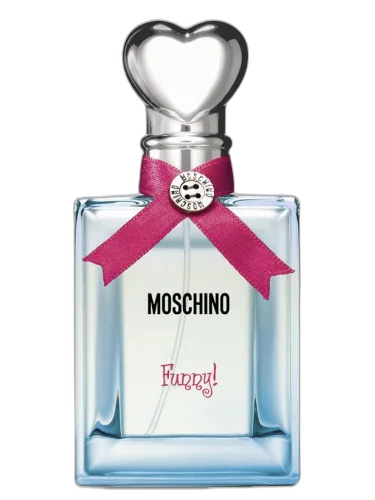
Moschino Funny! Moschino
At a glance
Is Moschino Funny! Moschino worth trying?
Moschino Funny! by Moschino is a Floral Fruity fragrance for women.
- Best match
- Casual wear in Spring
- Performance feel
- Moderate longevity with Moderate sillage
- Signature profile
- citrus, fresh, green with Bitter Orange, Red Currant, Pink Pepper
The first impression
Moschino Funny! by Moschino is a Floral Fruity fragrance for women. Moschino Funny! was launched in 2007. The nose behind this fragrance is Antoine Maisondieu. Top notes are Bitter Orange, Red Currant and Pink Pepper; middle notes are Green Tea, Peony, Jasmine and Violet; base notes are Cedar, Musk, Oakmoss and Amber.
What shapes the scent
The perfumer behind it

Antoine Maisondieu
Antoine Maisondieu is a French perfumer and a senior vice president at Givaudan, where he has worked for decades. He is known for creating refined, modern compositions that balance natural elegance with subtle complexity. His work includes the woody, leathery Bottega Veneta Pour Homme and the fresh, floral Acqua di Parma Magnolia Nobile.
Notes pyramid
Top Notes
First impression · 15-30 min
 Bitter Orange
 Red Currant
 Pink Pepper
Heart Notes
Core character · 2-4 hours
 Green Tea
 Peony
Peony
 Jasmine
 Violet
Base Notes
Lasting impression · 4+ hours
 Cedar
Cedar
 Musk
Musk
 Oakmoss
 Amber
Amber
The mood it creates
The Magician Archetype: Portrait of Moschino Funny! Moschino
Essence
The person who adores Moschino Funny! is most closely aligned with The Magician Archetype-a figure of irreverence, playfulness, and subversion. Like the Fool in tarot or the trickster of myth, they thrive on disrupting the mundane, turning seriousness into satire, and refusing to take life at face value. Their fragrance is a wink in a world of straight faces: sweet, bold, and unapologetically whimsical.
Yet, the Jester is not merely a clown. Beneath the laughter lies a sharp mind, one that uses humor as both armor and weapon. They mock convention not out of shallowness, but because they see through its pretenses. Their scent-a blend of citrus, pineapple, and caramel-mirrors this duality: bright and effervescent on the surface, yet with an underlying richness that suggests depth beneath the jest.
Relationships
In love and friendship, they are magnetic but unpredictable. They attract others with their wit and refusal to conform, but their irreverence can alienate those who crave stability. Romantic partners either adore their spontaneity or grow exhausted by their refusal to "grow up." Yet, their closest bonds are with those who understand that their humor is not evasion, but a language of intimacy-jokes are their love letters.
They are the friend who sends absurd memes at 3 AM, who turns a dull party into an improv comedy show, who makes even heartbreak feel lighter with a well-timed quip. But they struggle with vulnerability; laughter is their shield, and few are permitted to see the moments when the mask slips.
Shadow
The Jester’s brilliance casts a shadow. Their relentless humor can become a defense mechanism, a way to avoid confronting pain or responsibility. They may be accused of immaturity, of treating life like a never-ending punchline. When irony becomes their only mode of engagement, sincerity feels dangerous, and depth becomes foreign.
There is also the risk of self-sabotage-refusing to commit, to take anything seriously, until opportunities slip away. The same wit that disarms can also wound; not every moment calls for a joke, and not every heartache should be met with deflection. The shadow Jester is the court fool who, in trying to entertain the king, forgets they too are human.
Conclusion
Their world is one of curated chaos. They dress in bold patterns, favoring irony over minimalism-a vintage band tee under a sequined blazer, or sneakers with a formal suit. Their home is an eclectic mix of kitsch and sophistication: a neon sign above a mid-century modern chair, a plastic flamingo next to a rare art book. They reject the notion that taste must be serious to be valid.
Philosophically, they embrace absurdism-not the nihilistic kind, but the joyous rebellion against meaninglessness. If life has no inherent purpose, why not paint it in neon? They are drawn to satire, surrealism, and anything that twists reality into something stranger and more amusing. Their humor is their compass, guiding them through disappointments with a smirk rather than a sigh.
If you like this, try these
Fragrances with a comparable profile - shared accords, notes, and character.