
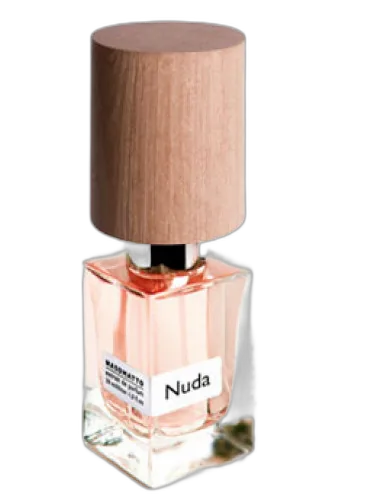

Nuda Nasomatto
At a glance
Is Nuda Nasomatto worth trying?
Nuda by Nasomatto is a Floral fragrance for women.
- Best match
- Evening wear in Spring
- Performance feel
- Excellent longevity with Moderate sillage
- Signature profile
- white floral with Jasmine
The first impression
Nuda by Nasomatto is a Floral fragrance for women. The nose behind this fragrance is Alessandro Gualtieri.
What shapes the scent
The perfumer behind it

Alessandro Gualtieri
Alessandro Gualtieri is an Italian perfumer and founder of the Nasomatto brand, known for his bold, unconventional approach to fragrance. His olfactory style emphasizes raw materials and intense, often provocative compositions that challenge traditional perfumery. Notable creations from our catalog include Nasomatto’s Absinth, Baraonda, and Blamage, as well as the MariaLux series and L’essence de Mastenbroek, all reflecting his signature dramatic and unapologetic aesthetic.
Notes pyramid
All Notes
Complete scent profile
 Jasmine
The mood it creates
The Lover Archetype: Portrait of Nuda Nasomatto
Essence
To wear Nuda by Nasomatto is to embrace a fragrance that is at once delicate and primal-a whisper of skin, a suggestion of intimacy, yet untamed in its quiet power. The person who chooses this scent is drawn to its paradox: it is both naked and veiled, vulnerable yet unapologetic. They are, at their core, an embodiment of the Lover archetype, one who seeks depth, connection, and beauty in all things-but whose shadow may slip into indulgence or a fear of true surrender.
Style & Aesthetic
Their presence is magnetic, not through ostentation but through an understated elegance. They favor textures that invite touch-soft cashmere, silk that glides against the skin, linen that breathes with the body. Their wardrobe is curated, not cluttered; they understand that true luxury lies in restraint. Colors are muted but rich-creams, deep ivories, dusky roses-like the fragrance itself, which lingers as an afterthought rather than an announcement.
They are drawn to art that evokes the body-Egon Schiele’s raw lines, Francesca Woodman’s ghostly self-portraits, the poetry of Sappho. Their home is a sanctuary, where light filters through sheer curtains, and every object is chosen for its tactile or emotional resonance. They do not merely consume beauty; they commune with it.
They are not hedonists in the reckless sense, but they refuse to live by deprivation. A well-aged whiskey, a perfectly ripe fig, the slow burn of a candle at midnight-these are their rituals. They understand pleasure as an art, not a vice.
Yet, their shadow may lure them into excess-another glass of wine, another lover, another indulgence-as if trying to fill a void that cannot be filled. Their challenge is to temper their hunger with wisdom, to recognize that true fulfillment comes not from accumulation but from presence.
Philosophy & Values
For them, life is not to be endured but to be felt. They reject the transactional nature of modern existence, seeking instead moments of transcendence-whether in the curve of a lover’s spine, the slow unfurling of a wine’s bouquet, or the silence between two people who understand each other without words.
They believe in eros as a sacred force, not merely as physical desire but as the connective tissue between souls. Yet, this idealism can become a double-edged sword. Their hunger for intensity may lead them to romanticize relationships to the point of disillusionment. They crave the perfect moment, the perfect touch-but perfection is a fleeting illusion, and their shadow whispers that they will never be fully satisfied.
Relationships
They love deeply, often too deeply. Their partners are drawn to their ability to see beyond facades, to their willingness to dwell in emotional depths where others fear to tread. But this very capacity for intimacy can become a burden-for them and for those they love.
They may oscillate between abandonment and engulfment, fearing both loneliness and the loss of self in another. Their shadow tempts them to manipulate affection, to test love’s limits, to seek proof of devotion in ways that erode trust. Yet, at their best, they teach others how to love more fiercely, more authentically.
Shadow
The Lover’s greatest danger is mistaking intensity for meaning. They may chase ecstasy at the cost of stability, or confuse passion with permanence. Their fear of boredom can make them restless, always seeking the next thrill, the next profound connection-only to discard it when the initial fire dims.
Yet, if they learn to embrace stillness, to find the sacred in the mundane, they become not just seekers but guides, showing others how to live with both fire and grace.
If you like this, try these
Fragrances with a comparable profile - shared accords, notes, and character.
Héritage Berbère
The Jasmin Héritage Berbère
Shared top notes: jasmine

O'Driu
Jmt O'driu
Shared top notes: jasmine

Hilde Soliani
Orgasmo Jasmine Hilde Soliani
Shared top notes: jasmine

Serenity + Scott
Jasmine Serenity + Scott
Shared top notes: jasmine

Il Profvmo
Vent De Jasmin Il Profvmo
Shared top notes: jasmine