
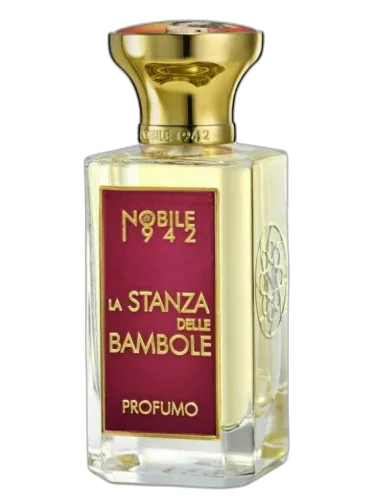

La Stanza Delle Bambole Nobile 1942
At a glance
Is La Stanza Delle Bambole Nobile 1942 worth trying?
La Stanza Delle Bambole by Nobile 1942 is a Oriental Floral fragrance for women and men.
- Best match
- Evening wear in Fall, Winter
- Performance feel
- Good longevity with Moderate sillage
- Signature profile
- powdery, lactonic, vanilla with Milk, Mandarin Orange, Bergamot
The first impression
La Stanza Delle Bambole by Nobile 1942 is a Oriental Floral fragrance for women and men. La Stanza Delle Bambole was launched in 2020. The nose behind this fragrance is Antonio Alessandria. Top notes are Milk, Mandarin Orange and Bergamot; middle notes are Powdery Notes, Ylang-Ylang, Hawthorn and Orange Blossom; base notes are Vanilla, Sandalwood, Tonka Bean and Musk.
What shapes the scent
The perfumer behind it

Antonio Alessandria
Antonio Alessandria is an independent Italian perfumer known for his artisanal approach and deep connection to raw materials. His style blends classical elegance with bold, contemporary contrasts, often exploring resinous, floral, and woody accords. Notable creations like Fleurs Et Flammes and Rusty Vibes showcase his ability to balance intensity with refinement, while Pluvia Sacra reflects his interest in atmospheric storytelling.
Notes pyramid
Top Notes
First impression · 15-30 min
 Milk
Milk
 Mandarin Orange
 Bergamot
Heart Notes
Core character · 2-4 hours
 Powdery Notes
 Ylang-Ylang
 Hawthorn
 Orange Blossom
Base Notes
Lasting impression · 4+ hours
 Vanilla
 Sandalwood
 Tonka Bean
 Musk
Musk
The mood it creates
The Archetype Archetype: Portrait of La Stanza Delle Bambole Nobile 1942
Essence
To wear La Stanza Delle Bambole is to wrap oneself in the soft, powdery embrace of nostalgia-vanilla and heliotrope, almond and iris, a scent that lingers like the memory of childhood. This is not a fragrance for those who stride boldly into the world, but for those who dwell in the quiet spaces between reality and reverie. The wearer is an Innocent Archetype, though not in the naive sense-rather, they are a seeker of purity, beauty, and simplicity, a soul who resists the harsh edges of modernity in favor of a world softened by imagination.
Shadow
Yet the Innocent is not without their shadows. Their devotion to beauty can become escapism, a refusal to engage with life’s inevitable roughness. They may withdraw when confronted with conflict, retreating into their inner world rather than facing discomfort. Their idealism, while noble, can make them passive-waiting for life to unfold like a fairy tale rather than shaping it with their own hands.
Their relationships may suffer from this reluctance to confront reality. They might idealize lovers, only to be disillusioned when flaws emerge. Their avoidance of harsh truths can make them seem distant, even cold, to those who do not understand their need for emotional sanctuary.
And then there is the danger of fragility. The world does not always reward gentleness, and their sensitivity can leave them wounded by even minor cruelties. They may struggle with melancholy, a quiet sorrow for the way things ought to be but rarely are.
Conclusion
This person moves through life with a quiet grace, drawn to the delicate and the refined. Their tastes are elegant but never ostentatious-vintage lace, porcelain teacups, the muted pastels of a faded fresco. They prefer the company of books to crowds, of gardens to cities, finding solace in the small, perfect moments: the first sip of jasmine tea, the rustle of silk, the golden light of late afternoon.
Philosophically, they are idealists, though not dogmatic ones. They believe in kindness as a quiet rebellion against cynicism, in beauty as an antidote to despair. Their values are rooted in gentleness-they abhor cruelty, whether in words or deeds, and they strive to create harmony in their relationships. Their friendships are deep but few, built on mutual understanding rather than obligation. Romantic partners must share their appreciation for the poetic; they are drawn to those who can see the world as they do-through a lens of wonder.
Their lifestyle is deliberate, unhurried. They may work in the arts, or in a profession that allows them to cultivate beauty-a curator, a florist, a writer of delicate prose. Their home is their sanctuary, filled with carefully chosen objects, each with its own story. They are not materialistic, but they are deeply attached to the things that evoke emotion-a grandmother’s cameo, a pressed flower from a long-ago summer.
If you like this, try these
Fragrances with a comparable profile - shared accords, notes, and character.

Ynepsie
Irisistible Ynepsie
Shared top notes: bergamot, mandarin orange, milk
Germaine Monteil
Soon Germaine Monteil
Shared top notes: bergamot, mandarin orange

Porsche Design
Porsche Design Woman Ruby Porsche Design
Shared top notes: bergamot, mandarin orange

Natura
Flor De Laranjeira Natura
Shared top notes: bergamot, mandarin orange

Valentino
Voce Viva Valentino
Shared top notes: bergamot, mandarin orange