
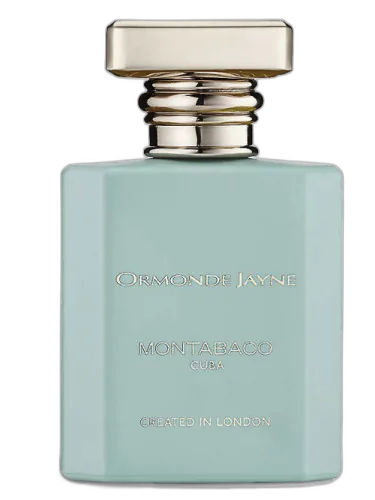

Montabaco Cuba Ormonde Jayne
Fragrance Story
Montabaco Cuba by Ormonde Jayne is a Woody Aromatic fragrance for women and men. This is a new fragrance. Montabaco Cuba was launched in 2022. Top notes are Bergamot, Juniper, Orange, Freesia and Mandarin Orange; middle notes are Tea, Jasmine, Dry Wood and Magnolia; base notes are Tobacco, Tonka Bean, Suede, Ambergris, Iso E Super, Sandalwood and Vanilla Absolute.
Composition Profile
About the Perfumer

Unknown Perfumer
Fragrance Notes
Top Notes
First impression · 15-30 min
 Bergamot
 Juniper
 Orange
 Freesia
 Mandarin Orange
Heart Notes
Core character · 2-4 hours
 Tea
Tea
 Jasmine
 Dry Wood
 Magnolia
Base Notes
Lasting impression · 4+ hours
 Tobacco
 Tonka Bean
 Suede
Suede
 Ambergris
 Iso E Super
 Sandalwood
 Vanilla Absolute
Character Profile
The Wanderer Archetype: Portrait of Montabaco Cuba Ormonde Jayne
Essence
The person who gravitates toward Montabaco Cuba by Ormonde Jayne is most closely aligned with the Explorer archetype-a seeker of the unknown, driven by curiosity and a restless spirit. This fragrance, with its smoky tobacco, green fig, and warm amber, evokes the scent of distant lands, of leather-bound journals and late-night conversations in dimly lit rooms. It is not a scent for those who crave comfort in the familiar; it is for those who find beauty in the uncharted.
The Explorer is not merely a traveler in the physical sense but a wanderer of the mind, drawn to ideas as much as to places. They resist confinement-whether in thought, routine, or relationships-always searching for the next horizon. Their life is an experiment, a series of deliberate choices that reject the mundane in favor of the extraordinary.
Style & Aesthetic
Their tastes are refined but never ostentatious. They prefer the understated luxury of well-worn leather, the weight of a vintage timepiece, the texture of raw linen. Their wardrobe is a curated collection of timeless pieces-nothing too trendy, nothing too loud. They might wear a tailored blazer with a slightly rumpled shirt, suggesting both discipline and disregard for rigid formality.
In art and music, they favor the complex over the simplistic-jazz that wanders into dissonance, literature that demands interpretation, films that leave questions unanswered. They are drawn to the works of Borges, the compositions of Miles Davis, the cinematography of Tarkovsky. Their home is filled with objects that tell stories: a Moroccan rug bought on impulse, a first edition of a forgotten novel, a bottle of aged rum saved for the right moment.
They thrive in cities with history-Lisbon, Havana, Istanbul-places where the past lingers in the air like smoke. They may work in creative fields-writing, photography, design-or in professions that allow movement, like consulting or academia. Routine is their enemy; they structure their days around spontaneity, leaving room for detours and discoveries.
They are not reckless, but they are willing to take calculated risks. A sudden trip, an impulsive investment, a career shift-they trust their instincts, even when logic warns against it. This can lead to brilliance or ruin, often both in succession.
Philosophy & Values
For them, life is not about accumulation but experience. They measure wealth in stories, not possessions. Their philosophy is one of radical self-determination-they refuse to be defined by societal expectations, careers, or even past versions of themselves. They believe in reinvention, in the fluidity of identity.
Yet this pursuit of authenticity has its contradictions. They disdain hypocrisy but are not immune to it-they may preach freedom while secretly fearing commitment, or champion individuality while quietly judging those who conform. Their values are noble, but their adherence to them is sometimes performative.
Relationships
They attract people effortlessly-their magnetism lies in their mystery, their refusal to be fully known. They are excellent conversationalists, skilled at drawing out others’ secrets while revealing little of their own. Their relationships are intense but often fleeting; they resist the weight of expectation.
Lovers find them intoxicating but frustrating-they give just enough to keep interest alive, but never enough to satisfy deeper longing. Friends admire their independence but sometimes feel kept at arm’s length. They are not cruel, merely self-protective; their greatest fear is not loneliness but stagnation.
Shadow
Their strength-their refusal to settle-is also their flaw. The constant search for the next experience can become an evasion of depth. They mistake motion for growth, novelty for meaning. Beneath their confidence lies a quiet anxiety: What if I’ve missed something? What if I stop and find nothing there?
They may grow weary of their own restlessness, yet fear that stopping means surrendering to mediocrity. Their shadow is the ghost who cannot rest, always moving but never arriving.
Conclusion
The lover of Montabaco Cuba is neither hero nor rebel-they are something more elusive. They are the one who walks just ahead, always slightly out of reach, leaving traces of tobacco and amber in their wake. They live by a simple creed: To stand still is to die. And so they move, not because they have found all the answers, but because the search itself is the answer.
Similar Fragrances
Fragrances with a comparable profile - shared accords, notes, and character.
Brocard
Un Jardin Mystique Brocard
Shared accords: aromatic, citrus, floral
Ormonde Jayne
Montabaco Cuba Ormonde Jayne
Shared accords: amber, citrus, floral

Ulric de Varens
Rectoverso Man Tea Tobacco Ulric De Varens
Shared accords: amber, aromatic, citrus
Red Carnation – Красная гвоздика
Львов Red Carnation – Красная Гвоздика
Shared accords: amber, aromatic, citrus
House Of James
Tomorrow House Of James
Shared accords: amber, aromatic, citrus