
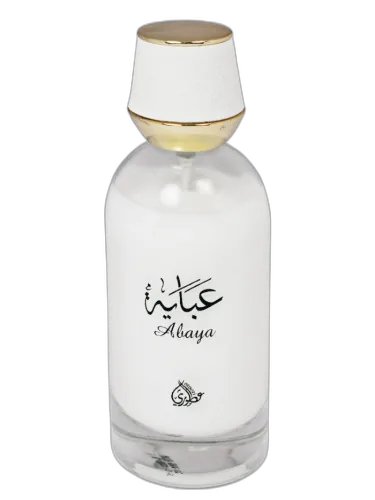

Abaya Otoori
At a glance
Is Abaya Otoori worth trying?
Abaya by Otoori is a fragrance for women.
- Best match
- Evening wear in Winter
- Performance feel
- Very Good longevity with Moderate sillage
- Signature profile
- sweet, powdery, fruity with Loukhoum, Sorbet, Sweet Almond
The first impression
Abaya by Otoori is a fragrance for women. Top notes are Loukhoum, Sorbet, Sweet Almond and Pear; middle notes are Powdery Notes, Caramel, Vanilla and Cinnamon; base note is Amber.
What shapes the scent
The perfumer behind it

Otoori
Otoori is a perfumer celebrated for blending traditional and contemporary fragrance styles. His creations, such as Abaya and Musk Al Safwa, showcase a deep appreciation for rich, evocative notes. He skillfully balances opulence with restraint, creating scents that feel luxurious yet approachable. His work appeals to those who value depth and artistry in perfumery.
Notes pyramid
Top Notes
First impression · 15-30 min
 Loukhoum
 Sorbet
 Sweet Almond
 Pear
Pear
Heart Notes
Core character · 2-4 hours
 Powdery Notes
 Caramel
 Vanilla
 Cinnamon
Base Notes
Lasting impression · 4+ hours
 Amber
Amber
The mood it creates
The Sage Archetype: Portrait of Abaya Otoori
Essence
To wear Abaya Otoori is to embrace a fragrance that is at once refined and enigmatic-a scent that whispers of wisdom rather than shouts of presence. The person who cherishes this fragrance is, above all, a seeker of truth. They are drawn to the quiet power of knowledge, the subtlety of insight, and the elegance of restraint. The Sage archetype defines them, for they are not merely intelligent but deeply contemplative, valuing understanding over mere accumulation.
Their life is a tapestry of deliberate choices. They move through the world with a measured grace, observing before speaking, listening before judging. They are not the loudest voice in the room, but when they speak, their words carry weight. Their philosophy is one of discernment-they believe that wisdom is not found in certainty but in the willingness to question.
Style & Aesthetic
Their tastes are refined but never ostentatious. They prefer the understated luxury of well-crafted materials-soft cashmere, aged leather, the weight of a finely bound book. Their wardrobe is a study in muted elegance, favoring deep hues and clean lines. They do not follow trends but instead cultivate a personal style that reflects their inner world: deliberate, timeless, and quietly confident.
In art and literature, they are drawn to works that demand engagement-poetry that lingers in the mind, films that unfold in layers, music that rewards patience. They appreciate complexity but despise pretension. A well-placed silence is as meaningful to them as a symphony.
Their daily life is structured but not rigid. They rise early, savoring the quiet hours before the world awakens. They may practice yoga, write, or simply sit with their thoughts. Their work is often cerebral-perhaps a scholar, a writer, a strategist, or an artist. They thrive in environments where intellect is valued over spectacle.
They are disciplined but not ascetic. They enjoy fine wine, gourmet food, and the occasional indulgence, but always with mindfulness. Excess disgusts them; they believe that mastery of the self is the highest form of freedom.
Philosophy & Values
Truth is their guiding star, but they understand that truth is often elusive. They are skeptical of absolutes, preferring the fluidity of thought over rigid dogma. Their values are rooted in intellectual honesty-they despise deception, especially self-deception. They believe that to know oneself is the highest form of wisdom, and they approach their own flaws with the same scrutiny they apply to the world.
They are not religious in the traditional sense, but they have a reverence for the mysteries of existence. They might meditate, journal, or lose themselves in long walks, using solitude as a crucible for thought. Their spirituality is private, a dialogue between themselves and the unknown.
Relationships
They do not give their trust lightly. Their friendships are few but profound, built on mutual respect and intellectual kinship. They are not the type to fill their life with acquaintances; they prefer depth over breadth. In love, they are slow to commit but fiercely loyal once they do. Their partner must be their equal-someone who challenges them, understands their need for solitude, and shares their hunger for meaning.
Their relationships are marked by a quiet intensity. They do not engage in idle chatter; when they speak, it is with purpose. Some may find them distant, but those who know them well understand that their silence is not coldness-it is the space in which thought flourishes.
Shadow
Yet, for all their wisdom, they are not without flaws. Their greatest strength-their intellect-can become their prison. They may retreat too far into thought, losing touch with raw emotion and spontaneity. Their skepticism can harden into cynicism, making them dismissive of simpler joys.
Their relationships may suffer from their tendency to analyze rather than feel. They might mistake detachment for wisdom, avoiding vulnerability under the guise of rationality. At their worst, they become the aloof philosopher, observing life from a distance rather than living it fully.
Conclusion
But when they are at their best, they are neither cold nor detached-they are deeply engaged, using their insight to illuminate rather than dissect. They understand that wisdom is not just knowing but being. They learn to temper their intellect with compassion, their skepticism with wonder.
To wear Abaya Otoori is to embody this balance-a fragrance that is both profound and inviting, mysterious yet warm. The Sage does not merely think; they live their philosophy, and in doing so, they become a beacon for those who seek more than surface truths.
If you like this, try these
Fragrances with a comparable profile - shared accords, notes, and character.
Nicolai Parfumeur Createur
Vanille Intense Nicolai Parfumeur Createur
Shared heart notes: cinnamon, vanilla

Dolce&Gabbana
Dgvib3 Eau De Parfum Dolce&gabbana
Shared heart notes: vanilla

I Profumi Del Marmo
Arabescato I Profumi Del Marmo
Shared heart notes: vanilla

Frederic M
Comme Une Reine Frederic M
Shared heart notes: vanilla

Rabanne
After Club Rabanne
Shared heart notes: vanilla