
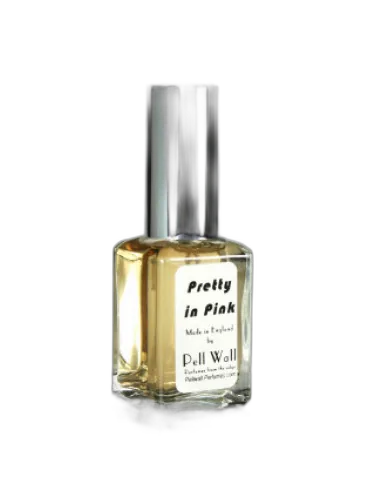

Pretty In Pink Pell Wall Perfumes
At a glance
Is Pretty In Pink Pell Wall Perfumes worth trying?
Pretty in Pink by Pell Wall Perfumes is a Floral fragrance for women.
- Best match
- Casual wear in Spring
- Performance feel
- Moderate longevity with Moderate sillage
- Signature profile
- white floral, green, citrus with Bergamot, Mint, Neroli
The first impression
Pretty in Pink by Pell Wall Perfumes is a Floral fragrance for women. Pretty in Pink was launched in 2011. The nose behind this fragrance is Chris Bartlett. Top notes are Bergamot, Mint and Neroli; middle notes are Rose, Violet Leaf, Lily-of-the-Valley, Lily and Jasmine; base notes are Sandalwood, Vanilla, Spices and White Musk.
What shapes the scent
The perfumer behind it

Chris Bartlett
Chris Bartlett is a British perfumer and the founder of Pell Wall Perfumes, where he creates a wide range of fragrances. His catalog includes classics like 1953 Eau De Toilette and 1953 Pour Homme, as well as more unique offerings such as Anjin, Devana, Equistem, Green Carnation, Jacinth, and Lasting Lavender. His work often explores traditional and modern perfumery techniques.
Notes pyramid
Top Notes
First impression · 15-30 min
 Bergamot
 Mint
Mint
 Neroli
Heart Notes
Core character · 2-4 hours
 Rose
Rose
 Violet Leaf
 Lily-of-the-Valley
 Lily
Lily
 Jasmine
Base Notes
Lasting impression · 4+ hours
 Sandalwood
 Vanilla
 Spices
White Musk
Spices
White Musk
The mood it creates
The Lover Archetype: Portrait of Pretty In Pink Pell Wall Perfumes
Essence
To wear Pretty in Pink by Pell Wall Perfumes is to embrace a fragrance that is delicate yet assertive, soft yet luminous-a scent that lingers like the memory of a first love. The person who cherishes this fragrance is not merely drawn to its floral sweetness but to the deeper resonance it holds: a celebration of beauty, sensuality, and the tender vulnerability of the heart. They are, at their core, an embodiment of the Lover archetype-one who seeks connection, cherishes aesthetics, and thrives on emotional and sensory richness.
Style & Aesthetic
For this individual, life is not merely lived but curated. Their surroundings reflect an instinctive pull toward harmony-soft pastels, flowing fabrics, and objects that carry an air of romance. They are drawn to the poetry of small things: the way light filters through sheer curtains, the texture of aged paper, the quiet elegance of a handwritten letter. Their taste in art, music, and literature leans toward the lyrical-Impressionist paintings, Chopin nocturnes, novels where emotion is as vivid as the prose.
Yet this is not mere frivolity. Their appreciation for beauty is a philosophy, a way of resisting the harshness of a utilitarian world. They believe that aesthetics are not superficial but essential, a means of elevating existence beyond mere survival.
Philosophy & Values
They reject cold rationality in favor of intuition. Decisions are made not by spreadsheet but by feeling-what moves them, what stirs their soul. They believe in kindness not as a moral obligation but as a natural state, as effortless as breathing. Their ethics are rooted in empathy; they cannot abide cruelty, and their outrage at injustice is visceral.
Yet this emotional immediacy can also be their undoing. They may struggle with boundaries, absorbing the pain of others until it becomes their own. Their aversion to conflict can lead to passive-aggression or silent resentment, a quiet storm beneath a serene surface.
Relationships
Love, for them, is both a sanctuary and a crucible. They approach relationships with an intensity that can be intoxicating-listening deeply, touching lightly, speaking in words that feel like caresses. They are the kind of lover who remembers anniversaries not out of obligation but because they delight in marking moments of connection. Their friendships are similarly rich; they are the confidant who listens with unwavering attention, the one who brings a perfectly chosen gift simply because it "reminded them of you."
But the shadow of the Lover is dependence-the fear of abandonment, the tendency to merge too completely with another. They may mistake possession for devotion, or confuse infatuation with love. When rejected, they do not merely grieve; they wither, as if their very sense of self were tied to the affections of others.
Shadow
The Lover’s greatest strength-their capacity for deep connection-is also their greatest peril. When unbalanced, they may slip into vanity, seeking validation through charm rather than substance. They might become overly dramatic, mistaking turbulence for passion, or cling to fading relationships out of fear of solitude.
At their worst, they are not the romantic hero but the tragic figure-one who loves too much, too soon, too blindly. Their challenge is to love without losing themselves, to cherish beauty without mistaking it for truth.
Conclusion
To know this person is to know someone who refuses the gray mundanity of existence. They are the one who lights candles for no occasion, who stops to admire the way petals catch the rain, who believes-despite all evidence-that love is the closest thing to divinity we will ever know.
They are flawed, yes. But their flaws are the price of their intensity, the cost of a heart that refuses to be anything less than alive.
If you like this, try these
Fragrances with a comparable profile - shared accords, notes, and character.

Thera Cosméticos
Agatha Thera Cosméticos
Shared top notes: bergamot, neroli

Salvador Dali
Crazy Kiss Salvador Dali
Shared top notes: bergamot

Porsche Design
Porsche Design Satin Porsche Design
Shared top notes: bergamot

O Boticário
Love Lily O Boticário
Shared top notes: bergamot, neroli

Montale
Golden Sand Montale
Shared top notes: bergamot, mint