
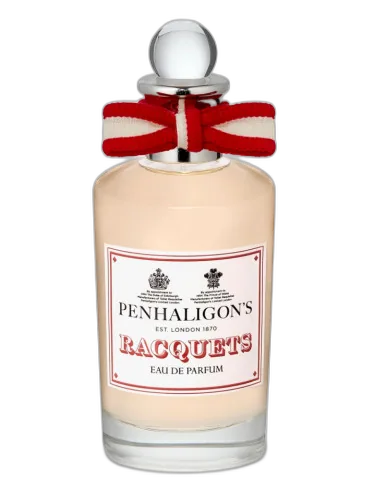

Racquets Penhaligon's
Fragrance Story
Racquets by Penhaligon's is a fragrance for women and men. Racquets was launched in 2021. Top note is Lemon; middle notes are Guaiac Wood and Ambroxan; base note is Leatherwood.
Composition Profile
About the Perfumer

Unknown Perfumer
Fragrance Notes
Top Notes
First impression · 15-30 min
 Lemon
Lemon
Heart Notes
Core character · 2-4 hours
 Guaiac Wood
 Ambroxan
Base Notes
Lasting impression · 4+ hours
 Leatherwood
Racquets Penhaligon's by Penhaligon's offers a distinctive olfactory experience that stands out from other fragrances in its category.
Crafted with the finest ingredients and a blend of traditional and modern perfumery techniques, this fragrance represents the pinnacle of the perfumer's art.
Racquets Penhaligon's embodies the distinctive style of Penhaligon's while adding a unique chapter to their fragrance portfolio.
Character Profile
The Archetype Archetype: Portrait of Racquets Penhaligon's
Essence
The one who chooses Racquets by Penhaligon’s is not merely selecting a fragrance-they are donning an invisible mantle of refinement, tradition, and quiet authority. This scent, with its crisp citrus, polished leather, and faint whisper of lavender, evokes the spirit of an old-world gentleman’s club, where wit is sharp, manners are precise, and power is wielded with effortless grace. The dominant archetype here is The Aristocrat-not in the crude sense of inherited privilege, but as a psychological disposition toward elegance, discernment, and an unshakable belief in the virtues of cultivated taste.
Style & Aesthetic
Their life is a carefully curated composition, where every detail-from the cut of their blazer to the selection of their evening whiskey-is deliberate. They inhabit spaces that balance warmth and restraint: a study lined with leather-bound books, a garden where roses grow in disciplined rows, a dining table set for conversation rather than mere consumption. They are drawn to pursuits that reward patience and precision-classical music, bespoke tailoring, the slow appreciation of art. Leisure is not idleness but an art form in itself; a game of chess, a well-timed witticism, a leisurely stroll through an autumn park.
They move through the world with an air of quiet confidence, neither seeking approval nor dismissing it outright. Their social circle is small but meaningful, composed of those who appreciate nuance and depth. They despise vulgarity, not out of snobbery, but because they see it as a failure of imagination-a surrender to the coarse and the transient.
Philosophy & Values
Their philosophy is one of cultivated excellence. They believe that life’s highest pleasures are not stumbled upon but earned through discipline and discernment. Tradition is not a cage but a foundation-a way to stand on the shoulders of those who refined beauty before them. They value intelligence, but not mere cleverness; charm, but not empty flattery; power, but never brute force.
Beneath this polished exterior lies a deep-seated belief in meritocracy, though not the kind measured in wealth or titles. To them, true aristocracy is of the mind and spirit-those who have honed themselves into something rare and enduring. They disdain the modern obsession with speed and novelty, seeing it as a shallow rebellion against the timeless.
Relationships
In love and friendship, they are selective, even guarded. They do not give their trust lightly, but once given, it is steadfast. Their romantic partners must possess a certain self-possession-someone who neither clings nor demands, but engages as an equal. They are drawn to those who share their appreciation for the subtle, the understated, the quietly profound.
Their friendships are built on mutual respect rather than neediness. They are the confidant who listens with piercing clarity, offering advice that is both cutting and kind. They do not suffer fools, but they are not cruel-merely unwilling to waste time on what they deem unworthy.
Shadow
Yet, like all archetypes, The Aristocrat has its shadow. Their devotion to refinement can curdle into haughtiness, their discernment into elitism. They may mistake taste for virtue, believing that their preferences make them superior rather than simply different. There is a danger of becoming a prisoner of their own aesthetic, so obsessed with maintaining appearances that they lose touch with spontaneity, warmth, even humanity.
At their worst, they may withdraw into a self-made fortress of exclusivity, dismissing anything outside their sphere as vulgar or insignificant. Their disdain for the ordinary can blind them to its hidden depths-the raw, unpolished beauty they refuse to see.
Conclusion
The true test of this archetype is whether their love of the refined leads them to elevate others or merely to isolate themselves. When balanced, they are a beacon of grace in a chaotic world-a reminder that excellence is not dead, merely rare. When unbalanced, they become a relic, admired but untouchable, a figure in a portrait rather than a living soul.
The wearer of Racquets is, at their best, a quiet force of civilization-someone who carries the past lightly but reverently, shaping the present with the weight of tradition and the sharpness of intellect. At their worst, they are a ghost of their own making, elegant but empty, admired but alone.
Their challenge, then, is not to abandon their ideals, but to ensure that their pursuit of the exquisite does not become a prison-that their love of the rare does not render them incapable of embracing the real.
Similar Fragrances
Fragrances with a comparable profile - shared accords, notes, and character.

Massimo Dutti
Summer Tales Massimo Dutti
Shared accords: amber, aromatic, citrus

Casaniche
Citric Fresh Casaniche
Shared accords: amber, aromatic, citrus

B.ATES
Citrus Woody B.ates
Shared accords: amber, aromatic, citrus

Dior
Dior Homme 2020 Dior
Shared accords: amber, aromatic, citrus

Art Deco Perfumes
Senor Fernando Art Deco Perfumes
Shared accords: amber, aromatic, citrus