
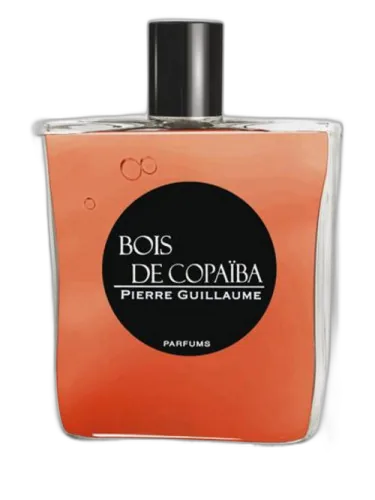

Bois De Copaiba Pierre Guillaume Paris
At a glance
Is Bois De Copaiba Pierre Guillaume Paris worth trying?
Bois de Copaiba by Pierre Guillaume Paris is a Woody Spicy fragrance for women and men.
- Best match
- Evening wear in Fall, Winter
- Performance feel
- Good longevity with Moderate sillage
- Signature profile
- amber, woody, almond with Amaretto, Mahogany, Copahu Balm
The first impression
Bois de Copaiba by Pierre Guillaume Paris is a Woody Spicy fragrance for women and men. Bois de Copaiba was launched in 2006. The nose behind this fragrance is Pierre Guillaume.
What shapes the scent
The perfumer behind it

Pierre Guillaume
Pierre Guillaume is a French perfumer and founder of the niche brand Parfumerie Generale. He has created fragrances for Laboratorio Olfattivo and Phaedon, among others. His style is known for its artistic and conceptual approach. Guillaume's work often features complex and evocative blends.
Notes pyramid
All Notes
Complete scent profile
 Amaretto
 Mahogany
 Copahu Balm
 Myrrh
Myrrh
 Sandalwood
 Orange
 Ginger
The mood it creates
The Wanderer Archetype: Portrait of Bois De Copaiba Pierre Guillaume Paris
Essence
The Wanderer is a seeker of horizons, a soul untethered by place or time. Bois de Copaiba is their compass-a scent of distant lands and ancient paths. The opening of amaretto and mahogany is the warmth of a foreign tavern, the copahu balm and myrrh the incense of a forgotten temple, and the sandalwood and ginger the spice of a bustling market. This fragrance is a journey, a story told in notes of amber and wood.
Style & Aesthetic
The Wanderer dresses for the road: sturdy boots, a worn leather jacket, and a scarf that has seen many winds. Their aesthetic is one of practical romance-layers of wool and linen, a hat pulled low against the sun. They carry little, but each possession has a history. Their look is effortlessly eclectic, a patchwork of cultures and climates, always ready for the next adventure.
Philosophy & Values
The Wanderer believes that the journey is the destination. They value freedom above all, the right to move, to explore, to never be tied down. Their philosophy is one of openness and curiosity, a willingness to be changed by the world. They know that home is not a place, but a feeling carried within. For them, the greatest sin is stagnation, the refusal to see what lies beyond the next hill.
Relationships
The Wanderer is a lover of many shores, but a citizen of none. They form intense, fleeting connections, each one a chapter in their ongoing story. In love, they are passionate and generous, but they cannot promise forever. They seek a companion who understands that the road is their true partner, someone who will walk beside them for a while, then let them go. Their friendships are global, a network of souls met along the way.
Lifestyle
Their life is a constant state of arrival and departure. They wake to unfamiliar ceilings, eat meals in markets and roadside stalls, and sleep under stars that change with the season. They are fluent in the language of maps and timetables, of chance encounters and serendipitous detours. Their rituals are simple: a cup of tea at dawn, a journal entry at dusk, the scent of Bois de Copaiba as a talisman against the unknown.
Shadow
The Wanderer's shadow is rootlessness and avoidance. Their fear of commitment can become a prison of perpetual motion, a refusal to face the stillness that true growth requires. They may use the road to escape, to avoid the hard work of building a life. Their freedom can become a lonely exile, a wandering without purpose or home.
Conclusion
Bois de Copaiba is the Wanderer's elixir, a fragrance that captures the spirit of the open road. It is a reminder that the world is vast and full of wonder, and that every path leads to a new beginning. To wear it is to embrace the call of the unknown, to set out with hope and a heart full of stories yet to be written.
If you like this, try these
Fragrances with a comparable profile - shared accords, notes, and character.

Filippo Sorcinelli
Lentezza Carezza Filippo Sorcinelli
Shared top notes: myrrh, orange

Spiritum
1 Solar Soul Spiritum
Shared top notes: amaretto

Mexx
Inspired Warmth Men Mexx
Shared top notes: ginger

Recreation
Lost In Dusk Recreation
Shared top notes: myrrh

Molton Brown
Muddled Plum Molton Brown
Shared top notes: orange