
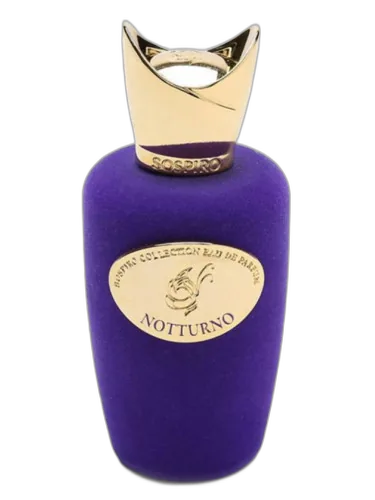

Notturno Sospiro Perfumes
At a glance
Is Notturno Sospiro Perfumes worth trying?
Notturno by Sospiro Perfumes is a Oriental fragrance for women and men.
- Best match
- Evening, Special Occasion wear in Fall, Winter
- Performance feel
- Very Good longevity with Strong sillage
- Signature profile
- warm spicy, woody, smoky with Rum, Pineapple, Ink
The first impression
Notturno by Sospiro Perfumes is a Oriental fragrance for women and men. The nose behind this fragrance is Chris Maurice. Top notes are Rum and Pineapple; middle notes are Ink, Cloves, Leather and Birch Leaf; base notes are Incense, Cedar, Amber and Musk.
What shapes the scent
The perfumer behind it

Chris Maurice
Chris Maurice is a perfumer with a wide-ranging portfolio that includes work for Aqualis, Artal Perfumes, Assaf, Astrophil & Stella, Azman, and Bey Parfum. His creations include Egoli, Forbidden Rose, Darley, Love Is Lost, Moonage Daydream, Riad Jasmine, Song For A Wanderer, and Abyssoria. His style varies from floral and romantic to dark and mysterious.
Notes pyramid
Top Notes
First impression · 15-30 min
 Rum
Rum
 Pineapple
Heart Notes
Core character · 2-4 hours
 Ink
Ink
 Cloves
 Leather
 Birch Leaf
Base Notes
Lasting impression · 4+ hours
 Incense
 Cedar
Cedar
 Amber
Amber
 Musk
Musk
The mood it creates
The Notturno Sospiro Wearer Archetype: Portrait of Notturno Sospiro Perfumes
Essence
This is a person who does not merely wear a fragrance-they inhabit it. Notturno Sospiro ("Nighttime Sigh") is not a scent for the daylight crowd; it is for those who find truth in twilight, who listen to the whispers of the unseen. The dominant archetype here is The Mystic-the seeker who dwells in the liminal spaces between reality and reverie, drawn to the enigmatic, the poetic, the half-revealed.
The Mystic does not chase answers but dwells in questions, finding beauty in the unresolved. They are not a fanatic, nor a dogmatic believer, but someone who intuits meaning in the unseen patterns of life. Their spirituality is sensual, not doctrinal-a quiet conversation with the night air, the flicker of candlelight, the scent of incense lingering in an empty room.
Shadow
Their world is one of deliberate contrast-not stark, but softly blurred, like the edges of a dream. They prefer dimly lit spaces where the mind can wander, where the boundaries between thought and feeling dissolve. Their home is a sanctuary of textures: velvet drapes, aged leather books, dark wood that hums with history. They collect objects not for their utility but for their aura-antique keys, handwritten letters, dried flowers pressed between pages.
Music is essential to them, but not as mere entertainment. They listen to compositions that breathe-Chopin’s nocturnes, the slow burn of jazz ballads, the haunting minimalism of Arvo Pärt. They do not dance; they sway, eyes closed, lost in the undercurrent of sound.
Their philosophy is one of quiet resistance-not against society, but against the tyranny of the obvious. They distrust loud declarations, preferring the weight of silence. They believe in depth over speed, in the slow unfurling of truth rather than its hasty proclamation.
Yet the Mystic’s depth comes at a cost. Their sensitivity, while profound, can tip into melancholy-a lingering sadness for no clear reason, a nostalgia for moments they never lived. They are prone to withdrawal, disappearing into their inner world for days, leaving others wondering where they have gone.
Their elusiveness can be frustrating to those who crave certainty. They resist definition, slipping away when pinned down. This is not deception but self-preservation-a fear that too much exposure will dilute their essence.
At their worst, they can become lost in their own mystique, mistaking obscurity for wisdom. They may romanticize suffering, believing depth must always be born from sorrow. Their reluctance to engage with the mundane can leave them adrift, caught between worlds but belonging to neither.
Conclusion
The Mystic’s greatest strength is their ability to perceive what others overlook. They sense moods before they are spoken, detect the unspoken tensions in a room, and understand people not through words but through presence. Their intuition is their compass, guiding them toward those who vibrate on the same frequency.
They are sensualists, not in the hedonistic sense, but in their reverence for texture, scent, and sound. A lover’s touch is not merely physical-it is a language. A meal is not just sustenance; it is an act of communion. They do not consume; they savor.
Their relationships are few but profound. They do not surround themselves with noise, only with those who understand the value of silence. When they love, it is with an intensity that is quiet but unshakable-a devotion that does not need to announce itself.
If you like this, try these
Fragrances with a comparable profile - shared accords, notes, and character.

Meo Fusciuni
Notturno Meo Fusciuni
Shared top notes: rum

Bahfamsn Fragrance
Borneo Tea Bahfamsn Fragrance
Shared top notes: pineapple

Darkbeat Parfums
Cuero Darkbeat Parfums
Shared heart notes: leather

INVISIBLE/HR1
Uriel Intense Shake Invisible/hr1
Shared top notes: pineapple, rum

Zirh
Ikon Zirh
Shared heart notes: cloves