
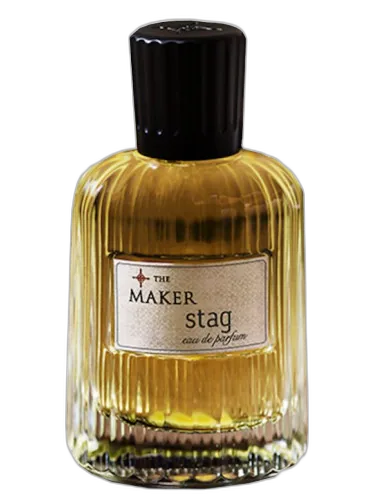

Stag The Maker
At a glance
Is Stag The Maker worth trying?
Stag by The Maker is a Woody fragrance for women and men.
- Best match
- Evening wear in Fall
- Performance feel
- Very Good longevity with Strong sillage
- Signature profile
- woody, citrus, amber with elemi, Bergamot, Blood Grapefruit
The first impression
Stag by The Maker is a Woody fragrance for women and men. Stag was launched in 2021. Top notes are elemi, Bergamot and Blood Grapefruit; middle notes are Black Leather, Agarwood (Oud) and Labdanum; base notes are Palo Santo, Incense and Patchouli.
What shapes the scent
The perfumer behind it

Unknown Perfumer
Notes pyramid
Top Notes
First impression · 15-30 min
 elemi
elemi
 Bergamot
Blood Grapefruit
Bergamot
Blood Grapefruit
Heart Notes
Core character · 2-4 hours
 Black Leather
 Agarwood (Oud)
 Labdanum
Base Notes
Lasting impression · 4+ hours
 Palo Santo
 Incense
 Patchouli
The mood it creates
The Archetypal Craftsman Archetype: Portrait of Stag The Maker
Essence
To wear Stag The Maker is to embody the spirit of creation-raw, deliberate, and unapologetically masculine in the oldest sense of the word. This is not the masculinity of brute force, but of steady hands shaping the world into something tangible, something enduring. The fragrance itself-woody, smoky, with the faintest hint of leather and spice-speaks of a person who values substance over spectacle, who finds meaning in the act of making rather than the noise of mere existence.
The Archetype: The Craftsman
Above all, this person is defined by the Craftsman archetype-a figure who stands at the intersection of skill and vision. Like Hephaestus at his forge, they are driven by the need to transform raw materials into something greater. Their world is one of precision and patience, where mastery is earned through repetition and failure. They do not seek applause, but rather the quiet satisfaction of a thing well-made.
Yet the Craftsman is not merely a laborer; they are also a philosopher of the tangible. They understand that to shape wood, metal, or even ideas is to impose order upon chaos. Their work is an act of defiance against the entropy of life, a way of asserting control in a world that often feels formless.
Life and Philosophy
Their tastes are deliberate, uncluttered by trends. They prefer the weight of solid oak over the fragility of glass, the texture of worn leather over the sterility of plastic. Their home is not a showroom but a workshop-tools hang within easy reach, books on craftsmanship and history line the shelves, and every object has been chosen for its function as much as its form.
Philosophically, they are drawn to stoicism and pragmatism. They believe in the virtue of labor, in the idea that a person is defined not by what they claim but by what they produce. They have little patience for abstraction without application; theories must be tested, ideas must be made real.
Relationships and Social World
In relationships, they are loyal but not effusive. Their love is expressed through acts of service-fixing a broken hinge, building a shelf, quietly ensuring that the people they care for are supported in practical ways. They are not the type for grand romantic gestures, but their presence is steady, reliable.
Yet their focus on craft can make them seem distant. They may retreat into their work for hours, forgetting the need for conversation or emotional exchange. Their partners may sometimes feel like spectators to their solitary devotion, admiring their skill but longing for deeper connection.
The Shadow: The Obsessive Perfectionist
The Craftsman’s greatest strength is also their greatest flaw. Their relentless pursuit of mastery can tip into obsession, leaving them frustrated by imperfection-in their work, in others, in themselves. They may grow impatient with those who lack their discipline, dismissing them as lazy or unserious.
At their worst, they become the Hermit of the Workshop, shutting out the world in favor of their solitary craft. They may mistake isolation for independence, forgetting that even the finest blade must eventually be wielded by a hand other than its maker.
Conclusion: The Balance of Creation
To love Stag The Maker is to embrace the duality of the Craftsman-the pride of creation and the weight of solitude. They are both the architect and the recluse, the builder and the critic. Their life is a testament to the belief that meaning is not found but forged, one deliberate stroke at a time.
Yet they must remember: a thing, no matter how finely made, is only as valuable as the hands that hold it. The true test of their craft is not in its perfection, but in its ability to serve, to connect, to endure beyond the workshop’s walls.
Conclusion
To wear Stag The Maker is to embody the spirit of creation-raw, deliberate, and unapologetically masculine in the oldest sense of the word. This is not the masculinity of brute force, but of steady hands shaping the world into something tangible, something enduring. The fragrance itself-woody, smoky, with the faintest hint of leather and spice-speaks of a person who values substance over spectacle, who finds meaning in the act of making rather than the noise of mere existence.
The Archetype: The Craftsman
Above all, this person is defined by the Craftsman archetype-a figure who stands at the intersection of skill and vision. Like Hephaestus at his forge, they are driven by the need to transform raw materials into something greater. Their world is one of precision and patience, where mastery is earned through repetition and failure. They do not seek applause, but rather the quiet satisfaction of a thing well-made.
Yet the Craftsman is not merely a laborer; they are also a philosopher of the tangible. They understand that to shape wood, metal, or even ideas is to impose order upon chaos. Their work is an act of defiance against the entropy of life, a way of asserting control in a world that often feels formless.
Life and Philosophy
Their tastes are deliberate, uncluttered by trends. They prefer the weight of solid oak over the fragility of glass, the texture of worn leather over the sterility of plastic. Their home is not a showroom but a workshop-tools hang within easy reach, books on craftsmanship and history line the shelves, and every object has been chosen for its function as much as its form.
Philosophically, they are drawn to stoicism and pragmatism. They believe in the virtue of labor, in the idea that a person is defined not by what they claim but by what they produce. They have little patience for abstraction without application; theories must be tested, ideas must be made real.
Relationships and Social World
In relationships, they are loyal but not effusive. Their love is expressed through acts of service-fixing a broken hinge, building a shelf, quietly ensuring that the people they care for are supported in practical ways. They are not the type for grand romantic gestures, but their presence is steady, reliable.
Yet their focus on craft can make them seem distant. They may retreat into their work for hours, forgetting the need for conversation or emotional exchange. Their partners may sometimes feel like spectators to their solitary devotion, admiring their skill but longing for deeper connection.
The Shadow: The Obsessive Perfectionist
The Craftsman’s greatest strength is also their greatest flaw. Their relentless pursuit of mastery can tip into obsession, leaving them frustrated by imperfection-in their work, in others, in themselves. They may grow impatient with those who lack their discipline, dismissing them as lazy or unserious.
At their worst, they become the Hermit of the Workshop, shutting out the world in favor of their solitary craft. They may mistake isolation for independence, forgetting that even the finest blade must eventually be wielded by a hand other than its maker.
Conclusion: The Balance of Creation
To love Stag The Maker is to embrace the duality of the Craftsman-the pride of creation and the weight of solitude. They are both the architect and the recluse, the builder and the critic. Their life is a testament to the belief that meaning is not found but forged, one deliberate stroke at a time.
Yet they must remember: a thing, no matter how finely made, is only as valuable as the hands that hold it. The true test of their craft is not in its perfection, but in its ability to serve, to connect, to endure beyond the workshop’s walls.
If you like this, try these
Fragrances with a comparable profile - shared accords, notes, and character.

100 Bon
Ambre Sensuel 100 Bon
Shared top notes: bergamot, elemi

Giorgio Armani
Acqua Di Giò Profumo Giorgio Armani
Shared top notes: bergamot

Histoires de Parfums
Irrévérent Histoires De Parfums
Shared top notes: bergamot, elemi

Niche4All
Oriental Incense Niche4all
Shared top notes: bergamot

Thera Cosméticos
Malta Thera Cosméticos
Shared top notes: bergamot