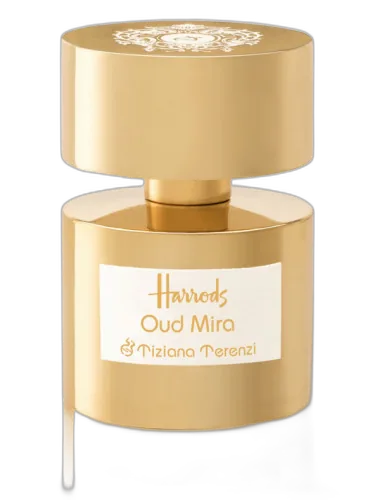

Oud Mira Tiziana Terenzi
At a glance
Is Oud Mira Tiziana Terenzi worth trying?
Oud Mira by Tiziana Terenzi is a Oriental Woody fragrance for women and men.
- Best match
- Evening wear in Fall
- Performance feel
- Excellent longevity with Strong sillage
- Signature profile
- woody, warm spicy, oud with Saffron, Bergamot, Tangerine
The first impression
Oud Mira by Tiziana Terenzi is a Oriental Woody fragrance for women and men. Oud Mira was launched in 2017. The nose behind this fragrance is Paolo Terenzi. Top notes are Saffron, Bergamot, Tangerine and Bulgarian Rose; middle notes are Ylang-Ylang, Cloves, Geranium and Nutmeg; base notes are Agarwood (Oud), Laotian Oud, Patchouli, Cypriol Oil or Nagarmotha, Amber, Vetiver and Sandalwood.
What shapes the scent
The perfumer behind it

Paolo Terenzi
Paolo Terenzi is a perfumer known for his work with Antonio Croce, creating a range of fragrances including Ardente, Incantevole, Meraviglia, Perfetta, Sofisticata, Straordinaria, and Unica. He also composed 1+7 Extrait De Parfum for D'OTTO. Terenzi's style is characterized by bold, opulent compositions that often feature rich florals and warm resins.
Notes pyramid
Top Notes
First impression · 15-30 min
 Saffron
 Bergamot
 Tangerine
 Bulgarian Rose
Heart Notes
Core character · 2-4 hours
 Ylang-Ylang
 Cloves
 Geranium
 Nutmeg
Base Notes
Lasting impression · 4+ hours
 Agarwood (Oud)
 Laotian Oud
 Patchouli
 Cypriol Oil or Nagarmotha
 Amber
Amber
 Vetiver
 Sandalwood
The mood it creates
The Mystic Archetype: Portrait of Oud Mira Tiziana Terenzi
Essence
The person who cherishes Oud Mira by Tiziana Terenzi is most closely aligned with the Mystic archetype-a seeker of hidden truths, drawn to the enigmatic and the profound. This fragrance, with its smoky, resinous depth, dark florals, and animalic sensuality, mirrors their inner world: a place where beauty and shadow intertwine. They are not content with surface-level existence; they crave meaning, intensity, and the kind of beauty that lingers like incense in sacred spaces.
Style & Aesthetic
Their aesthetic is one of controlled decadence-luxurious but never ostentatious. They favor rich textures: velvet, aged leather, silk that whispers against the skin. Their wardrobe is a study in contrasts: dark hues with flashes of gold or deep burgundy, as if they are both mourning and celebrating existence simultaneously.
They are drawn to art that unsettles as much as it enchants-Caravaggio’s chiaroscuro, the poetry of Rumi or Baudelaire, the haunting melodies of neoclassical composers like Hildur Guðnadóttir. Beauty, to them, must have an edge-it must cut as much as it caresses.
They thrive in environments that mirror their inner complexity-dimly lit libraries, old churches, late-night cafés where conversations stretch into the early hours. They may keep odd hours, finding the night more conducive to thought than the garish light of day. Their home is a sanctuary: bookshelves heavy with philosophy and poetry, candles burning low, a record player spinning vinyl that hums with nostalgia.
They are not ascetics-they indulge in fine wine, dark chocolate, the occasional cigar-but their pleasures are deliberate, never frivolous. Excess, for them, is not about quantity but quality of experience.
Philosophy & Values
To them, life is not merely lived-it is deciphered. They are drawn to paradoxes: the sacred and the profane, the ephemeral and the eternal. Their philosophy is one of depth over breadth; they would rather know one thing profoundly than many things superficially. They value authenticity above all, despising pretense and hollow social niceties. Their moral compass is not rigid but fluid, shaped by intuition rather than dogma.
Yet, this very depth can become their undoing. Their relentless pursuit of meaning sometimes leads them into labyrinths of their own making-obsessing over hidden motives, reading too much into fleeting moments, or withdrawing into isolation when the world fails to meet their intensity.
Relationships
They do not give their intimacy lightly. Their relationships are few but fiercely deep, built on shared silences as much as shared words. They attract others effortlessly-there is something magnetic in their quiet intensity-but they are selective in whom they let in. Romantic partners must be willing to navigate their shadows, to understand that love, for them, is not a refuge from darkness but a communion within it.
Yet, their very depth can alienate. They may unintentionally intimidate with their penetrating gaze, their refusal to engage in trivialities. Some mistake their silence for coldness, their intensity for arrogance. Their shadow here is a tendency toward emotional elitism-believing that only those who "understand" them are worth their time.
Shadow
Their greatest strength-their depth-can curdle into isolation. When disillusioned, they may retreat entirely, convinced that the world is too shallow to meet them where they stand. Cynicism lurks beneath their idealism; if unchecked, they may dismiss joy as naivety, mistaking suffering for wisdom.
Yet, when balanced, they are alchemists-turning pain into poetry, solitude into revelation. They remind us that not all who wander are lost; some are simply searching for a truth too vast for daylight.
Conclusion
Oud Mira is their essence distilled: dark, complex, unapologetically rich. It does not ask to be understood-it demands to be felt. And so do they. In a world that often favors the obvious, they are a reminder that the most profound truths are whispered, not shouted.
But they must remember: even mystics must sometimes step into the light.
If you like this, try these
Fragrances with a comparable profile - shared accords, notes, and character.