
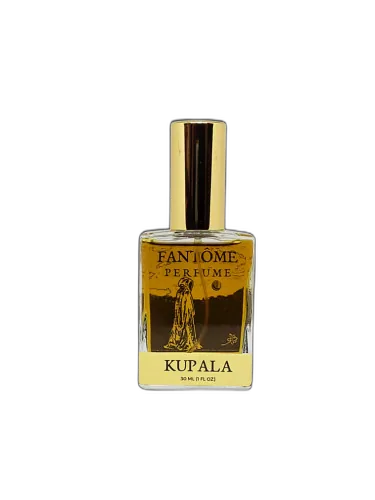

Kupala Fantôme
Fragrance Story
Kupala by Fantôme is a Floral Green fragrance for women and men.
Composition Profile
About the Perfumer

Unknown Perfumer
Fragrance Notes
All Notes
Complete scent profile
 Smoke
Smoke
 Fern
Fern
 Birch
Birch
 Davana
 Dew Drop
 Mountain Air
Kupala Fantôme by Fantôme offers a distinctive olfactory experience that stands out from other fragrances in its category.
Crafted with the finest ingredients and a blend of traditional and modern perfumery techniques, this fragrance represents the pinnacle of the perfumer's art.
Kupala Fantôme embodies the distinctive style of Fantôme while adding a unique chapter to their fragrance portfolio.
Character Profile
The Wanderer Archetype: Portrait of Kupala Fantôme
Essence
The one who is drawn to Kupala Fantôme-a fragrance evoking moonlit forests, damp earth, and the ghostly whisper of forgotten rituals-is a soul in perpetual motion, guided by the Seeker archetype. They are not content with the mundane, nor do they settle for the well-trodden path. Their life is a pilgrimage toward meaning, a quest for something just beyond reach-something sacred, elusive, and deeply personal.
Style & Aesthetic
Their appearance is an extension of their inner world-deliberate yet effortless, blending the archaic with the contemporary. They favor textures that evoke the wild: raw linen, worn leather, silver that tarnishes with time. Their clothing is not fashion but armor and ritual garb, each piece carrying a story.
They are drawn to scents that defy convention-earthy yet ethereal, dark yet luminous. Kupala Fantôme suits them because it is neither sweet nor harsh, but something in between: a fragrance for those who dwell in twilight.
They live in cycles of immersion and retreat. One month, they are lost in books, music, or meditation; the next, they vanish into the wilderness or a foreign city. Routine suffocates them, yet they secretly long for a home they cannot define.
They are creators-not for fame, but because creation is their prayer. Their art (whether writing, painting, or something else) is fragmentary, like ruins of a forgotten temple. They do not seek completion, only expression.
Philosophy & Values
Their worldview is shaped by a restless curiosity and a belief that truth is not fixed but fluid, hidden in the liminal spaces between waking and dreaming. They reject dogma, preferring instead to assemble their own mosaic of wisdom-borrowing from mysticism, philosophy, and the natural world. They value authenticity above all, despising pretense, yet they themselves are not always transparent. Their truths are layered, revealed only to those who earn their trust.
They see life as a series of initiations, each hardship a rite of passage. Suffering, to them, is not meaningless-it is the fire that refines. They do not seek comfort but transformation, and this makes them both inspiring and unsettling to others.
Relationships
They are magnetic but elusive, drawing people in with their depth yet frustrating them with their inscrutability. They crave deep connection but fear confinement, so their relationships are often intense but transient. They love fiercely but leave quietly, always chasing the next horizon.
Romantically, they are drawn to kindred spirits-those who understand solitude, who do not demand possession. Yet their shadow emerges here: they can be emotionally nomadic, leaving behind wounded hearts who mistook their passion for permanence.
Shadow
Their greatest strength-their refusal to be bound-is also their curse. They mistake motion for progress, mistaking the journey for the destination. In their quest for the sublime, they may overlook the beauty of the ordinary. Their fear of stagnation can make them reckless, abandoning stability before it has a chance to root.
At their worst, they become spectral-present but not truly here, haunted by the paths not taken. They may grow bitter, resenting those who seem content with simplicity, not realizing that their own hunger for the extraordinary is a form of imprisonment.
Conclusion
Yet, in their best moments, they embody the essence of the Seeker: one who understands that the search itself is sacred. They do not need to arrive; the act of wandering is enough. Kupala Fantôme is their scent because it is the fragrance of thresholds-of doorways between worlds. And they are forever stepping through.
Similar Fragrances
Fragrances with a comparable profile - shared accords, notes, and character.

Firn Handcrafted
Badlands Firn Handcrafted
Shared accords: aromatic, leather, smoky

The Vagabond Prince
Land Of Warriors The Vagabond Prince
Shared accords: aromatic, fresh spicy, green

Le Goût De Peau 肌肤之味
Yubeng 雨崩 Le Goût De Peau 肌肤之味
Shared accords: aromatic, fresh spicy, green

Bravanariz
Fum Bravanariz
Shared accords: aromatic, fresh spicy, leather

Bohdidharma
Black Lapsang Bohdidharma
Shared accords: aromatic, fresh spicy, green