
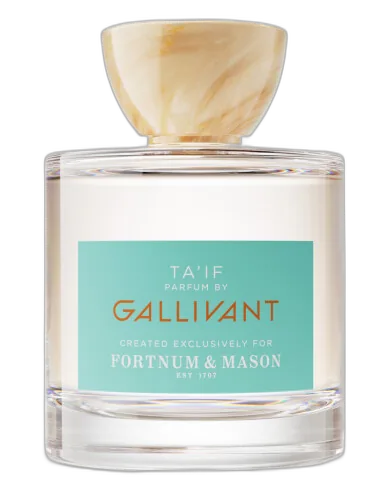

Ta'if Gallivant
Fragrance Story
Ta'if by Gallivant is a Oriental Floral fragrance for women and men. This is a new fragrance. Ta'if was launched in 2024. The nose behind this fragrance is Angéline Leporini. Top notes are Saffron, Honey, Dates and Pink Pepper; middle notes are Rose, Olibanum and Cypriol; base notes are Gurjan balsam, Patchouli, Amber and Musk.
Composition Profile
About the Perfumer

Angéline Leporini
Angéline Leporini is a French perfumer known for her work with major houses like Amouage and Ajmal. Her style balances fresh, citrusy accords with deeper woody and oriental notes, as seen in 4711 Acqua Colonia Yuzu & Cedarwood and Epic Woman. She also creates complex, opulent compositions such as Qasida Dahabia and the green, modern twist of 4711 Remix Green Oasis.
Fragrance Notes
Top Notes
First impression · 15-30 min
 Saffron
 Honey
Honey
 Dates
Dates
 Pink Pepper
Heart Notes
Core character · 2-4 hours
 Rose
Rose
 Olibanum
Cypriol
Olibanum
Cypriol
Base Notes
Lasting impression · 4+ hours
Gurjan balsam
 Patchouli
 Amber
Amber
 Musk
Musk
Ta'if Gallivant by Gallivant offers a distinctive olfactory experience that stands out from other fragrances in its category.
Crafted with the finest ingredients and a blend of traditional and modern perfumery techniques, this fragrance represents the pinnacle of the perfumer's art.
Ta'if Gallivant embodies the distinctive style of Gallivant while adding a unique chapter to their fragrance portfolio.
Character Profile
The Lover Archetype: Portrait of Ta'if Gallivant
Essence
The person who cherishes Ta’if by Gallivant is, at their core, an Explorer-an archetype driven by curiosity, sensuality, and a hunger for the unfamiliar. This fragrance, with its intoxicating blend of rose, saffron, and dates, evokes the warmth of distant lands, the spice of hidden markets, the whisper of desert winds. It is not a scent for those who seek comfort in the known; it is for those who find beauty in the uncharted.
The Explorer is restless, always in pursuit of new experiences, new sensations, new philosophies. They are not content with stagnation; they thrive on movement, whether physical or intellectual. Yet, like all archetypes, the Explorer has a shadow-a tendency toward rootlessness, an inability to commit, a fear of stillness that can leave them perpetually unsatisfied.
Style & Aesthetic
Their aesthetic is an extension of their essence: rich, textured, slightly undone. They favor fabrics that tell stories-linen wrinkled from travel, a silk scarf bought in Marrakech, leather boots worn thin from walking. Their home is a curated chaos, filled with artifacts from journeys: a brass incense burner, a faded postcard, a half-empty bottle of oud oil.
They are drawn to flavors that linger-spiced tea, dark chocolate, ripe figs. Music for them is an emotional compass: perhaps the melancholic strings of Arabic classical music, the raw energy of flamenco, or the hypnotic pulse of electronic beats that mimic the rhythm of train tracks.
Philosophy & Values
This person moves through the world with a quiet intensity, drawn to places and ideas that shimmer with mystery. They may have lived in multiple cities, or at least dreamed of doing so. Their bookshelf is a mosaic of travelogues, poetry, and philosophy-Neruda, Rumi, Pessoa-works that speak of longing and discovery. They are not a tourist; they are a wanderer, seeking depth rather than spectacle.
Their philosophy is one of sensual empiricism-they believe truth is best understood through experience, through the body as much as the mind. They are not dogmatic, but they are deeply reflective, always questioning whether they have truly felt life, or merely passed through it.
Relationships
The Explorer loves deeply but fleetingly. They are magnetic, drawing others in with their stories, their passion, their willingness to listen. Yet intimacy is both their gift and their struggle-they fear being anchored, suffocated by routine. Their relationships are often intense but ephemeral, built on shared moments rather than long-term plans.
They are not cruel in their detachment; they simply move at a different frequency. Those who love them must understand that their heart belongs, in part, to the horizon.
Shadow
The dark side of the Explorer is a haunting dissatisfaction. When the thrill of the new fades, they may find themselves adrift, unable to appreciate what they have because they are already dreaming of what’s next. They may become collectors of experiences rather than truly living them, mistaking accumulation for depth.
At their worst, they are a ghost-present but never fully there, always half-turned toward the next destination. The scent of Ta’if lingers, but so does the question: Have I truly arrived, or am I always leaving?
Conclusion
The wisest Explorers learn that discovery is not only external. The most profound journeys are those within-the stillness between footsteps, the depth beneath the surface. Ta’if is their reminder: beauty exists in both the voyage and the pause. They are not lost-they are simply in motion, and that, too, is a way of being found.
Similar Fragrances
Fragrances with a comparable profile - shared accords, notes, and character.

Trussardi
The Courtyards Of Castello Sforzesco Trussardi
Shared accords: amber, floral, fresh spicy

Sospiro Perfumes
Grazioso Sospiro Perfumes
Shared accords: amber, floral, fresh spicy

Strangers Parfumerie
Rosa Raimunda Strangers Parfumerie
Shared accords: amber, floral, fresh spicy

Agent Provocateur
Miss Ap Agent Provocateur
Shared accords: amber, fresh spicy, patchouli

Unique'e Luxury
Mangonifiscent Unique'e Luxury
Shared accords: floral, fresh spicy, honey