
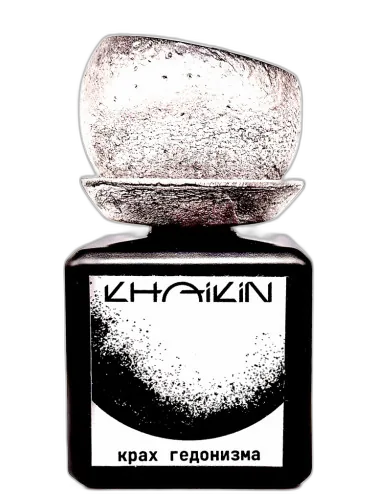

Collapse Of Hedonism — Крах Гедонизма Khaikin
Fragrance Story
Collapse of Hedonism - Крах гедонизма by Khaikin is a Leather fragrance for women and men. This is a new fragrance. Collapse of Hedonism - Крах гедонизма was launched in 2023. The nose behind this fragrance is Kirill Khaikin. Top notes are Cognac, Smoke and Metallic notes; middle notes are Leather, Smoke, Dark Chocolate and Rose; base notes are Ash, Vetiver, Dried Plum, Texas Cedar, Immortelle and Ambergris.
Composition Profile
About the Perfumer

Kirill Khaikin
Kirill Khaikin is a Russian perfumer known for his brand Khaikin, which explores philosophical and abstract themes. His catalog includes Collapse Of Hedonism, Narcissus Grove, and The Sacrament Is Powerless, each with Russian titles. These fragrances often feature complex, dark, and introspective compositions. Khaikin's work is recognized for its intellectual depth and artistic ambition.
Fragrance Notes
Top Notes
First impression · 15-30 min
 Cognac
 Smoke
Smoke
 Metallic notes
Heart Notes
Core character · 2-4 hours
 Leather
Smoke
Leather
Smoke
 Dark Chocolate
 Rose
Rose
Base Notes
Lasting impression · 4+ hours
 Ash
Ash
 Vetiver
Dried Plum
Texas Cedar
Vetiver
Dried Plum
Texas Cedar
 Immortelle
 Ambergris
Collapse Of Hedonism — Крах Гедонизма Khaikin by Khaikin offers a distinctive olfactory experience that stands out from other fragrances in its category.
Crafted with the finest ingredients and a blend of traditional and modern perfumery techniques, this fragrance represents the pinnacle of the perfumer's art.
Collapse Of Hedonism — Крах Гедонизма Khaikin embodies the distinctive style of Khaikin while adding a unique chapter to their fragrance portfolio.
Character Profile
The Lover Archetype: Portrait of Collapse Of Hedonism - Крах Гедонизма Khaikin
Essence
The person who chooses Collapse of Hedonism by Khaikin as their signature scent is not merely drawn to fragrance-they are drawn to the philosophy embedded within it. This is someone who embodies the Dionysian Sage, an archetype that fuses the ecstatic abandon of Dionysus with the introspective wisdom of the Hermit. They revel in sensory experience, yet they are acutely aware of its fleeting nature. Their hedonism is not naive indulgence, but a conscious dance with decadence, knowing full well that all pleasure is transient.
Style & Aesthetic
Their appearance is a carefully curated paradox-luxurious yet disheveled, refined yet deliberately imperfect. They favor textures that evoke both opulence and decay: velvet with faint wear, silk slightly wrinkled, leather that has softened with time. Their color palette leans toward deep reds, blacks, and golds-colors that speak of passion, mystery, and faded grandeur.
They appreciate perfumes that tell a story, and Collapse of Hedonism-with its juxtaposition of rich florals and smoky, almost burnt undertones-resonates with their soul. They wear fragrance not to impress, but to provoke thought, to leave an impression that lingers like the ghost of a forgotten feast.
Their daily life is a rhythm of indulgence and introspection. They might spend an evening lost in the sensory overload of a dimly lit jazz bar, only to retreat the next day into solitude, reading Schopenhauer or composing fragmented poetry. They are not afraid of excess, but they are not ruled by it-they understand the line between ecstasy and self-destruction, though they sometimes flirt with it dangerously.
They are drawn to cities with a sense of history and decay-Venice, Lisbon, St. Petersburg-places where beauty and ruin coexist. They collect objects with stories: a chipped teacup from a Parisian flea market, a first-edition book with yellowed pages, a vinyl record that crackles with age.
Philosophy & Values
To them, life is not about accumulation, but about the exquisite tension between creation and destruction. They find poetry in decay, elegance in excess, and truth in the moment just before the fall. Their philosophy is one of radical acceptance-they do not shy away from the darker aspects of existence but embrace them as necessary contrasts to joy.
They value authenticity above all else. Superficiality disgusts them; they seek depth in every experience, whether it be in art, conversation, or love. Their moral compass is not rigid but fluid, shaped by intuition rather than dogma. They are drawn to Nietzsche’s idea of amor fati-the love of fate-believing that even suffering has its place in the grand aesthetic of life.
Relationships
In love, they are both passionate and detached. They crave intensity but resist permanence, viewing relationships as transient masterpieces rather than eternal bonds. They are drawn to those who share their appetite for depth, but they may struggle with commitment, fearing that routine will dull the vibrancy of connection.
Their friendships are few but profound. They attract kindred spirits-artists, philosophers, and wanderers-who understand their need for both solitude and communion. They despise small talk, preferring conversations that spiral into existential depths or dissolve into shared silence.
Shadow
For all their wisdom, they are not immune to their own contradictions. Their greatest strength-their embrace of transience-can become their downfall. When unbalanced, they may slip into nihilistic apathy, mistaking detachment for enlightenment. Their love of intensity can lead to self-sabotage, chasing experiences that leave them emptier than before.
They may also struggle with emotional evasiveness, using philosophy as a shield against vulnerability. In darker moments, their appreciation for decay can morph into a kind of romanticized self-destruction, where they mistake suffering for profundity.
Conclusion
The lover of Collapse of Hedonism is a walking paradox-a soul that burns brightly precisely because it knows it will one day fade. They are not afraid of endings; they find beauty in them. Their life is an ongoing performance, a dance between ecstasy and melancholy, between the feast and its inevitable aftermath.
They do not seek to be understood by the masses, only by those who recognize the poetry in a dying flame. And in that recognition, they find their truest communion.
Similar Fragrances
Fragrances with a comparable profile - shared accords, notes, and character.
Khaikin
Collapse Of Hedonism — Крах Гедонизма Khaikin
Shared accords: animalic, aromatic, chocolate

Azzaro
Forever Wanted Elixir Azzaro
Shared accords: animalic, aromatic, fruity

Clair de Lune
Whisper Of Mirage Clair De Lune
Shared accords: animalic, fruity, leather

Kintsugi Perfumes
Phénix Kintsugi Perfumes
Shared accords: animalic, aromatic, fruity

EcoParfum
Искушение Ecoparfum
Shared accords: animalic, aromatic, leather