
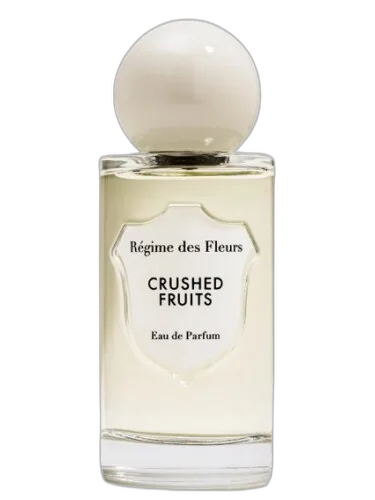

Crushed Fruits Régime Des Fleurs
Fragrance Story
Crushed Fruits by Régime des Fleurs is a fragrance for women and men. This is a new fragrance. Crushed Fruits was launched in 2024. The nose behind this fragrance is Alia Raza. Top notes are Plum, Peach and Raspberry; middle notes are Orris, Rose Hip and Jasmine Sambac; base notes are Pineapple, Bitter Orange and Amber.
Composition Profile
About the Perfumer

Alia Raza
Alia Raza is a perfumer and co-founder of the New York-based niche fragrance house Régime des Fleurs. Her olfactory style is known for blending natural and synthetic notes to create evocative, often floral-forward compositions with a modern edge. Notable creations from the brand include Bel Epoq, Blood Spider Orchids, and Chloë Sevigny Little Flower, each reflecting her ability to capture mood and memory through scent.
Fragrance Notes
Top Notes
First impression · 15-30 min
 Plum
Plum
 Peach
Peach
 Raspberry
Heart Notes
Core character · 2-4 hours
 Orris
Orris
 Rose Hip
Jasmine Sambac
Rose Hip
Jasmine Sambac
Base Notes
Lasting impression · 4+ hours
 Pineapple
 Bitter Orange
 Amber
Amber
Crushed Fruits Régime Des Fleurs by Régime des Fleurs offers a distinctive olfactory experience that stands out from other fragrances in its category.
Crafted with the finest ingredients and a blend of traditional and modern perfumery techniques, this fragrance represents the pinnacle of the perfumer's art.
Crushed Fruits Régime Des Fleurs embodies the distinctive style of Régime des Fleurs while adding a unique chapter to their fragrance portfolio.
Character Profile
The Lover Archetype: Portrait of Crushed Fruits Régime Des Fleurs
Essence
To wear Crushed Fruits by Régime des Fleurs is to embrace the ephemeral-to luxuriate in the fleeting pleasures of life with an almost Dionysian abandon. This person is a modern-day hedonist, not in the crude sense of mere indulgence, but in the refined pursuit of beauty, sensation, and the sublime. They are drawn to the fragrance’s lush, pulpy sweetness, its playful yet sophisticated blend of apricot, fig, and blackcurrant-notes that suggest ripeness, decadence, and the inevitability of decay.
Their presence is intoxicating, not because they demand attention, but because they exude an effortless magnetism. They move through the world as if life were a banquet laid out for them, and they intend to savor every bite.
Style & Aesthetic
Their style is a deliberate contradiction-both polished and undone, as if they have just emerged from a sun-drenched orchard or a late-night soirée. They favor fabrics that drape and flow, textures that invite touch: silk that whispers against skin, linen that wrinkles with lived-in ease. Their palette leans toward rich, organic tones-deep burgundies, golden ochres, the bruised purple of overripe plums.
They are drawn to art that celebrates the body and the senses-Baroque still lifes with fruit on the verge of rot, Fauvist explosions of color, the languid eroticism of a Klimt painting. Their home is a sanctuary of tactile pleasures: velvet cushions, aged leather books, bowls of figs left to soften in the sun.
Philosophy & Values
For them, pleasure is not frivolity-it is a philosophy. They reject the puritanical notion that joy must be earned through suffering. Instead, they believe in the sacredness of the present moment, in the wisdom of the body’s desires. They are not afraid of excess, but their indulgence is never careless; it is a deliberate act of reverence for life’s richness.
Yet, this philosophy is not without its dangers. Their pursuit of beauty can tip into decadence, their love of sensation into escapism. They risk becoming like the overripe fruit in their favorite fragrance-so soft, so sweet, that they threaten to collapse under their own weight.
Relationships
They love deeply, passionately, but often fleetingly. Their relationships are intense bursts of connection, like summer storms-beautiful, overwhelming, and gone too soon. They are drawn to those who share their appetite for life, who can match their fervor without trying to tame it.
But their shadow lurks here: they fear stagnation, commitment that dulls the edge of desire. They may leave lovers bewildered, wondering if they were ever truly seen, or merely tasted and discarded like a half-finished glass of wine.
Shadow
Beneath their radiant exterior lies the inevitable reckoning with impermanence. Their greatest strength-their ability to live fully in the moment-is also their greatest vulnerability. When the music fades and the feast is over, they may find themselves hollow, chasing sensation to fill a void they refuse to name.
They must learn that pleasure, untempered by depth, becomes its own kind of prison. True hedonism is not just in the taking, but in the savoring-the ability to let joy linger, to find meaning in the aftermath.
Conclusion
They are both the fruit and the hand that crushes it-alive with the knowledge that sweetness and decay are inseparable. Their life is a dance on the edge of excess, a balancing act between ecstasy and emptiness.
To love them is to understand that they will never be tamed, only tasted. And perhaps, for them, that is enough.
Similar Fragrances
Fragrances with a comparable profile - shared accords, notes, and character.

Alexandra Gluck
Vdnkh (вднх) Alexandra Gluck
Shared accords: fruity, powdery, rose

Marissa Zappas
The Pink Bedroom Marissa Zappas
Shared accords: fruity, iris, powdery

Ralph Lauren
Midnight Romance Ralph Lauren
Shared accords: fruity, iris, powdery

Jaguar
Miss Jaguar Jaguar
Shared accords: fruity, iris, powdery

Anatole Lebreton
Incarnata Anatole Lebreton
Shared accords: fruity, iris, powdery