
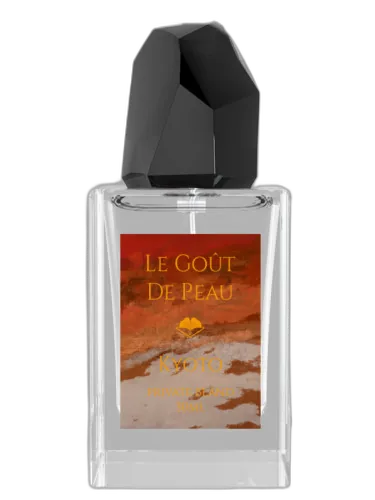

Kyoto 京都 Le Goût De Peau 肌肤之味
Fragrance Story
Kyoto 京都 by Le Goût De Peau 肌肤之味 is a fragrance for women and men. Kyoto 京都 was launched in 2021. Top note is Weeping Cherry Blossom; middle notes are Frankincense, Pine and Dry Wood; base notes are Incense and Smoke.
Composition Profile
About the Perfumer

Unknown Perfumer
Fragrance Notes
Top Notes
First impression · 15-30 min
 Weeping Cherry Blossom
Heart Notes
Core character · 2-4 hours
 Frankincense
Pine
Frankincense
Pine
 Dry Wood
Base Notes
Lasting impression · 4+ hours
 Incense
 Smoke
Smoke
Kyoto 京都 Le Goût De Peau 肌肤之味 by Le Goût De Peau 肌肤之味 offers a distinctive olfactory experience that stands out from other fragrances in its category.
Crafted with the finest ingredients and a blend of traditional and modern perfumery techniques, this fragrance represents the pinnacle of the perfumer's art.
Kyoto 京都 Le Goût De Peau 肌肤之味 embodies the distinctive style of Le Goût De Peau 肌肤之味 while adding a unique chapter to their fragrance portfolio.
Character Profile
The Sage Archetype: Portrait of Kyoto 京都 Le Goût De Peau 肌肤之味
Essence
This person is most closely aligned with the Sage-a seeker of wisdom, drawn to the quiet depths of thought and the subtle textures of experience. The Sage does not chase the obvious; they are attuned to the undercurrents of meaning, the whispers beneath the noise. Kyoto 京都 Le Goût De Peau (肌肤之味, "The Taste of Skin") is their chosen scent because it is not a fragrance that announces itself, but one that lingers like a half-remembered dream-incense, musk, and something elusive, like the memory of a temple at dusk.
The Sage is not merely intellectual; they are sensual in their contemplation. They do not dissect the world but absorb it, allowing impressions to settle like incense smoke in an empty room. Their wisdom is not loud, but it is deep-a quiet knowing that comes from observing, listening, and feeling more than most.
Style & Aesthetic
Their clothing is understated, favoring natural fabrics-linen, silk, wool-in muted tones that suggest rather than declare. They wear layers, not for fashion, but for the tactile pleasure of texture against skin. Their jewelry, if any, is minimal: a single silver ring, a thin chain, something that carries personal meaning rather than ornamentation.
In music, they prefer the spaces between notes-the silence in a Satie composition, the breath before a Noh chant. They read poetry more than novels, drawn to the way a few words can hold an entire world. Their taste in food is refined but not decadent; they savor the bitterness of matcha, the umami of miso, the way a single persimmon can taste like autumn itself.
Philosophy & Values
They are drawn to places and things that carry the weight of time-old books, worn wood, the silence of museums, the stillness of a Zen garden. Their home is sparse but deliberate, each object chosen for its resonance rather than its utility. A single calligraphy scroll hangs on the wall; a well-loved teapot sits on a low table. They do not accumulate, but curate.
Their philosophy is one of presence without possession. They do not seek to own beauty, but to witness it, to let it pass through them like light through stained glass. They might meditate, not as a ritual of self-improvement, but as a way of dissolving the boundaries between self and world. They are skeptical of dogma but reverent toward mystery.
Relationships
They are not a recluse, but neither are they gregarious. Their friendships are few but profound, built on mutual understanding rather than shared activity. They listen more than they speak, and when they do speak, their words are measured, deliberate. They do not offer advice lightly, but when they do, it is often the kind that lingers in the mind for years.
Romantically, they are drawn to those who share their depth but challenge their solitude. They do not love easily, but when they do, it is with a quiet intensity-a devotion that does not need to be spoken. Their relationships are marked by a kind of sacred patience, an understanding that love, like incense, must be allowed to unfold in its own time.
Shadow
Yet the Sage is not without their darkness. Their love of solitude can harden into detachment, their wisdom into a kind of intellectual arrogance. They may begin to see themselves as above the mundane concerns of others, dismissing emotions they deem "unrefined" or relationships they consider "superficial." Their pursuit of depth can become a refusal to engage with the messiness of life, leaving them stranded in their own mind.
There is also the danger of passivity-the Sage can become so absorbed in contemplation that they fail to act. They may observe the world with such acuity that they forget to participate in it, becoming a spectator rather than a creator. Their greatest fear is not failure, but irrelevance-the sense that their wisdom is a beautifully bound book left unread on a shelf.
Conclusion
At their best, the Sage does not merely think-they live their philosophy. They understand that wisdom is not an end, but a way of moving through the world. Their love of Kyoto 京都 Le Goût De Peau is not an affectation, but a reflection of their essence: a fragrance that does not shout, but lingers, leaving traces of itself long after the wearer has passed.
They are neither fully of this world nor entirely apart from it. They walk the line between observer and participant, between silence and speech, between the ephemeral and the eternal. And in that balance, they find their truth.
Similar Fragrances
Fragrances with a comparable profile - shared accords, notes, and character.

Monart Parfums
Soleil De Minuit Monart Parfums
Shared accords: amber, balsamic, smoky

Comme des Garcons
Comme Des Garcons Series 3 Incense: Kyoto Comme Des Garcons
Shared accords: amber, balsamic, smoky

Comme des Garcons
Comme Des Garcons Series 3 Incense: Avignon Comme Des Garcons
Shared accords: amber, balsamic, smoky

Haught Parfums
Smoke N Haught Haught Parfums
Shared accords: amber, balsamic, smoky

The Row
W The Row
Shared accords: amber, balsamic, smoky