
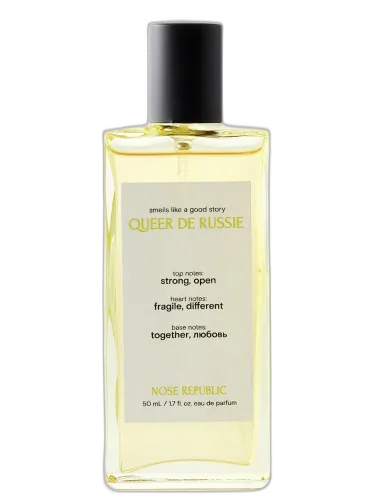

Queer De Russie Nose Republic
At a glance
Is Queer De Russie Nose Republic worth trying?
Queer de Russie by Nose Republic is a Leather fragrance for women and men.
- Best match
- Evening wear in Fall
- Performance feel
- Good longevity with Moderate sillage
- Signature profile
- fresh, fresh spicy, plastic with latex, Ginger, Melon
The first impression
Queer de Russie by Nose Republic is a Leather fragrance for women and men. This is a new fragrance. Queer de Russie was launched in 2023. The nose behind this fragrance is Valery Mikhalitcyn.
What shapes the scent
The perfumer behind it

Valery Mikhalitcyn
Valery Mikhalitcyn is a perfumer who collaborates with Yan Froloff on fragrances such as Cananga Superba, Rosa Avara, and Wisteria Gulosa, and also creates for Mercurio Perfumes with scents like Asile Du Décadent and Droit À La Passion. His work often features bold floral and complex compositions. He brings a creative and avant-garde approach to perfumery.
Notes pyramid
All Notes
Complete scent profile
 latex
latex
 Ginger
 Melon
Melon
 Leather
 Peach
Peach
 Ylang-Ylang
 Labdanum
 Patchouli
The mood it creates
The Lover Archetype: Portrait of Queer De Russie Nose Republic
Essence
The one who wears Queer De Russie by Nose Republic is not merely drawn to fragrance-they seek transformation. This scent, with its interplay of leather, violet, and smoky birch, speaks to a soul that thrives in the liminal spaces between identities, eras, and sensations. They are most closely aligned with the Alchemist archetype, the eternal experimenter who transmutes the raw materials of existence into something richer, stranger, more personal.
Like the alchemist’s pursuit of turning base metals into gold, this person is fascinated by the metamorphosis of the self. They do not accept fixed categories-gender, aesthetics, even morality are fluid to them. Their life is a laboratory where they test the limits of convention, blending the poetic with the provocative.
Style & Aesthetic
Their wardrobe is a carefully curated dissonance-vintage military coats draped over silk slips, boots that could belong to a 19th-century cavalry officer paired with modern, genderless tailoring. They favor textures that tell stories: worn leather, crushed velvet, the faint shimmer of something once opulent now faded.
Their home is no less deliberate-a mix of Soviet-era minimalism and decadent Art Nouveau flourishes. A samovar sits beside a sleek record player; a well-thumbed copy of The Master and Margarita rests near a collection of avant-garde perfumes. They are drawn to objects that carry history but refuse to be confined by it.
They are nocturnal by inclination, most alive in the hours when the world blurs. You might find them in dimly lit bars discussing Russian literature, at underground art shows, or wandering empty streets at dawn, savoring the quiet before the city wakes.
Work is secondary to experience-they may be a freelance creative, a curator, a writer, or simply someone who drifts between vocations, treating each as a temporary persona. Stability bores them; they thrive on the friction between chaos and control.
Philosophy & Values
They believe in the sanctity of personal myth-making. To them, identity is not inherited but constructed, a mosaic of influences they rearrange at will. They might quote Foucault on the fluidity of power or Mishima on beauty as rebellion, but their true creed is lived, not spoken.
Their values are paradoxical: they cherish authenticity yet revel in artifice. They disdain dogma but are drawn to ritual-whether it’s the precise application of fragrance or the nightly ritual of journaling in a leather-bound book. They see no contradiction here; to them, discipline and decadence are two sides of the same coin.
Relationships
They are magnetic but elusive, drawing others in with the promise of depth while maintaining a calculated distance. Their love affairs are intense, theatrical-more like collaborations than romances. Partners often feel like co-conspirators in some grand, undefined project.
Yet this very allure can become their shadow. Their relationships sometimes falter under the weight of their need for perpetual reinvention. Just as they tire of a scent, they may grow restless with people, seeking the next alchemical reaction-the next transformation. Their lovers may accuse them of emotional vampirism, of treating intimacy as another experiment.
Shadow
For all their brilliance, the Alchemist’s greatest danger is self-erasure. In their quest to transcend boundaries, they risk becoming unmoored, a collection of masks with no core. Their refusal to settle can curdle into rootlessness, leaving them isolated in their own labyrinth of identities.
They may also grow intoxicated by their own myth, mistaking aesthetic rebellion for true liberation. The very artifice they cherish can become a gilded cage, trapping them in perpetual performance.
Conclusion
Queer De Russie is not just a scent to them-it is an incantation, a way of summoning the selves they have been and those they might yet become. They wear it as an alchemist wears their robes: not as a uniform, but as a vessel for transformation.
They are neither saint nor sinner, but something far more interesting-a work in progress, forever distilling the raw materials of life into something luminous, strange, and entirely their own.
If you like this, try these
Fragrances with a comparable profile - shared accords, notes, and character.

GL
Gl Embaixador Paraiso Particular Gl
Shared top notes: melon

Richard
Fake Love Richard
Shared top notes: melon, peach

Etat Libre d'Orange
Vierges Et Toreros Etat Libre D'orange
Shared top notes: labdanum, leather, patchouli

Gallagher Fragrances
Sunscape Gallagher Fragrances
Shared top notes: ginger, melon
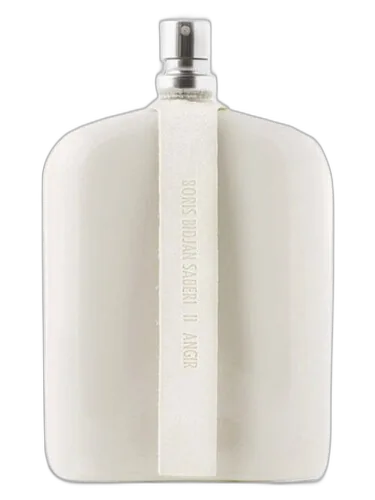
Boris Bidjan Saberi
Angir Boris Bidjan Saberi
Shared top notes: ginger, leather