
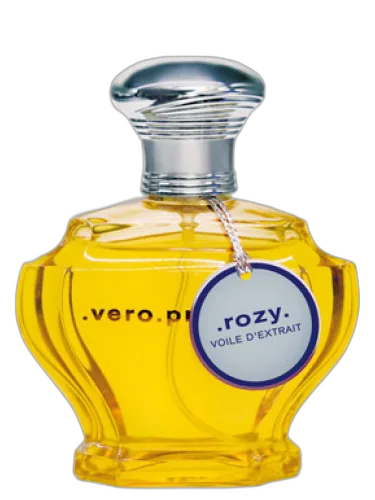

Rozy Voile D'extrait Vero Profumo
Fragrance Story
Rozy Voile d'Extrait by Vero Profumo is a Oriental Floral fragrance for women. Rozy Voile d'Extrait was launched in 2014. The nose behind this fragrance is Vero Kern.
Composition Profile
About the Perfumer

Vero Kern
Vero Kern is the founder and perfumer behind Vero Profumo, a niche fragrance house. Her creations include Kiki, Mito, Naja, and Onda, each offered in multiple concentrations such as Eau de Parfum and Extrait. Kern’s work is known for its bold, complex compositions that often feature rich floral, woody, and animalic notes, earning a dedicated following among fragrance enthusiasts.
Fragrance Notes
All Notes
Complete scent profile
 Tuberose
 Honey
Honey
 Rose
Rose
 Styrax
 Black currant leaf
 Labdanum
 Coriander
 Nutmeg
 Melon
Melon
 Sandalwood
 Vanilla
Rozy Voile D'extrait Vero Profumo by Vero Profumo offers a distinctive olfactory experience that stands out from other fragrances in its category.
Crafted with the finest ingredients and a blend of traditional and modern perfumery techniques, this fragrance represents the pinnacle of the perfumer's art.
Rozy Voile D'extrait Vero Profumo embodies the distinctive style of Vero Profumo while adding a unique chapter to their fragrance portfolio.
Character Profile
The Lover Archetype: Portrait of Rozy Voile D'extrait Vero Profumo
Essence
This person embodies The Mystic-an archetype that seeks transcendence through sensory and spiritual experience. They are drawn to the ineffable, the subtle, and the poetic. Rozy Voile D’Extrait, with its delicate interplay of rose, honey, and musk, mirrors their essence: a soul who thrives in the liminal space between the tangible and the ethereal. The Mystic does not merely wear fragrance; they commune with it, allowing it to shape their presence like an invisible aura.
Philosophy & Values
For them, beauty is not decorative-it is existential. They believe that life’s true richness lies in moments of quiet revelation: the way light filters through leaves, the cadence of a lover’s breath in sleep, the first sip of black tea at dawn. They are drawn to philosophies that embrace paradox-Zen koans, Sufi poetry, the writings of Jung and Nietzsche-because they understand that truth often resides in contradiction.
They value authenticity above all else, yet they are acutely aware of the masks they wear. They do not lie, but they withhold, revealing themselves only in fragments, like a poem written in disappearing ink. Their relationships are deep but few; they cannot abide superficiality, yet their own elusiveness can frustrate those who seek to know them fully.
Relationships
They love intensely but quietly. Their romantic partners are often artists, thinkers, or wanderers-people who understand that love is not possession but a shared journey toward the sublime. They are not possessive, but they are fiercely loyal, though their loyalty is expressed in silence rather than declarations.
Their friendships are rare but enduring. They do not engage in idle chatter; when they speak, it is with precision, as if each word has been weighed. Some mistake their reserve for coldness, but those who persist discover a well of warmth beneath the surface. Still, their need for solitude can make them seem remote, even to those closest to them.
Shadow
The Mystic’s greatest strength-their depth-is also their greatest peril. Their detachment, though born of wisdom, can harden into isolation. They may grow so accustomed to their own inner world that the external one begins to feel like an intrusion. At their worst, they become the Exile, a figure who stands at the edge of life, observing but never fully participating.
Their pursuit of the sublime can also tip into escapism. They may romanticize melancholy, mistaking suffering for profundity. There is a danger in their preference for the veiled over the visible-they might miss the raw, messy beauty of ordinary life in their quest for the transcendent.
Conclusion
Their world is one of quiet intensity. They prefer dimly lit rooms, where the scent of old books mingles with the faint trace of incense. Their home is a sanctuary-sparsely decorated but carefully curated, each object chosen for its resonance rather than its utility. A vintage Persian rug, a single stem of peonies in a slender vase, a well-worn copy of Rilke’s Letters to a Young Poet-these are the artifacts of their inner life.
They move through the world with a deliberate grace, as if aware that every gesture carries meaning. Their style is understated yet evocative: linen shirts that whisper against the skin, a single piece of heirloom jewelry, shoes that have molded to their feet over years. They do not chase trends; they embody an aesthetic that is timeless, almost monastic in its restraint.
Similar Fragrances
Fragrances with a comparable profile - shared accords, notes, and character.

Vero Profumo
Rozy Voile D'extrait Vero Profumo
Shared accords: amber, aromatic, fresh spicy

E. Coudray
Rose Tubereuse E. Coudray
Shared accords: amber, aromatic, fresh spicy

Bella Freud
Je T'aime Jane Bella Freud
Shared accords: amber, fresh spicy, rose

Cristian Cavagna
Musa Paradisiaca Cristian Cavagna
Shared accords: amber, aromatic, green

Map Of The Heart
Pink Heart V 6 Map Of The Heart
Shared accords: amber, aromatic, fresh spicy